Chilean Apple Growers Must Use Insecticides to Control Quarantine Pests

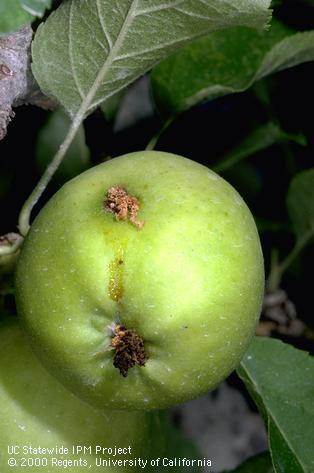
Codling Moth Frass

Codling Moth Frass

Chile is a major exporter of apples to other Latin American and Asian countries. Some of these countries do not have populations of the codling moth and they want to keep the insect out. Codling moth is present in Chilean apple orchards which means that growers must spray insecticides to assure that their export fruit shipments will not be rejected.

“Regular applications of insecticides have been the main management practice against codling moth in Chile. … Pest management in Chilean apple orchards with fruit grown for export is dependent on intensive pesticide use, mainly because of strong quarantine restrictions toward the codling moth from Asian and Latin America countries. In this production scenario, even low levels of fruit damage at harvest (<0.5%) are a major concern for growers. To avoid quarantine rejection of exports, an increase in the frequency of insecticide sprays has been observed.”

Authors: E. Fuentes-Contreras1, M. Reyes2, W. Barros1 and B. Sauphanor2

Affiliation:
1Department de Producción Agrícola, Universidad de Talca, Talca, Chile; 2PSH-Ecologie de la Production Intégrée, INRA Site Agroparc, Avignon Cedex, France
Title: Evaluation of azinphos-methyl resistance and activity of detoxifying enzymes in codling moth (Lepidoptera: Tortricidae) from central Chile.
Publication: Journal of Economic Entomology. 2007. 100(2):551-556.

Insect Saliva Lowers the Quality of Italian Bread Wheat

Damaged Grain

Damaged Grain


Sunn Pest

Sunn Pest

Italian bread dough is famous for its high quality. Several insect species feed on the wheat plants in the field and when they do, they leave a little saliva behind, which would lower the quality of the bread if insecticides aren’t used.

“Several species known as sunn pests or cereal bugs, have long been recognized as detrimental to wheat bread-making quality in south central Europe, western Asia, and northern Africa. … In Italy, severe infestations of sunn pests have been reported in southern regions and also, although seldom, in the Po Valley.”

“For a long time, it has been recognized that damaged grains can show a discolored area around the point of stylet penetration and that flour derived from damaged kernels produces sticky dough and poor bread. The detrimental effect on baking quality is obvious even in presence of 3-5% damaged kernels and dramatically increases for values higher than 10%. The quality depletion is due to proteolytic enzymes injected in the kernels by insects via their saliva that persist in the flour after milling and cause breakdown of gluten structure in the dough.”

“Presently, no sources of resistance to E. Maura in Italian germplasm are known; thus the only way of reducing the damage is chemical pest control in the field.”

Authors: P. Vaccino1, M. Corbellini1, G. Reffo1, G. Zoccatelli2
, M. Migliardi3 and L. Tavella3
Affiliation: 1Instituto Sperimentale per la Cerealicoltura, Angelo Lodigiano, Italy; 2Dipartmento Scientifico e Tecnologico, University of Verona, Italy; 3University of Torino, Grugliasco, Italy.
Title: Impact of Eurygaster maura (Heteroptera: Scutelleridae) feeding on quality of bread wheat in relation to attack period.
Publication: Journal of Economic Entomology. 2006. 99(3):757-763.

Pecan Weevils Feast on Pecans in Orchards

Pecan Weevil Larva

Pecan Weevil Larva

Pecan Weevil Adult

Pecan Weevil Adult

The pecan weevil is a late season nut pest that feeds only on pecans and hickory. The female drills a hole in the nut with her snout and places one to four fertilized eggs within the kernel. The pecan weevil larvae are creamy, white legless grubs with soft fleshy bodies. Heavy populations of weevils can destroy all nuts on a tree.

“The pecan weevil is a major pest of pecans throughout the southeastern United States, as well as portions of Texas and Oklahoma. … Adults emerge from soil in late July-August to feed on and oviposit in developing nuts. Larval development is completed within the ripening kernel of the nut.”

“Current control recommendations for pecan weevil consist mainly of aboveground applications of chemical insecticides (e.g., carbaryl) to suppress adults. Application of chemical insecticides is recommended every 7-10 days during peak weevil emergence (generally up to at least a 6 week period).”

Authors: D.I. Shapiro-Ilan1, W.A. Gardner2, T.E. Cottrell1, R. W. Behle3 and B.W. Wood1

Affiliation:
1USDA-ARS, Southeastern Fruit and Tree Nut Research Laboratoy, Byron, GA; 2Department of Entomology, University of Georgia, Griffin, GA; 3USDA-ARS-NCAUR, Peoria, IL
Title: Comparison of application methods for suppressing the pecan weevil (Coleoptera: Curculionidae) with Beauveria bassiana under field conditions.
Publication: Environmental Entomology. 2008. 37(1):162-171.

Zero Tolerance for Maggots in Cherries Means Growers Must Spray

Cherry Maggot

Cherry Maggot

Pairs of cherry fruit flies have been observed copulating for 18 hours at a time. Each female may deposit 100 to 300 eggs under the fruit skin over a period of thirty days. Eggs hatch in 3-7 days and young maggots feed on cherry flesh, mainly around the pit. Maggots and their frass within the fruit render the product unsalable.

“Insecticides continue to be vital in efforts to control the western cherry fruit fly, the most serious insect pest of commercial sweet and sour cherries in the western United States. … The zero tolerance for fly larvae in cherries has necessitated the use of these highly toxic insecticides in commercial orchards. Isolated homeowner or abandoned trees can be heavily infested and also need to be treated with these insecticides to reduce chances of flies dispersing to commercial orchards.”

Authors: W.L. Yee1 and D.G. Alston2
Affiliation: 1USDA-ARS, Yakima Agricultural Research Laboratory, Wapato, WA; 2Department of Biology, Utah State University, Logan, UT
Title: Effects of spinosad, spinosad bait, and chloronicotiny insecticides on mortality and control of adult and larval western cherry fruit fly (Diptera: Tephritidae).
Publication: Journal of Economic Entomology. 2006. 99(5):1722-1732.

Consumers Don’t Want Bugs with Berries, Making Insecticides Necessary

Japanese beetles are often present in blueberry fields and are collected along with the berries at harvest. Because of zero consumer tolerance for bugs in blueberry products, insecticides are necessary to remove the beetles from the blueberry fields before harvest.

“The Japanese beetle, Popillia japonica Newman, is an invasive pest of fruit and vegetable crops, turfgrass, and ornamentals in eastern and central North America. … During the adult emergence period of June to September in Michigan beetles can be observed feeding and mating in clusters on host plants.”

“Much of the food industry maintains a zero tolerance standard for insect contamination at pack-out, which places added pressure on growers of fruit crops such as cherry, peach, plum, and blueberry that may be harvested when beetles are present. The majority of commercial blueberry producers use over-the-row mechanical harvesters for collecting fruit from their fields. This harvesting method does not effectively discriminate between beetles and berries, so adult Japanese beetles are a significant contamination risk in fields being harvested where Japanese beetle has not been controlled.”

“Color sorting technology has been adopted by many large processors to detect and remove beetles, providing >95% removal. Even with these management components available to help minimize the risk of fruit contamination with adult beetles, conventional insecticides remain the primary approach to in-field management of Japanese beetles in fruit crops.”

Authors: J. Wise¹, C. Vandervoort² and R. Isaacs¹.
Affiliation: ¹Department of Entomology, Michigan State University; ²Pesticide Analytical Laboratory, Michigan State University.
Title: Lethal and sublethal activities in imidacloprid contribute to control of adult Japanese beetle in blueberries.
Publication: Journal of Economic Entomology. 2007. 100(5):1596-1603.

Insecticides Prove Necessary for Managing New Invasive Stink Bug

The brown marmorated stink bug is native to Asia and was introduced into the US in the 1990s. The stink bug feeds on many orchard crops, small fruit, grapes, vegetables and row crops—particularly in mid-Atlantic states. Developing long-term control strategies takes time, which makes the immediate use of insecticides necessary.

“Damage in apple in the mid-Atlantic region inflicted by H. halys (brown marmorated stink bug) resulted in losses in excess of 37 million dollars in 2010. In addition, H halys is a serious nuisance pest in residential areas because it uses human-made structures as overwintering sites.”

“Because the brown marmorated stink bug is a newly established invasive pest in the United States, insecticides will play a key role in managing this pest on various crops at least in the short term. Indeed, the use of insecticides has substantially increased in commercial orchards because of the damage inflicted by H. halys and subsequent economic loss in the mid-Atlantic region.”

Authors: T.C. Leskey, D.-H. Lee, B.D. Short and S.E.Wright
Affiliation: USDA Agricultural Research Services, Kearneysville, WV
Title: Impact of insecticides on the invasive Halyomorpha halys (Hemiptera: Pentatomidae): Analysis of insecticide lethality.
Publication: Journal of Economic Entomology. 2012. 105(5):1726-1735.

Devastating New Potato Disease Has Growers Spraying at First Sign of Vector

Potato psyllids in the Pacific Northwest are spreading a new disease, Zebra chip. Beginning in 2011, psyllid feeding has spread a virus that reduces potato yields and renders tubers unmarketable with bands that darken when fried. Immediate spraying to control the insect vector is required.

“Researchers say populations of potato psyllids – vectors of zebra chip, a crop disease new to the region – are growing dramatically in the Columbia Basin.”

“Despite the increasing psyllid pressure during the past couple of weeks, Phil Hamm, an Oregon State University plant pathologist, believes the disease shouldn’t cause major problems for growers who stick with insecticide programs. … ‘When the region has psyllids, you treat,’ Hamm said.”

Author: John O’Connell
Headline: Psyllid populations growing dramatically
Publication: Capital Press. August 31, 2012.

Leafhoppers Transmit Deadly Grapevine Disease in Italy

The grapevine disease Flavescence dorée has been called “catastrophic.” Impacts include yield reductions, and reduced wine quality. The disease spreads rapidly and can affect 80-100% of the vines in a few years. The disease is spread by leafhoppers who acquire the organism while feeding on infected plants and then spread the disease when they feed on healthy plants. Spraying to control the leafhopper is mandatory in regions where the disease is known to exist.

“The leafhopper Scaphoideus titanus Ball (Hemiptera: Cicadellidae) is a serious pest of grapevines in Europe as it transmits the phytoplasmas of Flavenscence dorée (FD). … the eggs start to hatch in the middle of May, and nymphs can be found until the middle of July… The adults are present from the end of June until the middle of October.”

“Nymphs from the third instar onward acquire phytoplasmas by piercing the leaves and stems of infected grapevines. After a latency period of 4-5 weeks, during which time they become adults, they can transmit FD phytoplasmas to healthy grapevines. In Italy, insecticide treatment against S. titanus are mandatory in the districts where FD is present. The active ingredients include neonicotinoids and organophosphates; in vineyards subject to organic farming S. titanus is controlled with pyrethrum.”

Authors: F. Lessio, E.B. Mondino and A. Alma
Affiliations: University of Turin, Grugliasco, Italy
Title: Spatial patters of Scaphoideus titanus (Hemiptera: Cicadellidae): a geospatial and neural network approach.
Publication: International Journal of Pest Management. 2011. 57(3):205-216.

Apple Production in the UK Made Viable by Pesticides

UK apple growers produce about 400 million pounds of apples per year. About 18 insecticide and fungicide sprays are made yearly to control pests including scab, mildew, aphids and codling moth. By applying a full spray program, good growers have restricted losses due to pests and diseases to very low levels, usually no more than 1-2%. Below, an economic cost-benefit study determined the likely effect on UK apple production if growers did not use pesticides…

“Apples are the most important fruit crop in the UK in terms of area of production and require relatively high levels of pesticide inputs. … If pesticides were not used, apple production would thus not be commercially viable, and the market shortfall would be made up by imports at a similar price. With a negative gross margin apple producers would leave the industry and find other uses for their land.”

Authors: J.P.G. Webster and R.G. Bowles
Affiliation: Farm Business Unit, Wye College, University of London, Kent, UK
Title: Estimating the economic costs and benefits of pesticide use in apples.
Publication: Proceedings of the Brighton Crop Protection Conference, Pests and Diseases. 1996. 4B-1:325-330.

The Consumer is Always Right and That’s Why Farmers Use Pesticides

More than 90% of US fresh produce (fruits and vegetables) is sprayed with insecticides and fungicides to prevent rots and yield loss. This spraying also assures that there are no scabs or insect-feeding marks on the produce. Although some consumers would prefer no pesticide residues, many are unwilling to accept any cosmetic damage. You can’t have it both ways—picture-perfect produce requires pesticide use.

“Over 300 shoppers entering supermarkets completed a questionnaire about purchasing certified pesticide residue-free (CPRF) fresh produce. One-half expressed concern about pesticide use on fresh produce. Two-thirds were willing to pay 5 to 10% higher prices to obtain CPRF fresh produce, but were unwilling to accept any cosmetic defects or insect damage.” 

Author: S.L. Ott
Affiliation: USDA Economics Research Service
Title: Supermarket shoppers’ pesticide concerns and willingness to purchase certified pesticide residue-free fresh produce.
Publication: Agribusiness. 1990. 6(6):593-602.