Nematicide Applications Could Increase Food Production in Africa

Roots

Nematodes are invertebrate roundworms that are second only to insects in the number of species in the animal kingdom. One cubic foot of soil may contain millions of individual nematodes. Nematodes feed on plant roots. Damage and low yields caused by nematodes frequently go unrecognized or are attributed to other causes. Research in Africa has demonstrated that controlling plant-parasitic nematodes can increase crop yields dramatically.

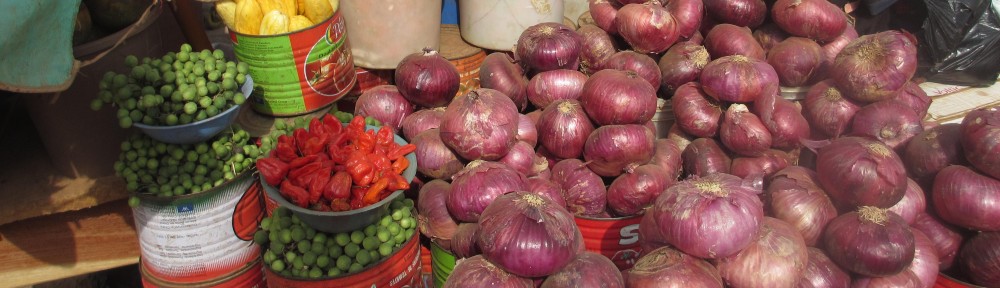
“Sweet pepper, the second most important vegetable crop in Niger, after onions is grown all over the country, but the region of Diffa alone accounts for over 85% of national production. The area planted in 2008 exceeds 7000 ha with a production estimated at 120000 t.

The production is mainly exported to Nigeria and procures substantial income to the people of the region of Diffa.

The average fruit yield of the crop is about 17 t/ha. This is very low compared to the potential of the crop. This low yield is partly due to diseases and pests pressure, namely the damage caused by plant-parasitic nematodes. …Yield losses caused by these nematodes can reach up to 60% in heavily infested sandy soils.

The study assessed the effectiveness of Savanem 20 EC (Ethoprophos, 200g/l), a newly introduced nematicide on the plant-parasitic nematodes associated with sweet pepper.

Savanem increased the average yield by 37.1% and Furadan by 20.6%.

Savanem 20 EC, at the dose of 50 L/ha is effective against the community of parasitic nematodes on sweet pepper.”

Authors: Adamou, H., et al.
Affiliation: Institut National de la Recherche Agronomique du Niger (INRAN)
Title: On-farm testing of savanem 20 EC (ethoprophos) for control of plant parasitic nematodes associated with pepper (Capsicum annuum) in tillaberi (Niger).
Source: Asian Journal of Agricultural Sciences. 2013. 5[4]:83-87.

Consumers Want Perfect Sunflower Seeds as Snack Foods: Insecticides Make It Happen

Seed Weevil

Seed Weevil

The sunflower is the only row crop in North America that coexists with its native ancestors. When extensive commercial planting of sunflower began in the 1970s, many of the insects which evolved in native perennial sunflower seed species transferred to the cultivated crop. Red sunflower seed weevils deposit eggs in sunflower seeds and larvae feed on the developing sunflower kernels destroying a portion of the kernel. The larvae make an exit hole and exit the seeds in late summer. Research indicates that most seeds are only partially fed upon.

“Several years ago, a set of trade standards were developed for nonoil sunflower kernels. These standards stipulate there should be no more than 10 percent broken kernels; not more than 0.5 percent heat damage; and not more than two percent insect damage.

Economic populations of seed feeders such as the red and gray seed weevils, head moth and banded sunflower moth can inflict very serious damage if not controlled. But they commonly consume just a portion of the kernel, so those seeds often are not separated from other seeds during combining. “It’s very difficult to remove all insect damage from in-shell sunflower,” affirms Jim Krogh, president of Agway, Inc., of Grandin, N.D. “Yet it’s also difficult to explain to today’s consumer why there’s a hole in the seed they bought. The hole is unsightly; the kernel tastes bad. It’s a bad deal all around.”

Since it is an edible product, economic thresholds for confection flowers are much lower than for oil-types. One to two weevils per plant should trigger prompt insecticide treatment, based on current recommendations.”

Author: Lilleboe, D.
Affiliation: Writer
Title: Optimizing the quality of your confection crop
Source: The Sunflower. April/May 1998. Available online at: https://www.sunflowernsa.com/magazine/details.asp?ID=77&Cat=10

Good News for Organic Apple Growers: An Insecticide that Kills the Flea Weevil

Weevil damage

Apple Flea Weevil damage

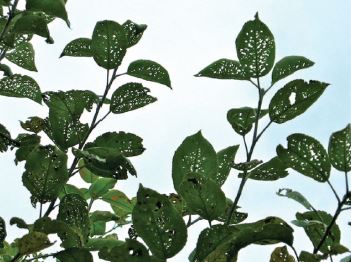
In 2008, the apple flea weevil emerged as a serious pest in Michigan’s organic apple orchards with some growers experiencing >90% crop loss. The organic apple growers were spraying insecticides later in the season to kill major pests like the codling moth and the flea weevil emerged as an early season pest. The weevils feed on developing buds and leaves. Heavy populations cause significant defoliation of leaf tissue resulting in a lacelike pattern which leads to decreased productivity and possible tree death. Research at Michigan State University led to a solution for the organic growers- spray an insecticide…..

“Organic apple growers in the Midwest appear to have a relatively simple solution to their problems with apple flea weevil, which appeared suddenly as a problem in Michigan two years ago and took out 90 percent of the fruit in some orchards.

The best solution, entomologists say, is to spray Entrust (spinosyn) very early in the season, at green tip to pink… The apple flea weevil adult does its most serious damage by feeding on and destroying fruit buds before they have a chance to emerge in the spring.

John Pote, a graduate student at Michigan State University working with Dr. Matt Grieshop and Dr. Anne Nielsen in the organic pest management laboratory, gave the good news to organic growers during a session at the Great Lakes Fruit, Vegetable, and Farm Market Expo in Grand Rapids, Michigan, in December.

Pote noted that the weevil emerged as a problem for organic growers, who normally do not apply insecticides that early in the season, since few insects become active so early.

In conventional apple management programs, the weevil is likely incidentally controlled by insecticide applications made to kill other insects either in April—when overwintering weevils emerge—or in early July—when the summer generation emerges from leaf mines.”

Author: Lehnert, R.
Affiliation: Writer.
Title: Organic control for flea weevil.
Source: Good Fruit Grower. March 15, 2012. Available: http://www.goodfruit.com/Good-Fruit-Grower/March-15th-2012/Organic-control-for-flea-weevil/

774,000 Cockroaches in Eden: Insecticides Protect the Lunchroom

Duke And Duchess Of Cornwell Visit The Eden Project

Duke And Duchess Of Cornwall Visit The Eden Project

Established in 1999, the Eden Project, near St Austell in Cornwall, has been an overwhelming success, attracting visitors from the UK and overseas to view some 3,000 plant species in three biomes.

The Eden project’s mission is to promote the understanding and responsible management of the vital relationship between plants, people and resources leading to a sustainable future for all.

Cockroaches were introduced into the RFB with some of the earliest plantings. The biome provided ideal living conditions for cockroaches with abundant leaf litter, temperatures of 25-30°C and mean relative humidity (RH) of 60% during daylight hours, rising to >90% overnight. From the start, cockroach control was contracted out to a pest control company, but by 2003 cockroach numbers were escalating and it was recognized that the control strategy was not effective.

“…populations of both cockroach species continued to increase overall. …the numbers of cockroaches had grown so large that rare young epiphytic plants such as orchids and many annual seedlings were being badly damaged on planting out. A survey using pre-baited cockroach traps was implemented, placing traps at 130 locations in the biome. From the resulting catches, the population was estimated at 774,000 individuals. …Of particular concern was P. australasiae being caught on traps placed in the catering areas adjacent to the RFB.

The only viable alternative was to use pesticide-fortified baits, two of which were available for immediate use in the UK: fipronil and hydramethylnon. …Baits were first applied in the RFB in November 2005 and in the first six months 3350g of bait were used. The treatment had an immediate and dramatic impact on the population of P. australasiae, whilst gradually reducing the population of P. surinamensis to manageable levels. In addition to the baiting programme, monthly sprays of lambdacyhalothrin were applied to an ‘exclusion zone’ consisting of the boundaries between the RFB and the catering areas and the entrance footbridge that connects RFB to a large café where the presence of cockroaches would be unacceptable.

With reduced cockroach populations, control treatments were switched in 2008 from baits to spot spray treatments using lambda-cyhalothrin applied when needed to population hot-spots, usually of 5-10m radius around the ‘hot’ traps, identified using the population distribution maps. The monthly treatment of the ‘exclusion zone’ has remained unchanged.”

Author: Treseder, K., et al.
Affiliation: Eden Project.
Title: Evolution of Pest-Management Strategies in the Rain-Forest Biome at the Eden Project, the First 10 Years.
Source: Outlooks on Pest Management. February 2011. Pgs. 22-31.

Insect Pests in Eden: Sprays Are Mandatory

The Eden Project

The Eden Project

The Eden Project was designed as a world class visitor destination to celebrate the interdependence of plants and people and to educate people about the need to care for the world that cares for them.

The project site, located in a recently decommissioned china clay quarry near St Austell, Cornwall, UK, is 105 hectares in size and consists of two large enclosed biomes set in gardens (outdoors biome) along with an educational resources building (the core) and a visitor reception building.

With two large indoor biomes covering the humid tropics and warm temperature climates, the outdoor biome with a range of temperate environments, plus several catering facilities, a warehouse and a waste recycling yard, pest management at Eden is very broad with many challenges in all areas.

Despite the procedures put in place for interception, a steady stream of introductions of pest and non-pest invertebrate species has occurred in the RFB.

“Unfortunately, during the early years of the project a number of non-indigenous pest species were introduced into the Rain Forest Biome (RFB) and not successfully eliminated. Currently there are five species that are the subjects of a containment notice issued by DEFRA; banana borer, banana aphid, atratus white fly, coconut mealybug and latin aphid. The containment notice dictates that the Eden Project has to monitor the populations of these pests and maintain pesticide programmes to control their populations.

In January 2002, adults of Tobacco White Fly were detected on leaf samples collected from the RFB. This discovery instigated the placement of an eradication order by DEFRA which initiated the immediate implementation of monitoring and a chemical control programme.

Eradication was achieved after a two year intensive spray programme involving repeated biome-wide sprays using a range of chemicals including buprofezin, thiacloprid, pymetrozine and nicotine.”

Author: Treseder, K., et al.
Affiliation: Eden Project.
Title: Evolution of Pest-Management Strategies in the Rain-Forest Biome at the Eden Project, the First 10 Years.
Source: Outlooks on Pest Management. February 2011. Pgs. 22-31.

Consumers Want Perfect Avocados: Growers Must Spray

Infected Avocados

Avocado Thrip Fruit Scarring

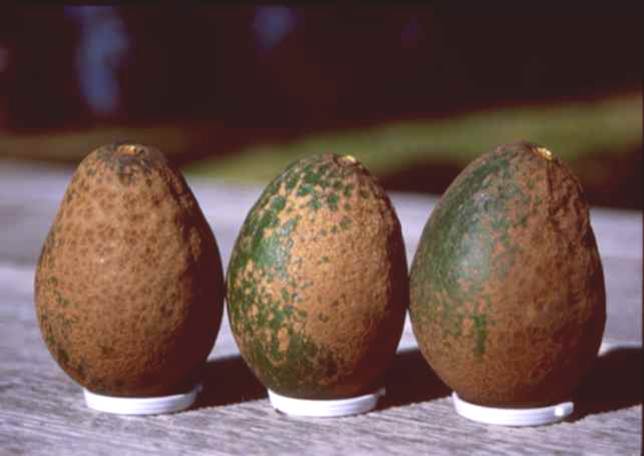
Historically, the production of avocados in California required little usage of insecticides. Avocado pests were kept under commercially acceptable control by a variety of beneficial organisms. This situation changed in 1996 with the appearance of avocado thrips which feed on the surface of the fruit. Feeding scars develop while the flesh of the fruit is a healthy green. Even partial fruit scarring results in downgrading of fruit in packinghouses because of cosmetic damage unacceptable to consumers .

“The California avocado industry is under increasing threat from the introduction of arthropod pests. The avocado thrips, was first detected in California avocado groves in June 1996, and it has since spread to most of the major production areas within the state where it has become the primary insect pest. The main source of economic loss arises from feeding damage that causes scarring of immature fruit, leading to a reduction in fruit quality at harvest.

In California avocado groves, the use of foliar insecticides is the predominant tactic adopted by growers for the management of arthropod pests, including the avocado thrips. Aerial applications by helicopter are needed for the majority of California avocado groves because most are grown on steep hillsides.”

Author: Byrne, F. J., et al.
Affiliation: University of California
Title: Field evaluation of systemic imidacloprid for the management of avocado thrips and avocado lace bug in California avocado groves.
Source: Pest Management Science. 2010. 66:1129-1136.

Large Scale Insecticide Spraying Needed to End Locust Plague in Madagascar

Birds

Locust Swarm, Madagascar

For many thousands of years, locust swarms have appeared in crop fields and farmers could only pray. Locust swarms may cover several hundred square kilometers during plagues and can contain 50 million locusts in each square kilometer. A locust plague has been building in Madagascar. Conditions for the locusts got better and better and then received a boost from a cyclone in February. The storm created ideal conditions for the locusts to breed. Without widespread spraying of insecticides, the locusts would devour most of Madagascar’s crops leading to millions of people going hungry.

“A locust control campaign has been launched by the United Nations and the Government of Madagascar to treat over 2 million hectares of infested areas in a bid to avert a food crisis that could affect some 13 million people in the island nation.

Aerial operations to identify and map out the areas requiring treatment by pesticides are expected to get underway this week, FAO said in a news release. In the meantime, ground surveys, conducted on a monthly basis since February, continue. Procurement of pesticides, vehicles and equipment for survey and control operations is also in progress. Spraying operations are expected to start in late October, after the onset of the rainy season.

An assessment mission carried out by FAO earlier this year found that rice and maize losses due to the locusts in some parts of the country vary from 40 to 70 per cent of the crop, with 100 per cent losses on certain plots. The agency estimates that losses in rice production could be up to 630,000 tonnes, or about 25 per cent of total demand for rice in Madagascar. Rice is the main staple in the country, where 80 per cent of the population lives on less than a dollar per day.”

Author: UN News Centre
Affiliation: The United Nations
Title: UN and Madagascar launch locust control campaign to avert food crisis
Source: UN News Centre. September 23, 2013. Available at: http://www.un.org/apps/news/story.asp?NewsID=45936&Cr=food+crisis&Cr1=#.UkXB06PD_IU

Fly Eggs in Fruit? Insecticides Are the Only Option

bugz

Serrated Egg Layer Drosophila

berries

Blueberries: Drosophila Infestation (Right)

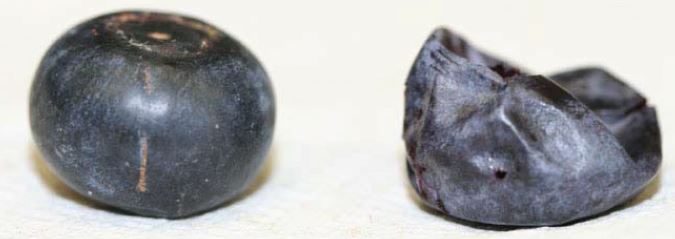
The invasive spotted wing drosophila fly came into the US from Asia in 2008 and has spread throughout the US. The fly prefers softer, sweeter ripe fruit- cherries, raspberries, blueberries,blackberries and strawberries. The female flies use saw-like blades on their abdomens to cut through the skin of ripe fruit and lay their eggs inside. The eggs hatch into worms that feed on the flesh of the fruit – ruining the fruit for sale. Insecticides are currently the only option for drosophila control and growers throughout the US are being advised to spray.

“The spotted wing drosophila, a tiny fly that can take a big bite of orchards and gardens, has gradually been making its way across the country from the West Coast and has discovered the summer bounty in the Granite State is much to its liking, according to Dr. Alan Eaton, an entomologist with the University of New Hampshire.

If the flies show up around the time the fruit ripens, the farmers have to immediately spray to kill them off, Eaton said. There are both standard and organic remedies available, he said, but spraying is vital to saving crops. “We’ve had a few growers who weren’t listening to us and their entire crops were wiped out,” said Eaton.”

Author: Nancy Bean Foster
Affiliation: Union Leader Correspondent
Title: Fruit farmers on guard for new pest
Source: Union Leader. August 26, 2013. Available at: http://www.unionleader.com/article/20130827/NEWHAMPSHIRE07/130829419?dm_i=1ANQ,1T79M,6LPYOS,6H5RF,1

A Voracious Noisy-Eater, the Red Palm Weevil Meets its Match in Saudi Arabia

Thumb Sized Grubs

Insecticide Injection For Weevil Control

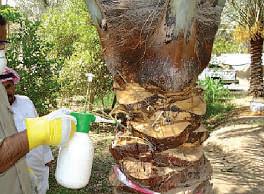
About 2.2 million tons of dates are produced in the Gulf region of the Middle East. The red palm weevil is a lethal pest of date palm trees –infested palms often die if not detected early and treated with insecticides. The thumb-sized grubs make so much noise eating that if you stand next to an infested tree, you can actually hear them munching their way through the trunk. Management depends on detecting the weevils in traps and injecting a chemical insecticide into the tree. An aggressive trapping and treatment program in Saudi Arabia has greatly reduced the problem.

“Red palm weevil is a native to south and southeast Asia where it is a notorious pest of coconut palms… Subsequent movement of infested plant material introduced this pest into Saudi Arabia in 1987 where it presented a significant threat to this country’s multi-million dollar date industry.

R. ferrugineus induced palm mortality results from internal feeding by weevil larvae and to a lesser extent, adults… This internal feeding, when severe enough, can weaken the trunk causing the collapse and premature death of P. dactylifera.

R. ferrugineus infestations of date palms in Al Ghowaybah increased significantly in 2009. In response to this outbreak, the Directorate of Agriculture in Al Ahsaa increased areawide treatments against R. ferrugineus on three different fronts: (1) the number of pheromone traps throughout the 1140 ha management area was increased 11 fold… (2) the number of date palms treated with pesticides increased 48 fold from 11,000 palms in 2008 to 531,590 in 2009, and (3) eradication of R. ferrugineus infested palms increased three fold from 2008 (1026 infested palms removed and destroyed) to 2009 (3097 date palms eradicated). These enhanced management practices in Al Ghowaybah had a rapid effect on R. ferrungineus populations as determined by the average number of weevils captured monthly in pheromone bucket traps and the monthly percentage of traps with weevils. In 2009, prior to the Oct. increase in pheromone trap numbers, ~5 adult weevils were captured per trap per week, compared to an average of 1.6 weevils per trap for 2012, which represents an ~68% decrease in the average number of weevils captured per trap.

It is likely that intensive R. ferrugineus management practices in Al Ghowaybah will need to be sustained at this current high level as long as new plantations are being developed and the majority of dates are <20 yr old, an age susceptible to attack.”

Authors: Hoddle, M. S., et al.
Affiliation: University of California
Title: Assessing the impact of areawide pheromone trapping, pesticide applications, and eradication of infested date palms for Rhynchophorus ferrugineus (Coleoptera: Curculionidae) management in Al Ghowaybah, Saudi Arabia.
Source: Crop Protection. 2013. 53:152-160.

Fetzer Gives Up Organic Certification to Save the Vineyard

Lake County

Ceago Vineyard

Ceago Vinegarden is owned by Jim Fetzer, former President of Fetzer vineyards. The Fetzer family built their business into an internationally-respected winery. When the Fetzer family sold the winery in 1992, Fetzer vineyard was producing 2.5 million cases of wine annually. In 1993, Jim Fetzer established Ceago Vinegarden which produces about 6000 cases of wine and has been certified as an organic producer since 2003.All was well at this beautiful vineyard until 2013 when a new pest invaded and Fetzer had to choose between keeping the organic certification or preserving the grapevines.

“Fetzer owns Ceago Vinegarden near Nice, California.

His 49-acre vineyard is situated at an elevation of 1,400 feet in a protected area along the shores of Clear Lake, where the landscape sports some palm and citrus trees.

Fatzer’s vineyard earned organic and biodynamic certification in 2003. This year, however, he lost both certifications. He was unable to control an infestation of the Virginia creeper leafhopper, a recent arrival in the North Coast area, using a soft-chemistry material that he’s used successfully to control the western grape leafhopper.

The leaf-feeding Virginia creeper leafhopper is also called the zigzag leafhopper because of markings on its back.

“It’s very vicious and sucks all the chlorophyll out of the leaves,” Fetzer says.

Even as many as four applications of the insecticide this season would not have controlled the Virginia creeper leafhopper, Fetzer says. So, he switched to Montana, an imidacloprid that is not approved for organic or biodynamic production. He treated his vineyard one time with the product, at a cost in material of $18 per acre. That was in mid-June after all the eggs had hatched so that he could target the adults.

“We had no choice,” Fetzer says. “Otherwise, we would have ended up at the end of the year with little chlorophyll in the leaves and difficulty getting the fruit to ripen. We lost our certification. But the synthetic product did a really good job and saved our vines.””

Author: Greg Northcutt
Affiliation: Journalist
Title: Pest outbreak mars good wine grape season
Source: Western Farm Press. August 28, 2013. Available at: http://westernfarmpress.com/grapes/pest-outbreak-mars-good-wine-grape-season