Europe Could Learn a Lot from US farmers about Using Fungicides on Corn Crops

Eyespot Disease on Maize Leaves

Eyespot Disease on Maize Leaves

Recently in the US, farmers have increasingly used fungicides on corn crops with a noticeable yield increase. There is significant corn (maize) acreage in Europe, but hardly even any research on fungicides. Recently, a European researcher experimented with fungicides and discovered the great potential of using fungicides for this overlooked problem.

“Since 2008, fungicide trials have been carried out by both the Danish advisory service (Knowledge Centre for Agriculture) and University of Aarhus to test the impact of fungicides on control of leaf diseases. In several of the trials, significant levels of diseases have occurred and significant yield responses have been obtained.

In 2009, a severe attack of northern corn leaf blight (E. turcicum) developed and 50% yield increases were accomplished from fungicide treatments in a number of trials. In 2011, a severe and early attack of Eyespot (K. zeae) developed in several trials and in that season yield increases between 50 to 60% were also achieved in grain maize crops in fields with minimal tillage with maize as the previous crop.

Based on good efficacy trials, the first fungicide epoxiconazole plus pyraclostrobin (as Opera) was authorized in Denmark for control of the leaf diseases in maize between detection of 3rd node and the tassels appearing at the top of the stem (BBCH GS 33-51).

For scientists, advisors and farmers, it was a surprise that yield reducing leaf diseases could play such a major role in the production of maize. When looking around Europe for information on this subject, we were slightly surprised that very little information on the use of fungicides was available. When looking around we also realized that in many countries no fungicides are authorized for control. Looking across to the US, which has long experiences with foliar diseases, there seem to be more knowledge available on disease management, including experiences from use of fungicides.”

Author: Jorgensen, L. N.
Affiliation: Department of Agroecology, Aarhus University, Denmark
Title: Significant yield increases from control of leaf diseases in maize – an overlooked problem?!
Source: Outlooks on Pest Management. August 2012. Pgs.162-165.
2013: Perfect Year for Peanut Diseases, But No Problem Thanks to Fungicides

White Mould

White Mold

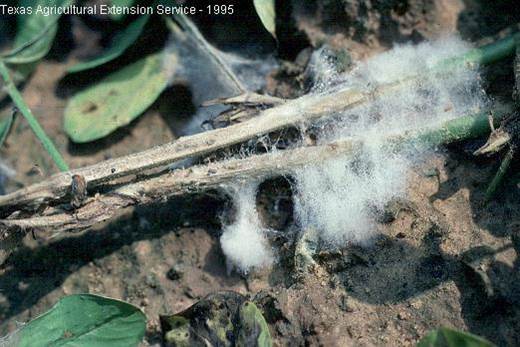
The unrelenting rains of 2013 in southeastern peanut fields created perfect conditions for the rapid development of white mold and rhizoctonia- diseases that can cause plant death. However, disease outbreaks did not occur because peanut growers were vigilant in applying fungicides.

“So far, 2013 has been a perfect weather year for peanut diseases in the Deep South: wet with swampy plus short spurts of hot with swampy.

But that disease pressure just hasn’t hit yet.

“Despite my repeated and dire predictions for severe disease outbreaks this year in our peanut fields, the reports from county agents have been fairly quiet.

…I know of very few situations where disease has overwhelmed a (peanut ) crop,” said Bob Kemerait, plant pathologist with the University of Georgia Cooperative Extension.

Why have peanut diseases not been so bad?

“Fungicides” is the short answer, he said, good fungicide products matched with grower know-how on best ways to use them.”

Author: Haire, B.
Affiliation: Reporter, Southeast Farm Press
Title: Grower know-how, good fungicides keeping peanut diseases at bay.
Source: Southeast Farm Press. August 9th, 2013. Available at: http://southeastfarmpress.com/peanuts/grower-know-how-good-fungicides-keeping-peanut-diseases-bay

Apple Scab Would Almost Completely Destroy Dutch Apple Orchards Without Fungicide Sprays

Apple Scab

Apple Scab

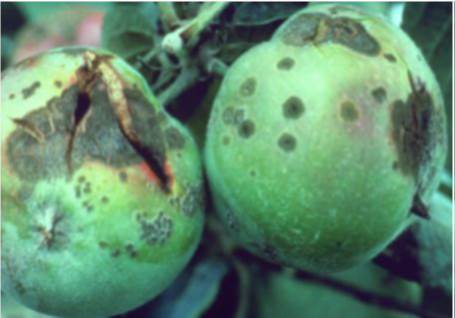
Apple scab is caused by a fungus Venturia inaqualis, which overwinters in infected leaves on the orchard floor.  Mating among different strains of the fungus occurs shortly after leaf fall and spores develop in the fallen leaves during the winter.  Spring rains cause spores to be forcibly discharged. Spores continue to mature and are discharged over a period of 5-9 weeks. If the surface of apple tissue is wet and temperatures are suitable, the spores germinate and penetrate the cuticle and outer layers of the plant, causing an infection.  The fungus grows beneath the cuticle and eventually ruptures it and forms dark green lesions.  Masses of spores are produced asexually within the lesions and become detached during rain.  Water splashes and redistributes these spores, causing secondary infections. Each leaf scab lesion is capable of producing 50,000-100,000 spores. Assuming 50,000 leaves per tree have 2% scab infection, about 50 million spores would be present on a single tree.  One spore can cause an infection. Infections early in the season can kill tissues near the fruit surface and the fruit develops unevenly as uninfected portions continue to grow.  Cracks appear in the skin and flesh and the fruit may become deformed.  Heavily infected fruit fall from the tree resulting in yield losses.  Scab lesions on harvested apples result in a lower price for growers since the commercial tolerance for scab damage approaches zero.

“Apple scab [Venturia inaequalis (CKE.) Winter] is one of the most important diseases of apple, causing considerable losses every year in many countries. Crop losses in the Netherlands caused by apple scab would be about 80% if no control measures were taken; therefore, 15-22 conventional spray applications per season are used to prevent apple yield loss under Dutch weather conditions.”

Authors: Holb, I. J., et al.
Affiliation: Department of Plant Protection, Centre of Agricultural Sciences, Debrecen University.
Title: Summer epidemics of apple scab: the relationship between measurements and their implications for the development of predictive models and threshold levels under different disease control regimes.
Source: Journal of Phytopathology. 2003. 151:335-343.

Lychee, A Favorite Fruit of Chinese Emperors, Would be Largely Unavailable Without Fungicides

Litchi (lychee)

Litchi (lychee)

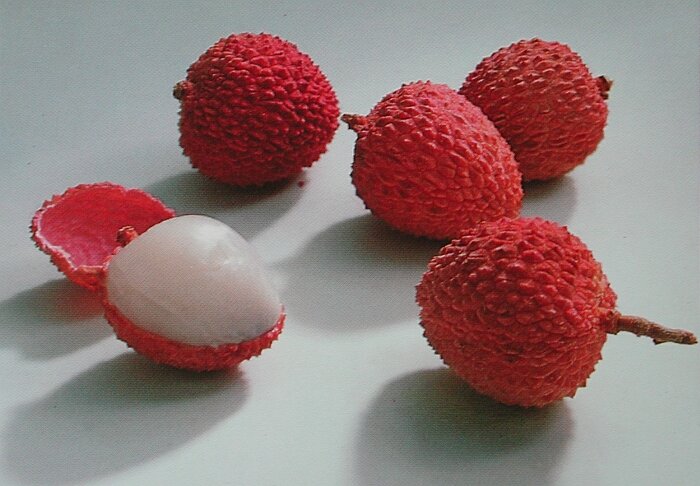
The lychee, also known as litchi, grows on a tropical and subtropical fruit tree native to southern China, Taiwan, Bangladesh and Southeast Asia, and now grown in many parts of the world. The lychee has a history and cultivation going back as far as 2000 BC. In the 1st century, fresh lychees were in such demand at the Imperial Court that a special courier service with fast horses would bring the fresh fruit from Guangdong. It was first introduced to the west in 1782. The fresh fruit has a delicate, whitish pulp with a floral smell and a fragrant, sweet flavor. Dried lychee are often called lychee nuts, though, of course, they are not a real nut. Litchi downy mildew is a devastating disease of litchi plants in China. Control of litchi downy mildew requires numerous fungicide applications.

“Litchi (Litchi chinensis Sonn.) is a tropical and subtropical fruit of high commercial value. Most litchi fruits are produced in China, India and Vietnam. In 2001, the world litchi production was approximately two million tons, and approximately 1.26 million tons were produced in China… However, the fruits are very susceptible to many diseases with significant losses in quality and yield. One of the most prevalent diseases is litchi downy blight caused by the peronosporomycete Peronophythora litchii.

P. litchii damages fruit, panicles and new shoots, causing panicle rot and withering, as well as watery brown spots on fruits which later produce snowy mildew. More than 60% of commercial losses have been reported after successive rainy and overcast days in the growing season.

The primary components of all commercial management programmes for this disease are applications of organic and/or inorganic fungicides.”

Authors: Wang, H., et al.
Affiliation: College of Plant Protection, Nanjing Agricultural University, China.
Title: Fungicide effectiveness during the various developmental stages of Peronophythora litchii in vitro
Source: Journal of Phytopathology. 2009. 157:407-412.

High Quality Spanish Greenhouse Vegetables Depend on Fungicides

Greenhouse Industry, Almeria

Greenhouse Industry, Almeria

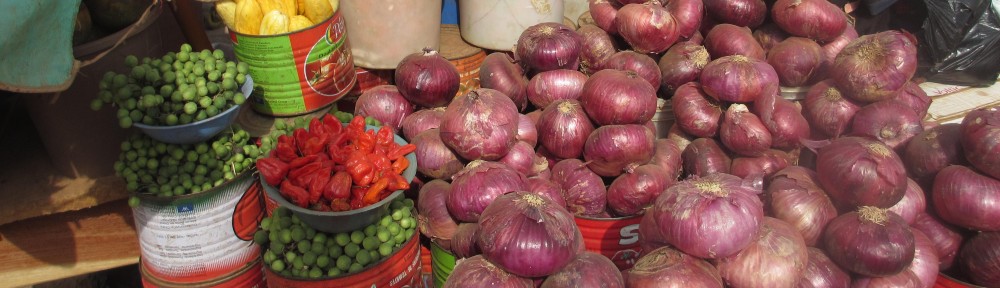
Almeria is located in the region of Andalucia in southeastern Spain. It has an average temperature of 68° and about 3000 hours of annual sunshine. Vegetable production in greenhouses has increased dramatically in Almeria. At present, about half of the total production from this area is exported to the European Union, especially Germany, France and the Netherlands. Almeria has become very competitive because it is relying on selling via high quality and not on low prices. Spain will try to improve its export position by increasing its market share in other parts of the world. Not only are prices competitive from Spain, but also the quality of Spanish produce is excellent. Needless to say, moldy vegetables are not acceptable for export from Spain and the greenhouse crops are intensively sprayed with fungicides.

Botrytis cinerea, is the causal agent of grey mould, one of the most important diseases of crops in Almeria, a region in south-east Spain where unheated plastic greenhouses cover an area of approximately 33.560 ha. Botrytis cinerea attacks a wide range of plant species in temperate zones and causes grey mould on many economically important crops such as vegetables, ornamentals, bulbs and fruit. Chemical control is the primary method for grey mould control, with alternative fungicides applied every 10 days, from November to March.”

Authors: Moyano, C., V. Gomez, and P. Melgarejo.
Affiliations: Department of Plant Protection, INIA, Ctra. De la Coruna, Spain.
Title: Resistance to pyrimethanil and other fungicides in Botrytis cinerea populations collected on vegetable crops in Spain.
Source: Journal of Phytopathology. 2004. 152:484-490.

New Fungicides Take the Worry out of Controlling Mildew on Lettuce

Lettuce

Lettuce Downy Mildew

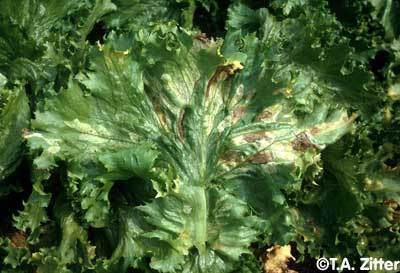
Downy mildew is a common fungus in most lettuce growing regions, especially during cool, moist weather.  Spores can be blown long distances.  Under favorable conditions, downy mildew is a very explosive disease, capable of appearing at high incidence in a field overnight.  When spores land on lettuce foliage, they germinate and can penetrate the lettuce leaf within three hours.  Lettuce is susceptible at all growth stages to the downy mildew pathogen.  Following penetration and establishment in the leaf, fruiting stalks grow through the leaves and branch repeatedly producing several spores on each tip, resulting in a whitish mat of millions of spores on each plant.  Affected tissues turn brown.  The fungus can penetrate to leaves internal to the wrapper leaves.  Relatively low levels of infection can downgrade a crop, cause significant trimming losses at harvest and promote decay by bacterial organisms during postharvest transport and storage.  During transit, lesions become soft and slimy as secondary decay organisms gain entrance through the tissues infected with the downy mildew fungus. High levels of disease can render a crop unmarketable.

“Incited by the obligate parasite Bremia lactucae, downy mildew is one of the most devastating diseases of lettuce worldwide. Attempts to manage this fungal disease using host-plant resistance have frequently failed due to the development of new races of the pathogen. Therefore, chemical control is of the utmost importance in humid areas where environmental conditions are very favorable for disease development.

Since the year 2000, a number of new fungicides targeting the Oomycetes, the class of fungi to which downy mildew belongs, have come to the market or are being considered for registration. It was the objective of these studies to investigate a select number of these for potential use in Florida for lettuce downy mildew control.

Of those investigated, mandipropamid and fenamidone consistently provided for high levels of control. Fluopicolide, dimethomorph, dimethomorph plus ametoctradin, cyazofamid, and propamocarb also provided significant control. With the majority of these fungicides already being labeled or close to being labeled on lettuce, it would appear that lettuce growers now have a wide array of efficacious downy mildew fungicides with differing modes of action from which to choose. This is a far cry from the situation that existed during 1989, when the EBDC fungicides were being threatened with cancellation and metalaxyl insensitivity was becoming widespread.”

Authors: Raid, R. N., and D. D. Sui.
Affiliation: University of Florida, IFAS, Everglades Research and Education Center.
Title: Management of lettuce downy mildew with fungicides.
Source: Proc. Fla. State Hort. Soc. 2012. 125:218-221.

More Sugar from Michigan Thanks to Fungicides

Fungicides: Used (left); Not Used (right)

Fungicides: Used (left); Not Used (right) (Rhizoctonia Control)

Rhizoctonia root rot is a serious disease problem in several sugarbeet-growing regions, with the result sometimes being dramatic—and expensive—reductions in tonnage and quality. Low levels of infections can easily cause yield losses in excess of a ton per acre while high infection levels can cut yields by more than 10 tons per acre. The quality of surviving beets can also be impacted, sometimes resulting in significant losses in recoverable sugar.

“During 2009 and 2010, the Michigan Sugarbeet Advancement Initiative established a study to determine the efficacy and economic impact of various application strategies for the use of Quadris flowable fungicide to control Rhizoctonia root rot.

On average (four trials in each of two years), even with low to moderate levels of Rhizoctonia infection, the per-acre net return of Quadris over the check trials ranged from $94 to $209, depending on the rate, timing and method used. The best treatment in these trials improved recoverable sugar per ton by 14 pounds and percent sugar by 0.7%. Even the “worst” treatment increased RST by 8 pounds and sugar content by 0.3%.”

Authors: Poindexter, S., and Wenzel, T.
Affiliation: Michigan Sugarbeet Advancement, Michigan State University
Title: Rhizoctonia control with quadris—update on Michigan research.
Source: The Sugarbeet Grower. April/May 2011. Pgs. 16-17.

Moldy Oranges Not Acceptable in Europe

Green mold and blue mold

Green mold and blue mold

Green mold is caused by a fungus which is ubiquitous to all citrus growing regions. Spores of this organism are airborne and large numbers are produced by the fungus on the surface of infected fruit. These spores will contaminate the packinghouse and its equipment, storage rooms, transit containers, and even the retail marketplace. Spores accumulate in water used in drenches and soak tanks. The fungus survives in the field on soil debris and produces spores that infect split and injured fruit in the tree and on the ground.

“Satsuma mandarin, one of the most economically important citrus crops in Izmir (Turkey). The most widely grown cultivar is primarily exported to European markets. Postharvest green mould caused by Penicillium digitatum and blue mould P. italicum are the most significant postharvest diseases of Satsuma mandarins. Control of the postharvest decay of mandarin is most commonly achieved by applications of synthetic fungicides.”

Authors: Yildiz, F., et al.
Affiliation: Department of Plant Protection and Horticulture, Ege University, Turkey.
Title: Effects of preharvest applications of CaCl2, 2,4-D and benomyl and postharvest hot water, yeast and fungicide treatments on development of decay on Satsuma mandarins.
Source: Phytopathology. 2005. 153:94-98.

Organic Cherry Growers Spray Fungicides More Often

Defoliated Cherry Trees

Leaf spot is the most important fungal disease of cherry.  The disease is caused by a fungus known as Coccomyces hiemalis which lives over the winter in the old leaves on the ground.  The first infection of new foliage in the early summer is caused by spores which are discharged from these old leaves.  After the fungus develops on the new leaves, more spores are produced and they may cause further spread of the disease.  Defoliation from leaf spot reduces the number of flower buds and subsequent fruit set for the following year.  Defoliated trees are less cold hardy and may be killed by low temperatures in winter.  Conventional and organic growers who spray regularly and thoroughly every year seldom suffer any serious loss from leaf spot. However, since the spray materials available for organic growers are not as effective as the synthetic chemicals used by conventional growers, the organic growers have to spray more often.

“Cherry leaf spot (CLS)… occurs worldwide and is the most prevalent disease of sour cherry in temperate zones. Epidemics caused by ascospore followed by repeated conidial cycles cause defoliation by midsummer, resulting in low fruit quality. Early defoliation delays acclimation of fruit buds and wood to cold temperatures in the fall, and reduces fruit bud survival during severe winters and fruit set the following spring.

In integrated sour cherry orchards, CLS management typically involves four to eight fungicide treatments per year, starting at petal fall and continuing until late summer. In organic orchards, only a few approved fungicides are available for CLS control, such as sulfur and copper compounds. These compounds are often less effective and more phytotoxic than synthetic fungicides used in integrated fruit growing. Therefore, in Hungarian organic sour cherry orchards, 7 to 12 sprays are applied against CLS in each season.”

Author: Holb, I. M.
Affiliation: University of Debrecen, Hungary.
Title: Effect of sanitation treatments on leaf litter density and leaf spot incidence in integrated and organic sour cherry orchards.
Source: Plant Disease. 2013. 97[7]:891-896.

A Crop Variety May Resist a Disease but May not be Desired by Consumers.

Blight on stems

Blight lesions on chickpea stems

The planting of disease-resistant varieties is often promoted as an alternative to the use of fungicides. If a plant variety is produced through traditional crop breeding and is able to somehow resist penetration and infection by fungi, then fungicides are not needed. Right? The problem is that when new varieties are produced through crop breeding, they often lose quality traits that are desired by consumers. In Turkey, the best quality chickpeas are susceptible to blights and require fungicide treatments in contrast to the lower quality resistant chickpea varieties.

“Chickpea is one of the most extensively grown legume crops in Turkey, the area and production being 622,214 ha and 548,000 tons, respectively. Chickpea blight, is one of the most important diseases affecting this crop wherever it is grown. The disease, which originates from infected seeds and diseased plant debris remaining in the field, mainly affects all the above-ground parts of the plants, causing lesions mostly on stems and stem breakage. Chickpea blight can be effectively controlled by using tolerant or resistant cultivars, but none of them has good quality or sells for high prices in Turkey; unfortunately, high-value cultivars are susceptible to the disease. Seed transmission is especially important where crop rotation is practiced. For this reason, effective chemical control is needed for seed and foliage treatments.”

Authors: Demirci, F., et al.
Affiliation: Department of Plant Protection, Ankara University, Turkey
Title: In vitro and in vivo effects of some fungicides against the chickpea blight pathogen, Ascochyta rabiei.
Source: Journal of Phytopathology. 2003. 151:519-524.