Apples Can be grown in New Zealand Thanks to Fungicide Sprays

Apple Scab

Apple Scab

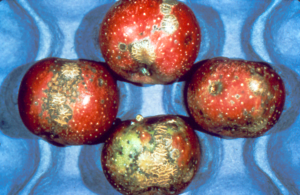
Apple scab is the most economically important disease of apples in the world. Fungal scab infections cause cracks in apples. Infected leaves fall off the tree which can result in reduced tree growth for one to three years. Apple growers worldwide have been spraying fungicides for over 100 years to control scab. And in New Zealand…..

“New Zealand apple industry spray programmes for control of black spot (scab), caused by Venturia inaequalis, typically use 16-20 fungicide applications each season, including dodine and fungicides in the demethylation inhibitor (DMI) group. These fungicides are particularly important to orchardists because their systemic activity prevents black spot development when they are applied after infection has occurred.”

Authors: R.M. Beresford1, P.J. Wright2, P.N. Wood3 and N.M. Park3
Affiliation: 1The New Zealand Institute for Plant & Food Research, Auckland, New Zealand; 2The New Zealand Institute for Plant & Food Research, Pukekohe, New Zealand; 3The New Zealand Institute for Plant & Food Research, Hawke’s Bay Centre, Hastings, New Zealand.
Title: Sensitivity of Venturia inaequalis to myclobutanil, penconazole and dodine in relation to fungicide use in Hawke’s Bay apple orchard.
Publication: New Zealand Plant Protection. 2012. 65:106-113.

China Warns of Famine Without Pesticides

Over the past several decades, China has become self-sufficient in basic foods such as wheat, maize, and rice. In addition, Chinese production of many fruit and vegetable crops has soared. The widespread use of pesticides has had a key role in this vast expansion in food production and without their use…

“China would ‘undergo famine if pesticides were not used’. The warning has come in a recent Ministry of Agriculture document entitled ‘pesticide residues in agricultural products and related safety issues’, reports the national newspaper, the AgriGoods Herald.”

“China has more than 1,700 types of plant disease and insect pests, with major pest outbreaks occurring on over 400 million hectares annually. Laboratory findings released by Chinese agrochemical company Beijing Yoloo Pesticide showed that rice production would be reduced by more than two-thirds if pesticides were not used, and wheat production would be halved.”

Authors: Agrow staff writer
Headline: China warns of famine without pesticides.
Publication: Agrow. 2012. No. 642, June 20.

Consumers Don’t Want Bugs with Berries, Making Insecticides Necessary

Japanese beetles are often present in blueberry fields and are collected along with the berries at harvest. Because of zero consumer tolerance for bugs in blueberry products, insecticides are necessary to remove the beetles from the blueberry fields before harvest.

“The Japanese beetle, Popillia japonica Newman, is an invasive pest of fruit and vegetable crops, turfgrass, and ornamentals in eastern and central North America. … During the adult emergence period of June to September in Michigan beetles can be observed feeding and mating in clusters on host plants.”

“Much of the food industry maintains a zero tolerance standard for insect contamination at pack-out, which places added pressure on growers of fruit crops such as cherry, peach, plum, and blueberry that may be harvested when beetles are present. The majority of commercial blueberry producers use over-the-row mechanical harvesters for collecting fruit from their fields. This harvesting method does not effectively discriminate between beetles and berries, so adult Japanese beetles are a significant contamination risk in fields being harvested where Japanese beetle has not been controlled.”

“Color sorting technology has been adopted by many large processors to detect and remove beetles, providing >95% removal. Even with these management components available to help minimize the risk of fruit contamination with adult beetles, conventional insecticides remain the primary approach to in-field management of Japanese beetles in fruit crops.”

Authors: J. Wise¹, C. Vandervoort² and R. Isaacs¹.
Affiliation: ¹Department of Entomology, Michigan State University; ²Pesticide Analytical Laboratory, Michigan State University.
Title: Lethal and sublethal activities in imidacloprid contribute to control of adult Japanese beetle in blueberries.
Publication: Journal of Economic Entomology. 2007. 100(5):1596-1603.

European Organic Wheat Suffers from “Stinking Smut”

Common bunt is one of the most destructive diseases of wheat. As the fungus grows in the plant, the wheat kernels are converted to bunt balls that, when crushed, release thousands of black spores. They smell of rotting fish, hence the name “stinking smut”. Because of effective chemical seed treatment, common bunt had become a forgotten disease—until its reemergence in European organic wheat.

“The legal requirement for organic seed has compounded the bunt problem in Europe. For many years, it was possible to use conventionally produced seed as long as the cultivars were not of transgenic origin and the seed had not been treated after harvest with synthetic fungicides. All of this changed with Commission Regulation (EC) No. 1452/2003, which stipulated that beginning January 2004, all plant materials used for organic agriculture must be produced under organic farming conditions.”

“In conventional agriculture, common bunt is often exclusively controlled with chemical seed treatments. … Now, more than half a century after common bunt was thought to be vanquished, it has re-emerged in organic wheat. … In the United Kingdom, organic seed lots are predominantly contaminated with common bunt spores.”

“Contamination of wheat with common bunt spores has resulted in considerable loss of yield and seed quality. … Given the epidemiology of the disease, it has the potential to cause economic devastation to low-input and organic farmers.”

Authors: J.B. Matanguihan, K.M. Murphy and S.S. Jones*
Affiliation: *Department of Crop and Soil Sciences, Washington State University
Title: Control of Common Bunt in Organic Wheat.
Publication: Plant Disease. 2011. 95(2):92-103.

Insecticides Prove Necessary for Managing New Invasive Stink Bug

The brown marmorated stink bug is native to Asia and was introduced into the US in the 1990s. The stink bug feeds on many orchard crops, small fruit, grapes, vegetables and row crops—particularly in mid-Atlantic states. Developing long-term control strategies takes time, which makes the immediate use of insecticides necessary.

“Damage in apple in the mid-Atlantic region inflicted by H. halys (brown marmorated stink bug) resulted in losses in excess of 37 million dollars in 2010. In addition, H halys is a serious nuisance pest in residential areas because it uses human-made structures as overwintering sites.”

“Because the brown marmorated stink bug is a newly established invasive pest in the United States, insecticides will play a key role in managing this pest on various crops at least in the short term. Indeed, the use of insecticides has substantially increased in commercial orchards because of the damage inflicted by H. halys and subsequent economic loss in the mid-Atlantic region.”

Authors: T.C. Leskey, D.-H. Lee, B.D. Short and S.E.Wright
Affiliation: USDA Agricultural Research Services, Kearneysville, WV
Title: Impact of insecticides on the invasive Halyomorpha halys (Hemiptera: Pentatomidae): Analysis of insecticide lethality.
Publication: Journal of Economic Entomology. 2012. 105(5):1726-1735.

The Story of Coffee Rust: Why the British Drink Tea

In England in the early and mid-1800s, the most popular drink was coffee from plantations in Ceylon (Sri Lanka). When the coffee rust fungus destroyed Ceylon’s coffee trees in 1875, the plantations began growing tea.

“When the coffee rust fungus, Hemileia vastatrix, reached Ceylon in 1875, nearly 400,000 acres of the island were covered with coffee trees. No effective chemical fungicide was available to protect the foliage, so the fungus was able to colonize the leaves until nearly all the trees had been defoliated. … In 1870, Ceylon exported 100 million pounds of coffee. By 1889, production was down to 5 million pounds. In less than 20 years, many coffee plantations had been destroyed, and production had essentially ceased.”

“As the coffee trees were dying, however, the plantation owners noticed that the thousand or so acres of tea bushes were still healthy. …the owners replaced most of the dead coffee trees with tea bushes. By 1875, more than 1 billion tea seedlings had been planted on 300,000 acres—an amazing increase from the acreage planted only a few years earlier. … Luckily, no fungus invaded the tea crop immediately, and newly discovered fungicides were soon available to protect tea from its fungal pathogens.”

Authors: G.L. Shumann and C.J. D’Arcy
Publication: Hungry Planet: Stories of Plant Diseases. 2012. APS Press.

Without Fungicides, the Worldwide Export of Bananas Would Collapse

About 34 billion pounds of bananas are exported around the world from tropical plantations. Black Sigatoka is the most important disease of bananas worldwide. The disease causes infected plant tissue to collapse; all leaves can be destroyed and bunches of unripe bananas can fall to the ground. Black Sigatoka is well controlled in export plantations thanks to fungicides.

“Without the frequent use of fungicides, the export trades could not control black Sigatoka and, thus, would be unable to produce profitable quantities of high quality fruit.”

“Despite recent advances in banana breeding, there are currently no resistant cultivars that could be used to replace [the most common cultivar] ‘Grand Nain’. Thus, fungicidal control of this disease will remain an absolute necessity in order for the trades to continue producing high quality fruit in the humid tropics.”

Author: R. Ploetz
Affiliation: Tropical Research & Education Center, University of Florida
Title: Black Sigatoka.
Publication: Pesticide Outlook. 2000. February:19-23.

Chile #1 Exporter of Table Grapes Thanks to Fungicides

Chile leads the world in the export of table grapes. A major challenge for Chile is the distance from the fields to the export markets. The long distance makes necessary having grapes of extremely high quality that can endure the trip and have a long shelf life. Botrytis is a disease that severely affects stored table grapes because it can infect the grapes in the field and then continue to grow in the berries’ storage, producing nests of gray-white fungus. Botrytis is common in Chilean vineyards, so the development of mold is prevented by the use of fungicides.

“Gray mold caused by Botrytis cinerea is a common disease that causes important economical losses in grape production in Chile. Under cool and humid conditions, several fungicide treatments between bloom and harvest, in addition to cultural control measures, are essential to control gray mold of grapevines. … Gray mold requires several fungicide treatments to achieve satisfactory control in Chile.”

Authors: B.A. Latorre and R. Torres
Affiliation: Pontificia Universidad Católica de Chile, Santiago, Chile
Title: Prevalence of isolates of Botrytis cinerea resistant to multiple fungicides in Chilean vineyards.
Publication: Crop Protection. 2012. 40:49-52.

Non-chemical Weed Control Methods Fail to Control Weeds in Organic Peanut Trials

Extensive research has been undertaken in Georgia to determine the effectiveness of non-chemical weed control methods for organic production systems. None of the systems has proven effective, meaning that hundreds of hours of hand weeding are necessary to make these peanut fields viable.

“The inability to sustain a reliable domestic supply of organic peanut is partially due to difficult and costly weed control. … The initial attempt to develop weed management systems using propane flaming and [Organic Materials Research Institute] OMRI herbicides in organic peanut was a weed control failure. Propane flaming and OMRI herbicides did not control annual grasses and perennial nutsedges, and provided only short-term control of dicot weeds.”

“A factor that limits successful in-row weed control using cultivation is inconsistent performance. … The lack of consistency using cultivation as the primary means of weed control in organic peanut appears to be a major unresolved challenge. Even when cultivator implements are properly adjusted and operated in a timely manner, in-row weeds can escape control. …hand weeding cannot be completely replaced by intensive in-row cultivation. … This is also shown by the time and cost of hand weeding to control escapes, particularly the brush-hoe cultivator at VE/1 wk in 2009 needing 116 hours/ha to remove escapes at a cost of $1,021/ha.”

Authors: W.C. Johnson1, M.A. Boudreau2 and J.W. Davis2
Affiliation: 1USDA-ARS, 2University of Georgia
Title: Implements and cultivation frequency to improve in-row weed control in organic peanut production.
Publication: Weed Technology. 2012. 26(2):334-340.

Commercial Wild Rice Production in Minnesota Depends on Fungicides

Wild rice originated in Minnesota and the surrounding Great Lakes. It is the only cereal native to North America that has been domesticated from a wild plant. Before commercial production began, wild rice was difficult to obtain. The first commercial field of wild rice was planted in 1950 in Minnesota. After one season, fungal brown spot disease destroyed the second crop. In the next decade, fungal brown spot destroyed much of Minnesota’s wild rice crops – epidemics in 1973 and 1974 resulted in complete crop loss in many paddies. Ever since 1974 Minnesota growers have sprayed fungicides in order to produce commercial wild rice.

“Propiconazole, a systemic ergosterol biosynthesis-inhibiting fungicide, was evaluated for FBS control during 1985-1987 at the University of Minnesota North Central Experiment Station in Grand Rapids. In 1985 and 1986, propiconazole applications at both boot and heading stages of development increased yield by 68 and 40%, respectively, and in 1987 applications increased yield 113%.”

“Registration of propiconozale is crucial, because commercial wild rice production in Minnesota without fungicides may not be economically feasible.”

Author: D.R. Johnson and J.A. Percich
Affiliation: University of Minnesota, St. Paul
Title: Wild rice domestication, fungal brown spot disease, and the future of commercial production in Minnesota.
Publication: Plant Disease. 1992. December:1193-1198.