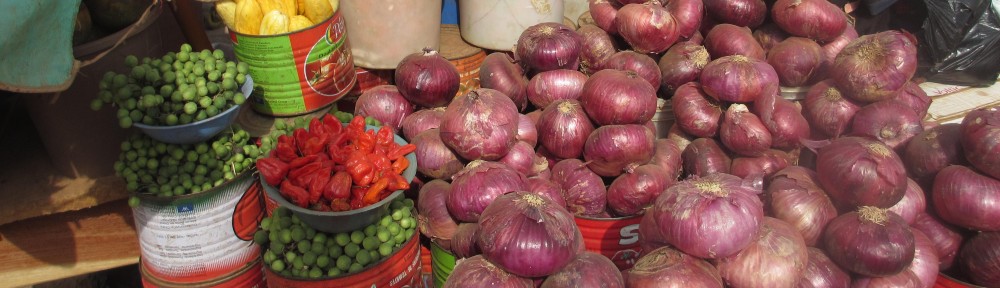
Fungicides Result in Mangoes Suitable for Export

Mango - Anthracnose

Mango – Anthracnose

Commonly known as the “King of Fruits,” the mango is the most important fruit of Asia. It is grown throughout the tropics and subtropics. Until recently, mango fruit was considered an exotic, specialty item in import markets such as the U.S. and Europe. Today a million tons of mangoes are exported. Among the diseases of mango, anthracnose is the most prevalent in humid growing regions. The incidence of this disease can reach almost 100% in fruit produced under wet or very humid conditions.

“Diseases are primary constraints to production in virtually all areas where mango is grown. … In humid regions, anthracnose is most destructive. … Pesticides are used in most commercial production situations, especially where anthracnose [is] important.”

“…irregular, dark brown to black lesions develop that are somewhat depressed and can crack the fruit surface. Under humid conditions, large areas may be involved and orange to pinkish masses of conidia are formed on the decaying surface. … Lesions on fruit are initially superficial, and penetrate deeper than 5 mm into the flesh only late in development. Anthracnose is caused by three closely related fungi. … Although some mango cultivars are moderately tolerant, none are sufficiently resistant to be produced without fungicides in humid areas.”

“In general, mango production currently has a heavy dependence on chemical disease control measures, especially where disease-conducive environments exist and when export quality fruit are desired.”

Author: R.C. Ploetz
Affiliation:
University of Florida Tropical Research and Education Center, Homestead, FL
Title: The major diseases of mango: strategies and potential for sustainable management.
Publication: Proceedings of the VIIth International Symposium on Mango. 2004. 137-150.

Numerous Fungicide Sprays Needed in Brazil to Prevent Tomatoes and Potatoes from Rotting

Late Blight Tomatoes

Late Blight Tomatoes

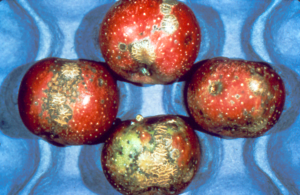
The late blight fungus infects both tomatoes and potatoes. The fungus attacks all the aboveground parts of the plant. Infected foliage becomes brown, shrivels, and soon dies. When severe, all the plants in a field may be killed in a week. On tomato fruit, greenish brown greasy spots develop and can cover the entire tomato. Decaying vines can be identified by a foul odor. Environmental conditions in Brazil are ideal for the development of the disease.

“Tomato and potato are the most important vegetable crops in Brazil. During 2002, production of tomato and potato in Brazil totaled 3.6 and 3.1 million tons, respectively. The major producing areas are the south and southeast regions, in which 57.2% of the tomato and 92.3% of the potato are produced. Late blight, caused by Phytophthora infestans, occurs in both regions and is the most serious foliar disease of these crops. The environmental conditions in these regions also are highly favorable to late blight development, leading to severe crop losses if no control measures are adopted.”

“Due to favorable environmental conditions and high susceptibility to late blight, up to 20 and 15 fungicide sprays commonly are used in tomato and potato crops, respectively.”

Authors: A. Reis, F.H.S. Ribeiro, L.A. Maffia and E.S.G. Mizubuti
Affiliation: Departamento de Fitopatologia, Universidade Federal de Viçosa, Viçosa-MG, Brazil
Title: Sensitivity of Brazilian isolates of Phytophthora infestans to commonly used fungicides in tomato and potato crops.
Publication: Plant Disease. 2005. 89(12):1279-1284.

Apples Can be grown in New Zealand Thanks to Fungicide Sprays

Apple Scab

Apple Scab

Apple scab is the most economically important disease of apples in the world. Fungal scab infections cause cracks in apples. Infected leaves fall off the tree which can result in reduced tree growth for one to three years. Apple growers worldwide have been spraying fungicides for over 100 years to control scab. And in New Zealand…..

“New Zealand apple industry spray programmes for control of black spot (scab), caused by Venturia inaequalis, typically use 16-20 fungicide applications each season, including dodine and fungicides in the demethylation inhibitor (DMI) group. These fungicides are particularly important to orchardists because their systemic activity prevents black spot development when they are applied after infection has occurred.”

Authors: R.M. Beresford1, P.J. Wright2, P.N. Wood3 and N.M. Park3
Affiliation: 1The New Zealand Institute for Plant & Food Research, Auckland, New Zealand; 2The New Zealand Institute for Plant & Food Research, Pukekohe, New Zealand; 3The New Zealand Institute for Plant & Food Research, Hawke’s Bay Centre, Hastings, New Zealand.
Title: Sensitivity of Venturia inaequalis to myclobutanil, penconazole and dodine in relation to fungicide use in Hawke’s Bay apple orchard.
Publication: New Zealand Plant Protection. 2012. 65:106-113.

European Organic Wheat Suffers from “Stinking Smut”

Common bunt is one of the most destructive diseases of wheat. As the fungus grows in the plant, the wheat kernels are converted to bunt balls that, when crushed, release thousands of black spores. They smell of rotting fish, hence the name “stinking smut”. Because of effective chemical seed treatment, common bunt had become a forgotten disease—until its reemergence in European organic wheat.

“The legal requirement for organic seed has compounded the bunt problem in Europe. For many years, it was possible to use conventionally produced seed as long as the cultivars were not of transgenic origin and the seed had not been treated after harvest with synthetic fungicides. All of this changed with Commission Regulation (EC) No. 1452/2003, which stipulated that beginning January 2004, all plant materials used for organic agriculture must be produced under organic farming conditions.”

“In conventional agriculture, common bunt is often exclusively controlled with chemical seed treatments. … Now, more than half a century after common bunt was thought to be vanquished, it has re-emerged in organic wheat. … In the United Kingdom, organic seed lots are predominantly contaminated with common bunt spores.”

“Contamination of wheat with common bunt spores has resulted in considerable loss of yield and seed quality. … Given the epidemiology of the disease, it has the potential to cause economic devastation to low-input and organic farmers.”

Authors: J.B. Matanguihan, K.M. Murphy and S.S. Jones*
Affiliation: *Department of Crop and Soil Sciences, Washington State University
Title: Control of Common Bunt in Organic Wheat.
Publication: Plant Disease. 2011. 95(2):92-103.

The Story of Coffee Rust: Why the British Drink Tea

In England in the early and mid-1800s, the most popular drink was coffee from plantations in Ceylon (Sri Lanka). When the coffee rust fungus destroyed Ceylon’s coffee trees in 1875, the plantations began growing tea.

“When the coffee rust fungus, Hemileia vastatrix, reached Ceylon in 1875, nearly 400,000 acres of the island were covered with coffee trees. No effective chemical fungicide was available to protect the foliage, so the fungus was able to colonize the leaves until nearly all the trees had been defoliated. … In 1870, Ceylon exported 100 million pounds of coffee. By 1889, production was down to 5 million pounds. In less than 20 years, many coffee plantations had been destroyed, and production had essentially ceased.”

“As the coffee trees were dying, however, the plantation owners noticed that the thousand or so acres of tea bushes were still healthy. …the owners replaced most of the dead coffee trees with tea bushes. By 1875, more than 1 billion tea seedlings had been planted on 300,000 acres—an amazing increase from the acreage planted only a few years earlier. … Luckily, no fungus invaded the tea crop immediately, and newly discovered fungicides were soon available to protect tea from its fungal pathogens.”

Authors: G.L. Shumann and C.J. D’Arcy
Publication: Hungry Planet: Stories of Plant Diseases. 2012. APS Press.

Without Fungicides, the Worldwide Export of Bananas Would Collapse

About 34 billion pounds of bananas are exported around the world from tropical plantations. Black Sigatoka is the most important disease of bananas worldwide. The disease causes infected plant tissue to collapse; all leaves can be destroyed and bunches of unripe bananas can fall to the ground. Black Sigatoka is well controlled in export plantations thanks to fungicides.

“Without the frequent use of fungicides, the export trades could not control black Sigatoka and, thus, would be unable to produce profitable quantities of high quality fruit.”

“Despite recent advances in banana breeding, there are currently no resistant cultivars that could be used to replace [the most common cultivar] ‘Grand Nain’. Thus, fungicidal control of this disease will remain an absolute necessity in order for the trades to continue producing high quality fruit in the humid tropics.”

Author: R. Ploetz
Affiliation: Tropical Research & Education Center, University of Florida
Title: Black Sigatoka.
Publication: Pesticide Outlook. 2000. February:19-23.

Chile #1 Exporter of Table Grapes Thanks to Fungicides

Chile leads the world in the export of table grapes. A major challenge for Chile is the distance from the fields to the export markets. The long distance makes necessary having grapes of extremely high quality that can endure the trip and have a long shelf life. Botrytis is a disease that severely affects stored table grapes because it can infect the grapes in the field and then continue to grow in the berries’ storage, producing nests of gray-white fungus. Botrytis is common in Chilean vineyards, so the development of mold is prevented by the use of fungicides.

“Gray mold caused by Botrytis cinerea is a common disease that causes important economical losses in grape production in Chile. Under cool and humid conditions, several fungicide treatments between bloom and harvest, in addition to cultural control measures, are essential to control gray mold of grapevines. … Gray mold requires several fungicide treatments to achieve satisfactory control in Chile.”

Authors: B.A. Latorre and R. Torres
Affiliation: Pontificia Universidad Católica de Chile, Santiago, Chile
Title: Prevalence of isolates of Botrytis cinerea resistant to multiple fungicides in Chilean vineyards.
Publication: Crop Protection. 2012. 40:49-52.

Commercial Wild Rice Production in Minnesota Depends on Fungicides

Wild rice originated in Minnesota and the surrounding Great Lakes. It is the only cereal native to North America that has been domesticated from a wild plant. Before commercial production began, wild rice was difficult to obtain. The first commercial field of wild rice was planted in 1950 in Minnesota. After one season, fungal brown spot disease destroyed the second crop. In the next decade, fungal brown spot destroyed much of Minnesota’s wild rice crops – epidemics in 1973 and 1974 resulted in complete crop loss in many paddies. Ever since 1974 Minnesota growers have sprayed fungicides in order to produce commercial wild rice.

“Propiconazole, a systemic ergosterol biosynthesis-inhibiting fungicide, was evaluated for FBS control during 1985-1987 at the University of Minnesota North Central Experiment Station in Grand Rapids. In 1985 and 1986, propiconazole applications at both boot and heading stages of development increased yield by 68 and 40%, respectively, and in 1987 applications increased yield 113%.”

“Registration of propiconozale is crucial, because commercial wild rice production in Minnesota without fungicides may not be economically feasible.”

Author: D.R. Johnson and J.A. Percich
Affiliation: University of Minnesota, St. Paul
Title: Wild rice domestication, fungal brown spot disease, and the future of commercial production in Minnesota.
Publication: Plant Disease. 1992. December:1193-1198.

Repeat of Irish Potato Famine Unlikely Thanks to Fungicides

The pathogen Phytophtera infestans causes a disease of potatoes called “late blight”. The pathogen grows in potato plants, breaking down cell walls so that it can use the nutrients found within them. Severely infected plants have an acrid odor which is the result of dying plant tissue. In the 1800s, Irish peasants subsisted almost entirely on potatoes. The late blight fungus arrived in 1845 and destroyed 40% of the Irish crop. In 1846, 100% of the crop was destroyed. Over 1.5 million Irish died of famine and a comparable number emigrated to America and other countries. Today, the fungus is still present in Ireland and would destroy the crop again if not for fungicides.

“Without the routine use of fungicides, large-scale commercial potato production in Ireland would be impossible. The cool, damp climate, which favours the cultivation of the potato and limits problems with virus diseases, is also ideal for the spread of blight. … In warm, wet weather when the humidity is high, P. infestans will lay waste an unprotected crop. … To prevent such devastating losses, the potato industry in Ireland has long been reliant on a substantial annual usage of fungicides.”

Author: L.R. Cooke
Affiliation: Plant Pathology Research Division, Department of Agriculture for Northern Ireland
Title: Potato blight control in Ireland: a challenging problem.
Publication: Pesticide Outlook. 1992. 13(4):28-31.

Fungicides “Vital” for Potato Production in Myanmar

Potato is a very popular vegetable crop in Myanmar and is essentially grown all year round. Phytophthora infestans, the fungus that caused the Irish Potato Famine in the 1840s, was first found in Southeast Asia in the late 1800s and has since been an annual widespread problem. Without fungicide protection, the disease spreads rapidly and can kill all the plants in a field within a few days.

“In Myanmar, late blight caused by Phytophthora infestans is the most destructive disease of potato. … High incidence and severity of potato late blight occur in this area because the crop can be found year-round at all stages of development, providing a constant source of primary inoculum.”

“At present, fungicide applications play a vital role in potato late blight control as resistant cultivars have not been widely available and adopted. … Fungicide is applied most frequently on post monsoon crops, which is when the weather conditions are ideal for late blight development.”

Author: M.M. Myint, Y.Y. Myint and H. Myint
Affiliation: Department of Plant Pathology, Yezin Agricultural University, Yezin, Myanmar
Title: Occurrence and growers’ perception of potato late blight in Kalaw Township, Myanmar.
Publication: Regional Workshop on Potato Late Blight for East and Southeast Asia and the Pacific Proceedings. 2004. 24-25 August, Yezin, Myanmar.