Southern California Vineyards Recover Thanks to Insecticide Applications

Grapevines Destroyed in 1999

Grapevines Destroyed in 1999

Temecula Today

Temecula Today

In 1999, about one-third of the vineyards in Temecula Valley, Riverside County, California were destroyed due to Pierce’s Disease which is caused by a bacteria transmitted to grapevines by an insect-the glassy winged sharpshooter. The disease seemed destined to spread throughout Southern California. However, research demonstrated that a carefully-timed insecticide application would prevent the sharpshooter from transmitting the disease to grapevines. As a result of this insecticide use, the wine grape industry in Southern California has recovered and is prospering.

“Twelve years ago a Pierce’s disease epidemic in Southern California wine grapes prompted a multi-pronged local, state and federal attack to contain the disease spread and find a cure or treatment.

Riverside County agriculture officials declared a local emergency in 1999 and 300 acres of Temecula wine grape vines were destroyed after they were found to be infested with the glassy winged sharpshooter.

Emergencies were declared, a task force was formed, and in 2000 $22.3 million in federal financial assistance was secured to reduce pest infestations and support research.

Research found that the Southern California epidemics were almost entirely the result of vine-to-vine transmission…. A protocol of applying one carefully timed application of a persistent systemic insecticide such as imidacloprid virtually eliminates the vine-to-vine spread.

Ben Drake is a Temecula-area wine grape grower and vineyard manager who began seeing problems from PD in the Temecula Valley as early as 1997.

We’ve found that if we apply (imidacloprid) at the middle to the end of May, before the sharpshooter moves out of the citrus and goes into the vineyards, we get levels of the material into the plant high enough that when the sharpshooter flies over from the citrus groves to try it, they just fly back where they came from. Or, if they feed long enough, it will kill them.

But just look at the Temecula Valley now to understand what’s changed: From 12 wineries in 1999, the Temecula Valley Winegrowers Association website today lists more than 50 growers and 34 wineries…. A thriving agritourism industry has developed…. Existing wineries are expanding and new ones are under construction or in planning phases.”

Author: Christine Thompson
Affiliation: Reporter
Title: Grape growers urged to remain vigilant against sharpshooter pest
Source: Western Farm Press. 2011-12-12. Available at: http://westernfarmpress.com/grapes/grape-growers-urged-remain-vigilant-against-sharpshooter-pest
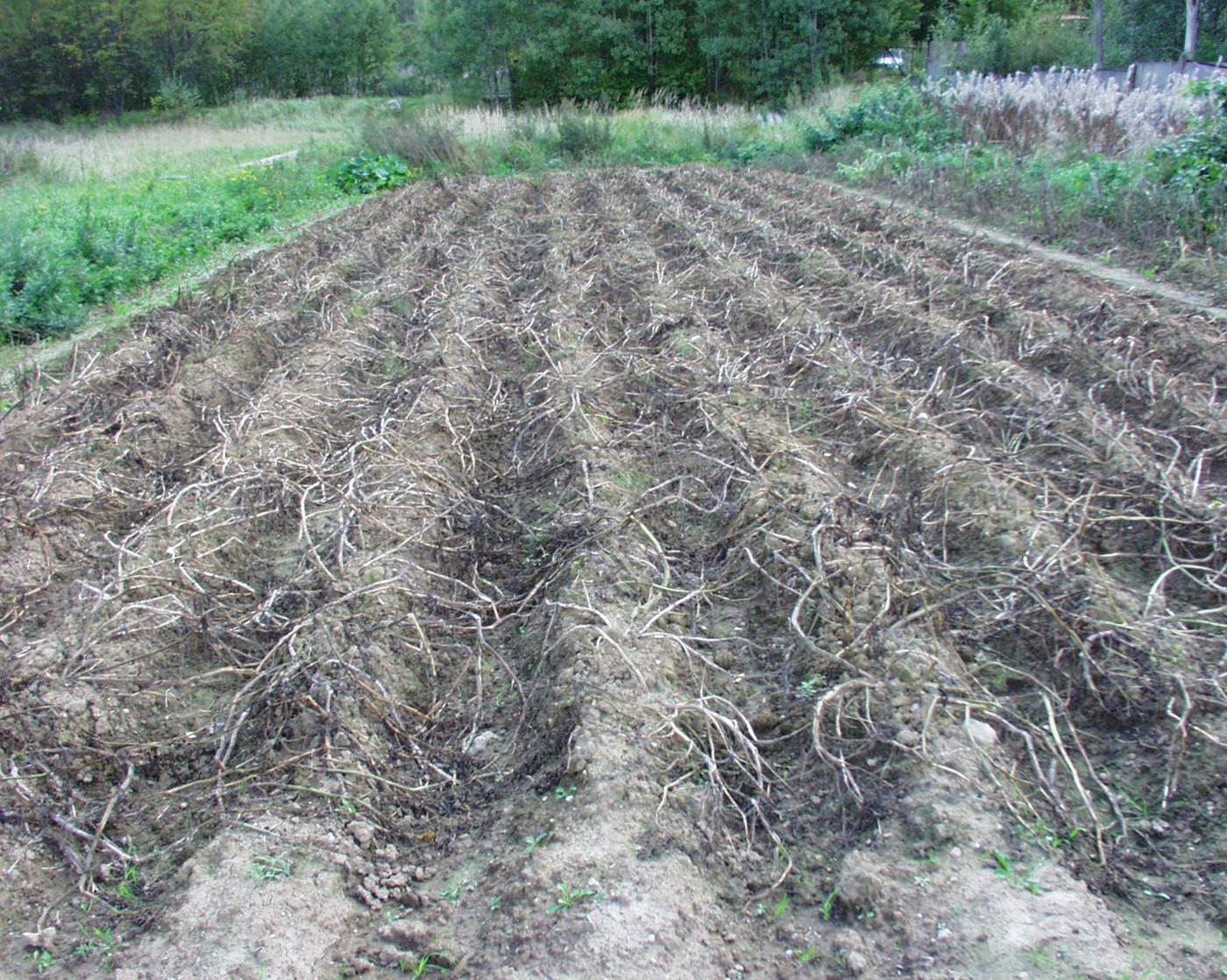
Czech Republic: Unsprayed Potatoes Completely Destroyed

Late Blight Destroyed Field

Late Blight Destroyed Field

Spanish explorers brought the potato to Europe from the Americas in the 16th century. A fungus causes a disease of potatoes known as late blight. Infected potatoes emit a distinctive unpleasant odor due to decay of plant tissue. Late blight first appeared in Europe in 1845 and had devastating consequences, particularly in Ireland. Today potato growers in Europe spray fungicides to prevent late blight infections. In the Czech Republic, 1.6 billion pounds of potatoes are grown annually and growers typically spray fungicides seven times yearly. 2011 was an ideal year for late blight development in the Czech Republic with devastating results for unsprayed potatoes….

Czech Republic 2011. In 2011, the weather conditions were very favourable for the development of potato late blight. Rainfall in May, June and August was near the normal in the main production region; however, in July it reached 160 – 180% of the normal. The spread of foliage blight was intensive and the level of tuber infection was also severe. The first more important outbreaks in the potato production region were observed in the second decade of July; however, epidemic late blight spreading was very rapid and non-treated crops were completely destroyed in 2 – 4 weeks, based on locality and varietal susceptibility.”

Authors: Hansen, J. G., et al.
Affiliation: Aarhus University, Dept. of Agroecology, Research Centre Foulum.
Title: The Development and Control of Late Blight (Phytophthora infestans) in Europe in 2010 and 2011.
Source: Thirteenth EuroBlight workshop, St. Petersburg (Russia), 9-12 October 2011.

Fungicides Protect Africa’s Wheat Fields From Rust

Treated and Un-Treated Wheat

Treated and Un-Treated Wheat

Rust spores that land on wheat plants germinate and infect the plant withdrawing nutrients. Fungus tissue proliferates until the epidermis bursts and pustules erupt. Each pustule contains thousands of spores that can be carried by the wind to infect other plants. Stem rust damaged wheat crops on a massive scale in the early 1900s. However, resistance to stem rust was successfully incorporated into wheat in the 1950s. Resistance to stem rust in most breeding programs was through the use of a single resistance gene Sr31. In 1999, a new strain (UG99) was detected in Uganda on a wheat variety containing the Sr31 gene. Yield losses of up to 80% were reported. Fungicide use became essential.

“Stem rust, caused by Puccinia graminis, is a serious disease of wheat occurring frequently in warm and moist environments, which is typical of the wheat-growing areas in Kenya. Although the disease has been under control through widespread use of resistant cultivars, the reemergence of a new virulent race, TTKS, has reversed the gains made by breeders, posing a new and significant threat to wheat in the Eastern Africa region.

Widespread deployment and cultivation of resistant cultivars had generally provided adequate protection without the need for fungicides in the past. However, the ineffectiveness of resistance to the new race necessitates new interventions in the management of the disease as efforts to incorporate new sources of varietal resistance continue. All the current commercial wheat cultivars are highly susceptible to the new race, and it is not possible to grow a profitable crop of wheat without the application of a fungicide.”

Authors: Wanyera, R., et al.
Affiliations: Kenya Agricultural Research Institute.
Title: Foliar Fungicides to Control Wheat Stem Rust, Race TTKS (Ug99), in Kenya.
Publication: Plant Disease. 2009. 93(9):929-932.

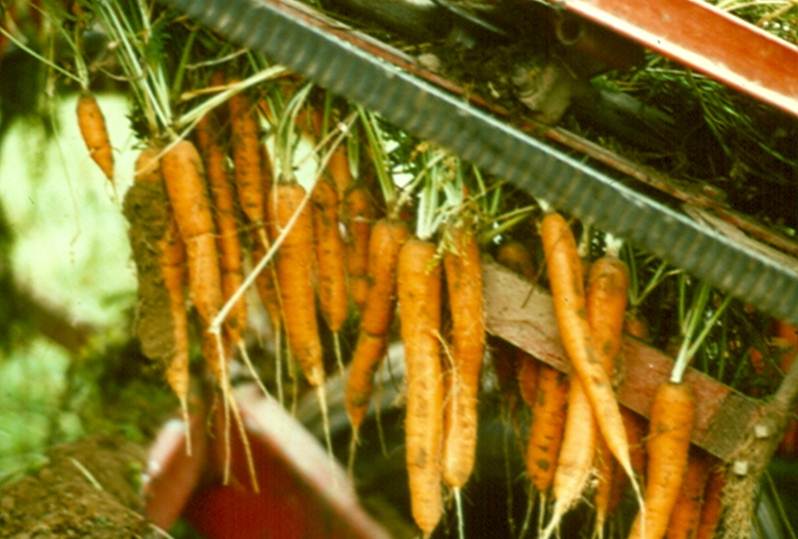
Carrots are Unharvestable Without Fungicide Use

Unharvestable Carrots

Harvesting Carrots

Alternaria leaf blight is the most common foliar disease of carrot. Under optimal conditions, severe foliar epidemics rapidly develop, leading to loss of foliage and reduced yields. Alternaria also indirectly reduces yields by interfering with mechanical carrot harvests. Leaves weakened by blight break off when gripped by a mechanical harvester and the roots are left behind in the ground.

“Because high humidity and frequent rainfall or irrigation is common during the growing season, yield-threatening foliar blights are a recurring problem for carrots. …Michigan growers harvest carrots mechanically and weakened foliage can disrupt harvest due to carrot tops breaking off during lifting. In situations where foliar disease is severe and not controlled, the tops may be compromised to the extent that the crop cannot be harvested. Therefore, fungicides currently play a critical role in the management of foliar diseases.”

Author: Hausbeck, M.K.
Affiliation: Michigan State University, Department of Plant Pathology
Title: Carrot Disease Update
Source: Carrot Country. 2012. Summer:6-8.

Soybean Rust Stopped in its Tracks

soybean rust

Soybean Rust Pustules

Asian soybean rust (ASR) was first detected in the continental U.S. in 2004 in Louisiana. Before the discovery in the U.S., the yield losses caused by ASR in many parts of the world were devastating. In South America, especially in Brazil, yield losses ranged from 10 to 80%. Funding was made available for a network of ASR sentinel plots that would serve as an early-warning system for the presence of the disease. Sentinel plots are planted two to three weeks earlier than commercial fields. If ASR is found in a sentinel plot, this is a signal to scout surrounding fields. The growth difference in sentinel and commercial fields allows growers and farm advisors time to make decisions. If conditions are optimal for the rapid spread of ASR (warm and humid), the solution is treatment with fungicides.

“Soybeans and wheat made an awesome economic combination for growers in the Southeast this year, creating plenty of optimism for profits from this year’s beans and optimism for planting more of the crop in 2013.

Even the earliest appearance on record of Asian Soybean Rust did little to slow down what is shaping up to be one of the best soybean crops on record in some parts of the Upper Southeast.

Rust was detected along a southern tier of North Carolina counties on Sept. 12, but Mother Nature, a well-coordinated system of sentinel plots, and timely actions by growers stopped rust in its tracks.

Though the disease was documented on Sept. 12, in North Carolina, the earliest on record by three days, it appears there will be little damage to the state’s 1.65 million acre soybean crop.

Duplin County, N.C., Extension Agent Curtis Fountain says once the disease was detected in counties less than 100 miles from his county, growers quickly reacted and applied fungicides when needed.

North Carolina State University Plant Pathologist Steve Koenning and Soybean Specialist Jim Dunphy issued timely updates on movement of the disease and provided virtually day-to-day observations on when and what to spray to best manage ASR.”

Author: Roberson, R.
Affiliation: Farm Press, Editorial Staff
Title: Rapid Grower Response, Weather Stop Early Soybean Rust Outbreak
Publication: Southeast Farm Press, December 5, 2012.

Europe’s Wheat Yields Are the World’s Highest Due to Fungicide Use

Septoria leaf blotch

Septoria leaf blotch

In the EU, where high levels of subsidy supports are available, wheat crops are grown in an intensive manner. In Europe, 11% of the world cereal production comes from only 6% of the world’s cereal acreage. Since the 1990s, more than 95%of wheat acres in the UK, France, Germany, Denmark, Belgium, and the Netherlands have been treated with fungicides. Average responses to treatment usually range between 0.5t/ha and 2.5 t/ha though where Septoria tritica blotch pressure is particularly high, yield responses of 5 t/ha are sometimes seen.

Article 01:

“Mycosphaerella graminicola is the causal agent of Septoria leaf blotch (SLB), an important foliar disease of wheat in Europe. Due to a lack of durable host resistance, disease control relies predominantly on the use of fungicides.”

Article 02:

“Yields of cereal crops in Europe are among the highest in the world and the levels and consistency of these yields is in no small part due to the use of fungicides to control the major fungal pathogens.”

Article 01:

Author: Bean, T. P.
Affiliation: Rothamsted Research
Title: Amino Acid Alterations in CYP51 Contribute Toward Reduced Triazole Sensitivities in a UK Field Population of Mycosphaerella graminicola
Publication: The BCPC International Congress – Crop Science & Technology 2005

Article 02:

Author: Redbond, A.
Affiliation: Market Scope Europe Ltd
Title: Cereal Disease Control in Europe
Publication:  International Pest Control, September/October 2006

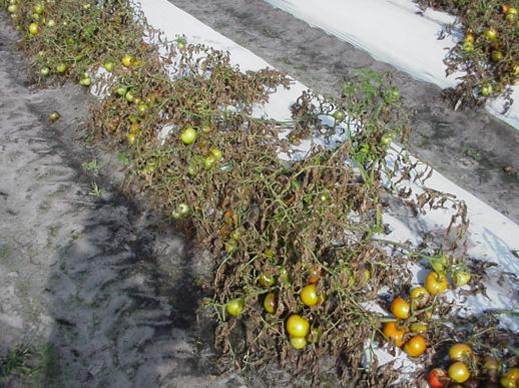
A Late Blight Pandemic Struck Northeast Tomatoes in 2009

Untreated Tomatoes

Untreated Tomatoes

Treated Tomatoes

Treated Tomatoes

The late blight fungus attacks all aboveground parts of the tomato plant. Infected foliage becomes brown, shrivels and soon dies. When severe, all plants in a field may be killed in a week or two. The spores can be disseminated up to 30 or 40 miles by wind or over short distances by dew and rain. Each spore may swim in a film of water on plant surfaces to initiate a new infection. A recent article summarizes the effects of a severe late blight outbreak in the U. S…

“Indeed, the tomato late blight pandemic of 2009 made late blight into a household term in much of eastern USA. Many home gardeners and many organic producers lost most, if not all, of their tomato crop. Some CSAs (Community Supported Agriculture) could not provide tomatoes to their members. …This pandemic was unusual. It started synchronously in mid to late June over much of the northeastern USA. The pathway was via infected tomato transplants shipped to the garden centers in large retail stores throughout the Northeast. …Many homeowners and organic growers lost crops when fungicide was not applied soon enough, and because they lacked highly effective curative fungicide options. (Conventional commercial growers, who have more fungicide options, were more successful in delaying the epidemic and subsequent yield loss.) …Later in the year other issues arose. Consumers were alarmed to see fungicide residues on tomatoes at farmers markets, especially on organically produced fruit. (Some copper-based fungicides are allowed in organic production in some states.)”

Authors: W. E. Fry, et al.
Affiliations: Cornell University
Title: The 2009 Late Blight Pandemic in Eastern USA.
Publication: APSnet Features. 2012. http://www.apsnet.org/publications/apsnetfeatures/Pages/2009LateBlight.aspx

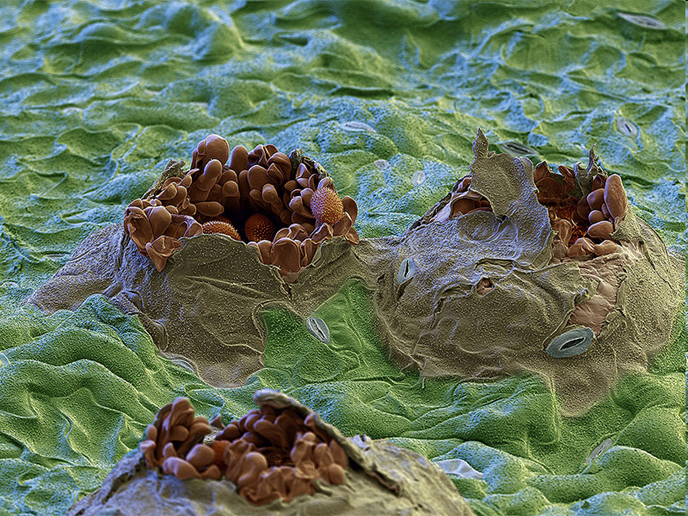
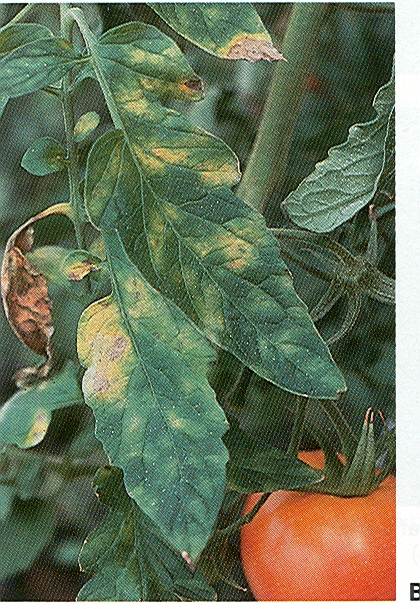
Mildew Causes Sunburned Tomatoes

Mildew on tomato leaves

Mildew on tomato leaves

Powdery mildew on tomatoes is restricted to warm, arid and semiarid climatic regions. A fine talcum-like powder growth develops on the leaves resulting in the loss of 30-40% of the leaf canopy. Defoliation predisposes fruit to sunscald and reduced quality. The tomatoes become soft or are burned before they reach maturity.

“Powdery mildew is a serious economic problem in Mediterranean tomato production. The disease is currently controlled by fungicides (especially sulfur) in both conventional and organic production. In addition to causing reductions in yield and quality, it may make plants vulnerable to secondary infections by other fungal pathogens (e.g., Botrytis cinerea). Fungicides are used to control tomato powdery mildew, even in organic production, where sulfur fungicides are permitted and widely used.”

Authors: N. G. Dafermos, et al.
Affiliation: School of Agricultural Technology, Technological Educational Institure of Crete, Heraklion-Crete, Greece.
Title: Integration of Elicitors and Less-Susceptible Hybrids for the Control of Powdery Mildew in Organic Tomato Crops.
Publication: Plant Disease. 2012. 96(10):1506-1512.

Fungal Growth on Sugarbeet Leaves Would Lower U.S. Sugar Production

Fungicide Treatment (Left: Treated - Right: Untreated)

Fungicide Treatment (Left: Treated – Right: Untreated)

The Red River Valley in North Dakota and Minnesota is a major sugarbeet production area. About ½ of U.S. sugar comes from sugarbeets. A disease on the leaves damages the plant’s ability to produce extractable sucrose in the roots. Fungicides kill the fungus before the damage is done to the plants.

“Cercospora leaf spot is the most economically damaging foliar disease of sugarbeet in Minnesota and North Dakota. The disease reduces root yield and sucrose concentration, and increases impurity concentrations resulting in reduced extractable sucrose and higher processing losses.”

“It is difficult to combine high levels of Cercospora leaf spot resistance with high recoverable sucrose in sugarbeet. Consequently, commercial varieties generally have only moderate levels of resistance and require fungicide applications to obtain acceptable levels of protection against Cercospora leaf spot under moderate and high disease severity.”

Authors: M.F.R. Khan1 and A.L. Carlson2
Affiliation:
1North Dakota State University & University of Minnesota; 2Plant Pathology Department, North Dakota State University
Title: Efficacy of fungicides for controlling Cercospora leaf spot on sugarbeet.
Publication: Sugarbeet Research & Education Board of Minnesota and North Dakota. 2011 Research report available at: http://www.sbreb.org/Research/research.htm.

Growing Berries in Germany Requires Fungicides to Prevent Mold

Gray Mold

Gray Mold

The German population has access to high quality strawberries, blueberries and raspberries that are grown in the country every year. However, the climate in Germany is conducive for the growth of mold in the berry fields making fungicide use necessary.

“Small-fruit production is an important component of Northern German agriculture, covering some 4,000 ha of strawberry, 100 ha of raspberry, and 1,500 ha of highbush blueberry as well as smaller acreages of redcurrant, gooseberry, and blackberry. Under the cool and humid regional climatic conditions, several fungicide treatments at bloom are essential in order to control phytopathogenic fungi, notably the gray mold pathogen Botrytis cinerea.”

Author: R.W.S. Weber
Affiliation: Esteburg Fruit Research and Advisory Center, Jork, Germany
Title: Resistance of Botrytis cinerea to multiple fungicides in Northern German small-fruit production.
Publication: Plant Disease. 2011. 95(10):1263-1269.