Research Backs Up India’s Herbicide Boom

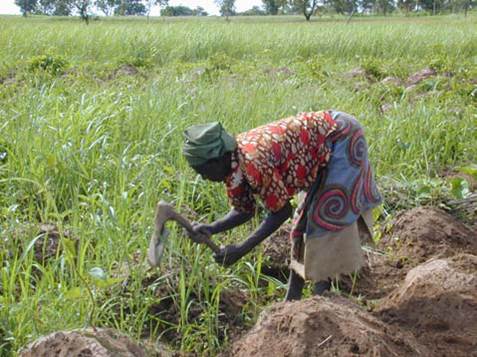
Handweeding Rice In India

Handweeding Rice In India

The India herbicide market is experiencing a growth spurt of epic proportions- growing by 35% in 2012. The increased use of herbicides in India is being spurred on by the lack of labor for hand weeding. The younger generation is losing interest in farming due to the availability of higher paying jobs in the fast growing industrial, business and construction sectors. Research by Indian agronomists backs up the positive contribution that herbicides make in terms of labor use, yield and profits.

“The objective of this study was to compare the profitability of farms that are using herbicides as one of their control measures and otherwise… For farms using herbicides, the analysis showed that labour usage was about 43, 33 and 80 hours lower in paddy rice, maize and sugarcane crops, respectively. Yields in farms using herbicides were also higher by about nine quintals in paddy rice, four quintals in maize and 100 quintals in sugarcane. Profits were also higher where herbicides were applied. It was concluded that application of herbicides to control weeds in paddy rice, maize and sugarcane is an efficient way of weed control in terms of labour use, yield and profits.”

Authors: Govindarajan, K., et al.
Affiliation: Tamil Nadu Agricultural University
Title: Impact analysis of integrated weed management under irrigated eco-systems in cultivation of tropical crops in Tamil Nadu, Southern India.
Source: 2nd International Conference on Novel and sustainable weed management in arid and semi-arid agro-ecosystems. September 7-10, 2009. Agricultural University of Athens

Trees Grown for the Wood Industry Benefit from Herbicides, So Does the Environment

Pare tree

Herbicide Strip to Establish Pine Trees

Loblolly pine is the most important and widely cultivated timber species in the southern United States. Because it grows rapidly on a wide range of sites, it is extensively planted for lumber and pulpwood. Loblolly pines are planted and managed for their fast growth rates. Unmanaged loblolly pine stands can take up to 50 years to mature into sawtimber-size trees. Managed stands can generate sawtimber-size trees much faster, often within 25 to 40 years. During the past twenty years, study after study has reported large gains in growth due to control of competing vegetation (weeds) in pine plantations in the southeast. Herbicides do a great job of getting the trees off quickly while alternatives for controlling weeds (burning, cultivation) have fallen from favor.

“The United States harvests approximately 708,000,000 m3 of wood annually, the highest rate of timber removal of any nation. …The 13 southeastern states (collectively referred to as the South) sustainably produce 60% of the forest products in the United States, more timber products than any other country (outside the United States) in the world.

One crucial component of intensive silviculture is the use of herbicides to control competing vegetation. Herbicides are applied to an estimated 2.0 million acres annually in the South, primarily associated with loblolly pine plantation establishment and stand management. Prescribed burning for vegetation control has declined during the past 2 decades, primarily due to concerns about liability from fire escapes and smoke management. Mechanical site preparation has also declined as more existing plantations and fewer naturally regenerated forests are harvested and replanted. Mechanical site preparation can also cause accelerated erosion losses. Replacing mechanical site preparation practices with herbicide applications lowers the potential for sediment and nutrient pollution of surface waters.”

Authors: McBroom, M. W., et al.
Affiliation: Austin State University
Title: Runoff of silvicultural herbicides applied using best management practices.
Source: Forest Science. 2013. 59(2):197-210.

African Farmers Need More Time to Manage Crops: Herbicides Provide the Solution

Woman in labor

African Farmer Weeding

African farmers are constrained in the amount of time that they have available to improve their farming operations due to the inordinate amount of time required to hand weed their fields. About 50% of their time is taken up with hand weeding. Other opportunities ( such as planting a cash crop) are neglected. The use of herbicides to kill weeds in African crop fields would significantly free up time for farmers to improve their farms.

“The use of herbicides as a weed control strategy under under conservation agriculture (CA) in Zimbabwe was tested in two consecutive cropping season in 2009-10 and 2010-11… The use of herbicides in conservation agriculture systems can be recommended in most farming circumstances; it controls weed species that are difficult to manage, reduces the weeding time for farmers and is seen as a viable option even for smallholder farmers in Zimbabwe.

The results show that it is economical to use herbicides under CA because farmers save at least US$388 worth of time to be used on other off-or on-farm activities.

The time savings by using herbicides under CA can only be a benefit if farmers use this additional time meaningfully for other tasks. Farmers who choose to use herbicides are likely to have more time to commit to other farm operations such as growing vegetables in their gardens for sale, value addition to their farm products and some may also sell their labour off-farm to improve their income. The use of herbicides under CA systems reduces the labour constraints during the peak labour demand periods of the season… With improved weed management through use of herbicides, smallholder farmers can increase their yields and recover the costs of herbicides use.” 

Authors: Tarirai Muoni, et al.
Affiliation: University of Zimbabwe
Title: Weed control in conservation agriculture systems of Zimbabwe: identifying economical best strategies.
Source: Crop Protection. 2013. 53:23-28.

Large Scale Insecticide Spraying Needed to End Locust Plague in Madagascar

Birds

Locust Swarm, Madagascar

For many thousands of years, locust swarms have appeared in crop fields and farmers could only pray. Locust swarms may cover several hundred square kilometers during plagues and can contain 50 million locusts in each square kilometer. A locust plague has been building in Madagascar. Conditions for the locusts got better and better and then received a boost from a cyclone in February. The storm created ideal conditions for the locusts to breed. Without widespread spraying of insecticides, the locusts would devour most of Madagascar’s crops leading to millions of people going hungry.

“A locust control campaign has been launched by the United Nations and the Government of Madagascar to treat over 2 million hectares of infested areas in a bid to avert a food crisis that could affect some 13 million people in the island nation.

Aerial operations to identify and map out the areas requiring treatment by pesticides are expected to get underway this week, FAO said in a news release. In the meantime, ground surveys, conducted on a monthly basis since February, continue. Procurement of pesticides, vehicles and equipment for survey and control operations is also in progress. Spraying operations are expected to start in late October, after the onset of the rainy season.

An assessment mission carried out by FAO earlier this year found that rice and maize losses due to the locusts in some parts of the country vary from 40 to 70 per cent of the crop, with 100 per cent losses on certain plots. The agency estimates that losses in rice production could be up to 630,000 tonnes, or about 25 per cent of total demand for rice in Madagascar. Rice is the main staple in the country, where 80 per cent of the population lives on less than a dollar per day.”

Author: UN News Centre
Affiliation: The United Nations
Title: UN and Madagascar launch locust control campaign to avert food crisis
Source: UN News Centre. September 23, 2013. Available at: http://www.un.org/apps/news/story.asp?NewsID=45936&Cr=food+crisis&Cr1=#.UkXB06PD_IU

Fly Eggs in Fruit? Insecticides Are the Only Option

bugz

Serrated Egg Layer Drosophila

berries

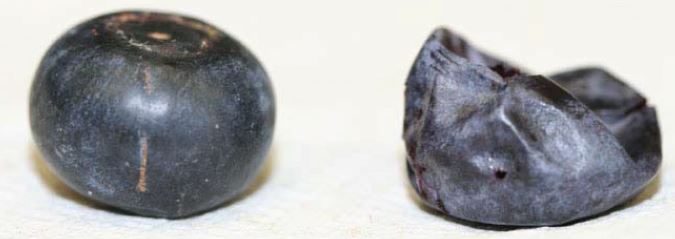
Blueberries: Drosophila Infestation (Right)

The invasive spotted wing drosophila fly came into the US from Asia in 2008 and has spread throughout the US. The fly prefers softer, sweeter ripe fruit- cherries, raspberries, blueberries,blackberries and strawberries. The female flies use saw-like blades on their abdomens to cut through the skin of ripe fruit and lay their eggs inside. The eggs hatch into worms that feed on the flesh of the fruit – ruining the fruit for sale. Insecticides are currently the only option for drosophila control and growers throughout the US are being advised to spray.

“The spotted wing drosophila, a tiny fly that can take a big bite of orchards and gardens, has gradually been making its way across the country from the West Coast and has discovered the summer bounty in the Granite State is much to its liking, according to Dr. Alan Eaton, an entomologist with the University of New Hampshire.

If the flies show up around the time the fruit ripens, the farmers have to immediately spray to kill them off, Eaton said. There are both standard and organic remedies available, he said, but spraying is vital to saving crops. “We’ve had a few growers who weren’t listening to us and their entire crops were wiped out,” said Eaton.”

Author: Nancy Bean Foster
Affiliation: Union Leader Correspondent
Title: Fruit farmers on guard for new pest
Source: Union Leader. August 26, 2013. Available at: http://www.unionleader.com/article/20130827/NEWHAMPSHIRE07/130829419?dm_i=1ANQ,1T79M,6LPYOS,6H5RF,1

A Voracious Noisy-Eater, the Red Palm Weevil Meets its Match in Saudi Arabia

Thumb Sized Grubs

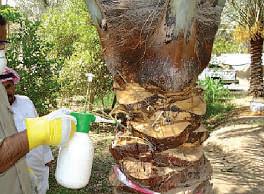
Insecticide Injection For Weevil Control

About 2.2 million tons of dates are produced in the Gulf region of the Middle East. The red palm weevil is a lethal pest of date palm trees –infested palms often die if not detected early and treated with insecticides. The thumb-sized grubs make so much noise eating that if you stand next to an infested tree, you can actually hear them munching their way through the trunk. Management depends on detecting the weevils in traps and injecting a chemical insecticide into the tree. An aggressive trapping and treatment program in Saudi Arabia has greatly reduced the problem.

“Red palm weevil is a native to south and southeast Asia where it is a notorious pest of coconut palms… Subsequent movement of infested plant material introduced this pest into Saudi Arabia in 1987 where it presented a significant threat to this country’s multi-million dollar date industry.

R. ferrugineus induced palm mortality results from internal feeding by weevil larvae and to a lesser extent, adults… This internal feeding, when severe enough, can weaken the trunk causing the collapse and premature death of P. dactylifera.

R. ferrugineus infestations of date palms in Al Ghowaybah increased significantly in 2009. In response to this outbreak, the Directorate of Agriculture in Al Ahsaa increased areawide treatments against R. ferrugineus on three different fronts: (1) the number of pheromone traps throughout the 1140 ha management area was increased 11 fold… (2) the number of date palms treated with pesticides increased 48 fold from 11,000 palms in 2008 to 531,590 in 2009, and (3) eradication of R. ferrugineus infested palms increased three fold from 2008 (1026 infested palms removed and destroyed) to 2009 (3097 date palms eradicated). These enhanced management practices in Al Ghowaybah had a rapid effect on R. ferrungineus populations as determined by the average number of weevils captured monthly in pheromone bucket traps and the monthly percentage of traps with weevils. In 2009, prior to the Oct. increase in pheromone trap numbers, ~5 adult weevils were captured per trap per week, compared to an average of 1.6 weevils per trap for 2012, which represents an ~68% decrease in the average number of weevils captured per trap.

It is likely that intensive R. ferrugineus management practices in Al Ghowaybah will need to be sustained at this current high level as long as new plantations are being developed and the majority of dates are <20 yr old, an age susceptible to attack.”

Authors: Hoddle, M. S., et al.
Affiliation: University of California
Title: Assessing the impact of areawide pheromone trapping, pesticide applications, and eradication of infested date palms for Rhynchophorus ferrugineus (Coleoptera: Curculionidae) management in Al Ghowaybah, Saudi Arabia.
Source: Crop Protection. 2013. 53:152-160.

Soggy Weather in the Southeast Leads to doubling of Fungicide sprays on Pecan Trees

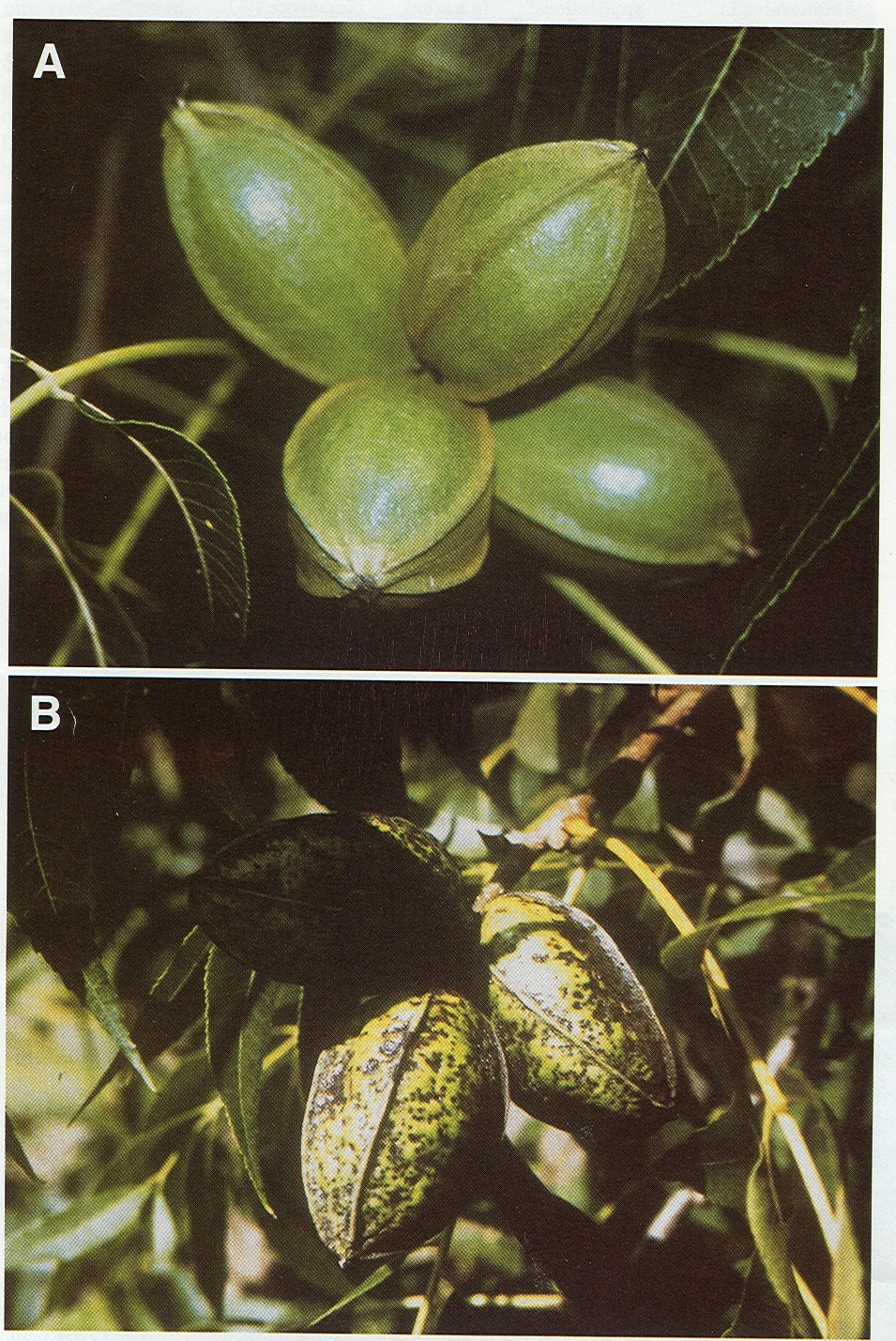
Top: Fungicide Treated Bottom: Scab Infected

Top: Fungicide Treated
Bottom: Scab Infected

Pecan scab is the most significant disease affecting pecan trees in the US. The scab fungus survives the winter in masses of cells in twigs. During the spring, spores are abundantly produced and infection occurs during periods when rains are frequent. In the absence of spray programs, pecan nut losses approaching 100% can occur. 2013 was a very wet year in the Southeast where most pecans are grown.

“The last time Tom Stevenson remembers pecan disease being as bad as this year was in 1994, when a tropical storm stalled over south Georgia and dumped record rainfall in 24 hours – deadly flooding followed it.

Though not deadly, record soggy weather dominated the Southeast in many areas this summer. It left pecan orchards vulnerable for a big attack from the crop’s No. 1 enemy. The fungal disease scab scars husks, cuts yield and hurts quality.

“We’ve had some wet years before, but not like it has been this summer where it has rained all summer long,” said Stevenson, a south Georgia-based pecan orchard manager.

This year, he said, to try and stay ahead of the disease, his orchards got 16 or 17 fungicide sprays, or twice as much as in a normal year, costing $600 per acre this year for fungicide applications. Again, that cost is double what it is typically.

Scab claimed about 20 percent of the crop in 2003.

But unlike 2003, though, growers have more products and better practices to fight scab, even in bad years, Wells said. And, most importantly, growers have a bigger incentive to fight the disease to max out yields. “A lot of it now is nuts are worth more and growers are more willing to spend money on them,” he said.

The U.S. pecan industry has hit a boom in recent years with exports to China now vying for near half of the U.S. production each year. Where once prices fell into a production-driven boom or bust cycle, steady high prices, or $2 to $2.50 per pound, have put orchard management on the front burner for established growers and those looking to expand in it.

Pecan growers have good chemistries to fight scab with several modes of action, including strobilurin, triazole, triphenyltin hydroxide, organotin. Plus, an old tried-and-true chemistry called dodine is once again working on scab in Georgia, where growers stopped using it many years ago because it had lost some effect on the disease. But it seems to be working again, especially in combination with the other chemistries.”

Author: Brad Haire
Affiliation: Southeast Farm Press
Title: Pecan disease worst in recent memory
Source: Southeast Farm Press. September 5, 2013. Available at: http://southeastfarmpress.com/orchard-crops/pecan-disease-worst-recent-memory

Fetzer Gives Up Organic Certification to Save the Vineyard

Lake County

Ceago Vineyard

Ceago Vinegarden is owned by Jim Fetzer, former President of Fetzer vineyards. The Fetzer family built their business into an internationally-respected winery. When the Fetzer family sold the winery in 1992, Fetzer vineyard was producing 2.5 million cases of wine annually. In 1993, Jim Fetzer established Ceago Vinegarden which produces about 6000 cases of wine and has been certified as an organic producer since 2003.All was well at this beautiful vineyard until 2013 when a new pest invaded and Fetzer had to choose between keeping the organic certification or preserving the grapevines.

“Fetzer owns Ceago Vinegarden near Nice, California.

His 49-acre vineyard is situated at an elevation of 1,400 feet in a protected area along the shores of Clear Lake, where the landscape sports some palm and citrus trees.

Fatzer’s vineyard earned organic and biodynamic certification in 2003. This year, however, he lost both certifications. He was unable to control an infestation of the Virginia creeper leafhopper, a recent arrival in the North Coast area, using a soft-chemistry material that he’s used successfully to control the western grape leafhopper.

The leaf-feeding Virginia creeper leafhopper is also called the zigzag leafhopper because of markings on its back.

“It’s very vicious and sucks all the chlorophyll out of the leaves,” Fetzer says.

Even as many as four applications of the insecticide this season would not have controlled the Virginia creeper leafhopper, Fetzer says. So, he switched to Montana, an imidacloprid that is not approved for organic or biodynamic production. He treated his vineyard one time with the product, at a cost in material of $18 per acre. That was in mid-June after all the eggs had hatched so that he could target the adults.

“We had no choice,” Fetzer says. “Otherwise, we would have ended up at the end of the year with little chlorophyll in the leaves and difficulty getting the fruit to ripen. We lost our certification. But the synthetic product did a really good job and saved our vines.””

Author: Greg Northcutt
Affiliation: Journalist
Title: Pest outbreak mars good wine grape season
Source: Western Farm Press. August 28, 2013. Available at: http://westernfarmpress.com/grapes/pest-outbreak-mars-good-wine-grape-season

Quick Profits from Organic Sugar: Deforestation is the Way

Paraguay

Organic Sugar Mill, Paraguay

Most organic sugar used in US foods comes from sugarcane crops grown in Paraguay. When converting an existing field to organic, a company needs to wait three years since the last pesticide spray was made before being certified as organic. With a desire for large profits, sugar companies are clearing forests so that sugarcane fields can be immediately certified as organic.

“The Ybytymi hills of eastern Paraguay are crowded with mango trees, palms, and gnarled cacti.

It’s one of the most biodiverse areas in the world, home to jaguars, tapirs, a plethora of reptiles and amphibians, and more than 500 species of birds.

In a remote area known as Isla Alta, the forest abruptly halts at the edge of sugar fields. The land belongs to a company called Azucarera Paraguaya (AZPA), one of the country’s chief sugar producers and the supplier of nearly one-third of the organic sugar consumed in the United States. If you’ve ever eaten a bowl of Cascadian Farm breakfast cereal or had a glass of Silk soy milk, you’ve probably enjoyed some of its harvest.

Organic producers have little incentive not to clear land, says Laura Raynolds, codirector of the Center for Fair and Alternative Trade Studies at Colorado State University.

This dynamic was evident when I visited Paraguay, where AZPA has been looking for additional land to grow more organic cane to feed the American market. Converting its conventionally farmed fields to organic would take three years, during which it would have to use more expensive organic methods on “transitional” crops that must be sold at the lower conventional price. A more attractive approach is to establish new fields where forest once grew; then, the cane can fetch the higher organic price from the first harvest.”

Author: Rogers, H.
Affiliation: Journalist.
Title: Sweet & lowdown organic
Source: Mother Jones. May/June 2010. Pgs. 58-59, 79.

EU Subsidies Lead to Increased Pesticide Use in Poland

Crop Protection Product Sales

Pesticide Sales, Poland (million $)

In 2003 Poland voted to join the European Union (EU). However, Polish farmers were concerned that they would not be able to compete with other EU member countries. Polish agriculture benefitted from over €10billion from the EU and Polish budgets. As a result, farmers had more funds to buy pesticides and accession to the EU influenced an upward trend in pesticide use in Poland.

“Since EU accession an increase in plant protection products consumption has been observed in Poland. According to Eurostat, in 2003 (before accession) the average use of active substances in Poland amounted to 0.8 kg AS/ha. In 2011…the average use of active substances of plant protection products in Poland amounted to 1.4 kg AS/ha.

The reason for the increasing demand for PPPs was probably the impact Poland’s accession to the EU has had on the agricultural sector. The rise of export to the European single market and prices for many agricultural products along with subsidies have boosted farmers’ income and profitability in agricultural production. As a result, on the one hand, farmers had more funds to buy agrochemicals, while on the other hand, they had more possibilities to sell their crops (if of suitable quality) for an attractive price. These conditions led to an increased demand for PPPs. In this manner, accession to the EU influenced the increase of PPP sales in Poland, in spite of EU policy concerning the reduction of pesticide use.”

Author: Matyjaszczyk, E.
Affiliation: Plant Protection Institute, Poland.
Title: Plant protection in Poland on the eve of obligatory integrated pest management implementation.
Source: Pest Management Science. 2013. 69:991-995.