The Worst Fruit Pest in the World is Even Worse in South Africa

Codling Moth

Codling Moth

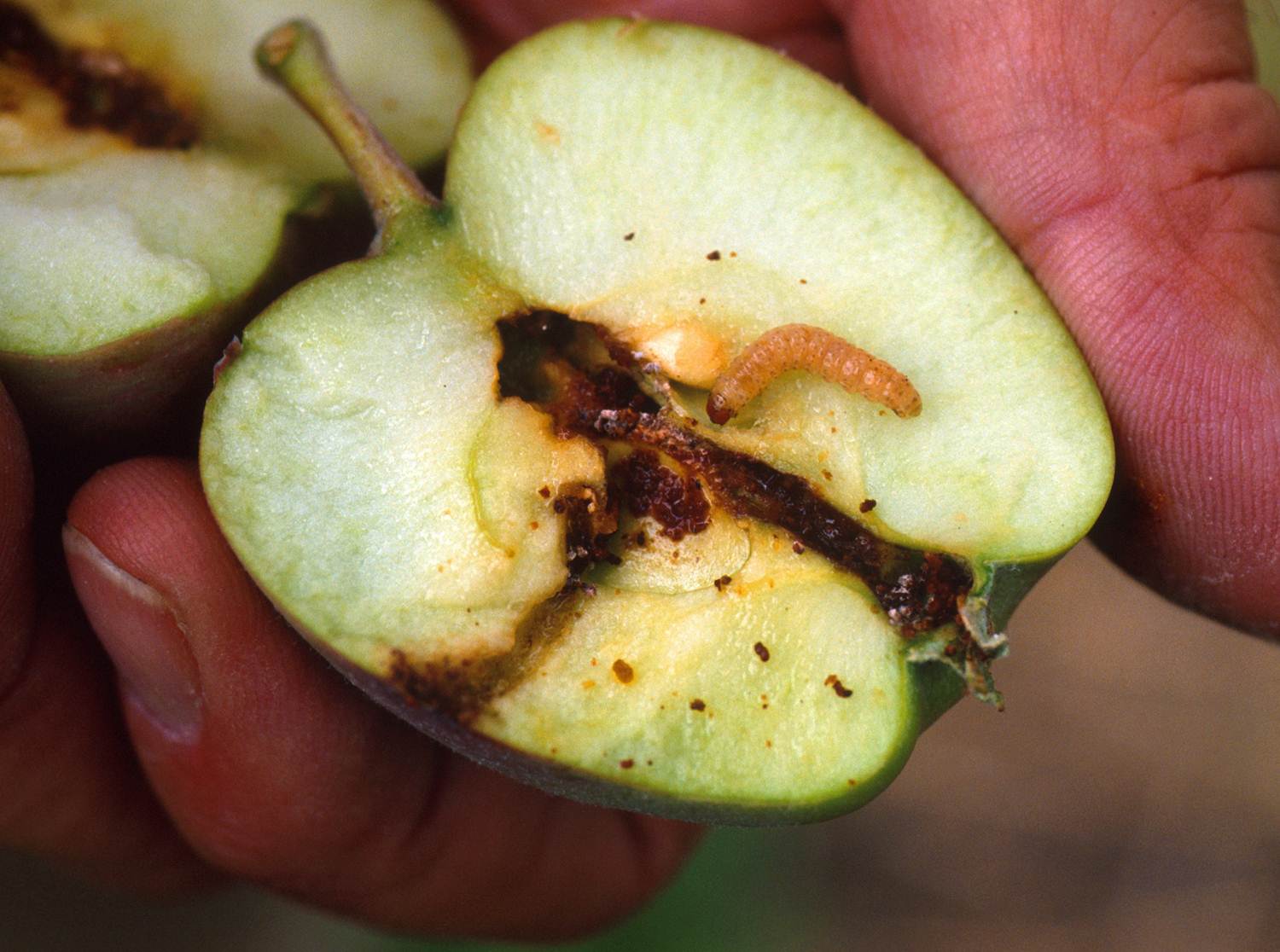
The codling moth is the most destructive insect pest of pears and apples worldwide. Females deposit eggs on or near fruit and the hatched larvae bore into the fruit and tunnel to the core. As they near development, they eat out an exit hole which they plug with frass. Fruit attacked by codling moth cannot be used for fresh shipment or for commercial canning.

“The codling moth has been the key pest in South African pome fruit orchards since the species was first reported in the country in 1885. The infestation potential of codling moth in South Africa is one of the highest in the world, and moths may be active over as much as 8 months of the year. Codling moth causes extensive damage to apples and pears, with stone fruit being only occasionally attacked. The use of insecticides remains the primary means of controlling codling moth in South African pome fruit orchards, with up to 11 different insecticides being used for control.”

Authors: A.E. Timm1, H. Geertsema1 and L. Warnich2

Affiliation:
1Department of Entomology and Center for Agriculture Biodiversity, University of Stellenbosch, South Africa; 2Department of Genetics, University of Stellenbosch, South Africa
Title: Gene flow among Cydia pomonella (Lepidoptera: Tortricidae) geographic and host populations in South Africa.

Publication: Journal of Economic Entomology. 2006. 99(2):341-348.

China Warns of Famine Without Pesticides

Over the past several decades, China has become self-sufficient in basic foods such as wheat, maize, and rice. In addition, Chinese production of many fruit and vegetable crops has soared. The widespread use of pesticides has had a key role in this vast expansion in food production and without their use…

“China would ‘undergo famine if pesticides were not used’. The warning has come in a recent Ministry of Agriculture document entitled ‘pesticide residues in agricultural products and related safety issues’, reports the national newspaper, the AgriGoods Herald.”

“China has more than 1,700 types of plant disease and insect pests, with major pest outbreaks occurring on over 400 million hectares annually. Laboratory findings released by Chinese agrochemical company Beijing Yoloo Pesticide showed that rice production would be reduced by more than two-thirds if pesticides were not used, and wheat production would be halved.”

Authors: Agrow staff writer
Headline: China warns of famine without pesticides.
Publication: Agrow. 2012. No. 642, June 20.

UK Consumers Would Need to Pay 40% More for Food…

Most cropland in the UK is treated with pesticides to prevent diseases, insects and weeds from lowering crop yields. Without the use of pesticides, crop production would fall significantly resulting in higher prices for consumers. A 2010 study estimated the impact of the lower food production on consumer costs…

“This report estimates that without plant protection products, food security in the UK, and by implication in the EU and in most countries across the world, would be severely reduced and the cost of food would rise substantially. In the UK the cost of food would rise by about 40 per cent, increasing food and drink expenditures by some £70 billion per year and raised to the level of the EU this implies additional food expenditures of some £750 billion.”

Author: Séan Rickard
Publication: The Value of Crop Protection: An Assessment of the Full Benefits for the Food Chain and Living Standards. 2010 Report from the Crop Protection Association.

Apple Production in the UK Made Viable by Pesticides

UK apple growers produce about 400 million pounds of apples per year. About 18 insecticide and fungicide sprays are made yearly to control pests including scab, mildew, aphids and codling moth. By applying a full spray program, good growers have restricted losses due to pests and diseases to very low levels, usually no more than 1-2%. Below, an economic cost-benefit study determined the likely effect on UK apple production if growers did not use pesticides…

“Apples are the most important fruit crop in the UK in terms of area of production and require relatively high levels of pesticide inputs. … If pesticides were not used, apple production would thus not be commercially viable, and the market shortfall would be made up by imports at a similar price. With a negative gross margin apple producers would leave the industry and find other uses for their land.”

Authors: J.P.G. Webster and R.G. Bowles
Affiliation: Farm Business Unit, Wye College, University of London, Kent, UK
Title: Estimating the economic costs and benefits of pesticide use in apples.
Publication: Proceedings of the Brighton Crop Protection Conference, Pests and Diseases. 1996. 4B-1:325-330.

The Consumer is Always Right and That’s Why Farmers Use Pesticides

More than 90% of US fresh produce (fruits and vegetables) is sprayed with insecticides and fungicides to prevent rots and yield loss. This spraying also assures that there are no scabs or insect-feeding marks on the produce. Although some consumers would prefer no pesticide residues, many are unwilling to accept any cosmetic damage. You can’t have it both ways—picture-perfect produce requires pesticide use.

“Over 300 shoppers entering supermarkets completed a questionnaire about purchasing certified pesticide residue-free (CPRF) fresh produce. One-half expressed concern about pesticide use on fresh produce. Two-thirds were willing to pay 5 to 10% higher prices to obtain CPRF fresh produce, but were unwilling to accept any cosmetic defects or insect damage.” 

Author: S.L. Ott
Affiliation: USDA Economics Research Service
Title: Supermarket shoppers’ pesticide concerns and willingness to purchase certified pesticide residue-free fresh produce.
Publication: Agribusiness. 1990. 6(6):593-602.

“Organic Farming Just Didn’t Work: Trees Became a Source of Pestilence”

Organic apple production in the Eastern US is very difficult because of the presence of insects and disease pests. The moist climate is perfect for mold, rots and other fungi. Recently, a couple in New Hampshire felled their organic apple trees. They explained their reasons in an article for the Concord Monitor.

“In 10 years of organic apple production we had yet to turn a profit. Additionally, the trees in our organic block were the least healthy on the farm and were a source of pestilence for our other apple trees. After harvest, the trees were cut down and will serve their last purpose: keeping us warm next winter.”

“Apple scab – which appears with the springtime rain in New England – was the toughest problem. In an organic orchard sulfur and copper are the pesticides used to combat scab. Trouble is, they wash off and are at best poor fungicides. At a recommended rate of 12 pounds per acre and their propensity to was off, I was spraying this block every time it rained, over and over again.”

“Last June we came to the realization that the organic block was not only a net financial drain on the farm but, more important, an environmental drain. I was spraying it more, using more fuel, more pounds of pesticides, more precious time, and it was serving as the source of pestilence for the rest of the farm.”

Author: Chuck Souther
Headline: Organic apple farming just didn’t work: Trees became a source of pestilence
Publication: New Hampshire Concord Monitor. 10 January 2010.

Australian Grains Council Extols Importance of Pesticides

Australia’s Grains Research & Development Corporation (GRDC) is one of the world’s leading grains research organizations, responsible for overseeing R&D that deliver improvements in production, sustainability and profitability across the Australian grains industry. Recently, draft legislation concerning regulation of agricultural and veterinary (Agvet) chemicals in Australia was circulated for comment. The Grains Council weighed in with their view on how important these chemicals are…

“The Australian grains industry is heavily dependent on the efficient use of pesticides in maintaining productivity and profitability.”

“Access to a wide range of effective, safe Agvet chemicals is crucial to maintaining the productivity, sustainability and international competitiveness of many farming systems. Australia’s biosecurity depends on access to a diversity of pesticides and a responsive regulatory system.”

Author: J. Harvey
Affiliation: Grains Research & Development Corporation
Source: Comments in relation to GRDC research delivery under the draft Agricultural and Veterinary Chemicals Legislation Amendment (Agvet) Bill. February 28, 2012

US Drought Effects Would Be Worse Without Pesticides

The current drought has received extensive media coverage. There will be no Dust Bowl this year thanks to the use of pesticides. Farmers have been using herbicides instead of tilling the soil for weed control. By not disturbing the soil, they have conserved soil moisture. Corn yields would be worse if it were not for herbicide technology, a point made in an editorial by David Bridges, President of Abraham Baldwin Agricultural College in Tifton, GA.

“The Midwest ‘flash drought’ is withering much of our 2012 corn crop. … Now is the perfect time to consider the benefits to farmers, consumers and the environment of something routinely demonized by activists – pesticides. Pesticides? Yes. Without them, things would be worse, on all ends of our current dilemma.”

“Between 1980 and 2011, corn yields here grew by 64 percent while soil loss dropped 67 percent, energy use dropped 43 percent and carbon emissions fell 36 percent. Of vital importance this year: Irrigation water use for corn dropped 53 percent in the same period.”

“Pesticides and other technologies conserve natural resources while providing a production buffer that limits the effects of natural disasters and the disruptions of unforeseen shortages.”

USA Today echoed these sentiments on August 20.

“The severe drought that has hit the Farm Belt does not immediately threaten to create another Dust Bowl or widespread crop failure, thanks to rapid innovations in the past 20 years in seed quality, planting practices and farming technology, farmers and plant scientists say. … In the past 20 years, farmers have transformed from plowing fields 8 to 11 inches deep to ‘no-till’ or ‘conservation-tillage’ practices designed to minimally disturb the ground. That exposes the soil to less wind erosion, preserves natural nutrients, and captures and retains what moisture does fall.”

Author: David Bridges
Affiliation: Agronomist and President of Abraham Baldwin Agricultural College, Tifton, GA
Headline: Drought Would Be Worse Without Pesticides
Publication: Des Moines Register, Wednesday, July 25, 2012.

Author: Chuck Raasch
Headline: Another Dust Bowl for Farm Belt Unlikely
Publication: USA Today, Monday, August 20, 2012

Residents Protest Organic Farm’s Mishandling of Pests

In September 2011, the situation in Jacumba, California got so out of hand that residents planned to protest the neighboring organic farm. Why? Eye gnats. Since Bornt & Sons Organic Farm can’t use chemical insecticides to control gnats, humans and animals in the small town of Jacumba are continually plagued with them flying around their eyes. East County Magazine reported on the issue…

The gnats serve as a vector for diseases including pink eye and summer mastitis, causing swelling and burning of the protective membrane lining the eyelids and discharge from the eyes. … Chelsea Russell, a teacher at Jacumba School, says for the past seven years, her students have suffered. …’I ask myself, do I teach in a third world country?'”

“Eye gnats are very common in warm, dry areas. They grow in light, well drained sandy soils that are freshly plowed and contain abundant organic matter. Conditions at Bornt’s farms are ideal and because the farm is organic, Bornt is limited to the types of pesticides he can use.”

As a follow up to this story, Bornt & Sons Organic Farm planned to cease operations as of June 2012. Because they have removed their non-chemical eye gnat controls in preparation to close, the eye gnat swarms have been growing in Jacumba this summer.

Title: Jacumba residents call for shut-down of organic farm over eye gnat infestation; plan protest march on Sept. 17.
Publication: East County Magazine. September 11, 2011.

Organic Cotton Discontinued in Uganda – Due to Damage to the National Economy!

Cotton is considered one of the most strategic commodities in Uganda for increasing household income, creation of employment, industrialization and poverty alleviation. In 1995 the Swedish International Development Agency began promoting organic methods of growing cotton in Uganda. The area under organic management expanded rapidly. Farmers were attracted to organic cotton because the promoters promised a premium price. Then, the reality of trying to grow cotton without chemical pesticides sunk in, shown below in remarks from a presentation by Jolly Sabune, Managing Director of the Cotton Development Organization.

  • During 2007/8, the en-mass introduction of organic caused over 68% drop in yields in the organic areas.
  • National cotton production also dropped by 50% from 134,000 bales in 2006/7 to 66,500 bales in 2007/8.
  • Organic promoters were sabotaging government efforts of increasing cotton yields by de-campaigning use of the effective conventional pesticides.
  • Following the sharp decline in production due to en-mass introduction of organic cotton, the government of Uganda decided that organic cotton promoted in the manner seen during 2007/8 was entrenching poverty rather than alleviating it and would therefore not be accepted.
  • Anyone who wants to support small-scale farmers in cotton must therefore promote conventional cotton production.

Author: Jolly Sabune
Affiliation: Cotton Development Organization
Title: Organic Cotton Production: Uganda’s Experience. Available at: http://www.icac.org/meetings/plenary/70_buenos_aires/documents/os3/os3_sabune.pdf