Fungal Colonies on Apples are not Acceptable to Consumers

Sotty Apple


Sooty blotch and flyspeck are diseases of apples which result from fungi colonizing the fruit surface without penetrating below the peel. These fungal colonies simply grow on the surface of the apple. However, consumers don’t want to purchase apples with any blemishes. As a result, numerous fungicide sprays are used to prevent the fungal colonies and meet consumer demands.

“Sooty blotch and flyspeck (SBFS) is a disease caused by a complex of saprophytic fungi that colonize the epicuticular wax layer of apple and several other fruit crops in humid production regions worldwide. In the eastern half of the continental United States, SBFS is a major problem for commercial apple growers because the dark blemishes of SBFS colonies result in downgrading fruit from fresh-market to processing use, with economic losses as high as 90%

To suppress SBFS and fruit rots, most apple growers in this region apply fungicide sprays every 1 to 2 weeks from 7 to 10 days after petal fall until shortly before harvest.”

Authors: Diaz Arias, M.M., et al.
Affiliation: Department of Plant Pathology, Iowa State University
Title: Diversity and Biogeography of Sooty Blotch and Flyspeck Fungi on Apple in the Eastern and Midwestern United States.
Source: Phytopathology. 2010. 100(4):345-355.

California Alfalfa Production Would be One Million Tons Lower with Conversion to Organic Practices

Alfalfa Weevil on Damaged Leaf

Alfalfa Weevil on Damaged Leaf

California is the #1 dairy state in the U.S. and one million acres of alfalfa are grown in the state. Alfalfa growers use herbicides to control weeds and insecticides to control key pests-the Egyptian and alfalfa weevils. Organic alfalfa growers do not have effective methods of controlling weeds and insect pests and they incur yield losses – particularly by harvesting early to avoid damage. A recent economic analysis from the University of California estimated that organic production of alfalfa is one ton less per acre which would mean a loss of one million tons of alfalfa if the entire state converted to organic practices.

“The Egyptian and alfalfa weevils are the most serious pests of alfalfa, causing yield and quality losses to the first harvest in late winter/early spring.

Most organic growers rely on early harvest to minimize weevil damage, but yields will be reduced.

The risks associated with the production of organic alfalfa hay should not be minimized. Weather and other risks are a continual concern for conventional growers, but organic growers face additional risks such as pest outbreaks that cannot be adequately controlled with organic methods.

Average annual yields in California range from 5.0 to 10 tons per acre with three to ten cuttings depending on location and alfalfa variety. Eight tons per acre over seven cuttings per year is common in the Central Valley. The crop in this study is assumed to yield 7.0 tons of hay per acre because yields of organic alfalfa are often slightly lower than conventional due to only partial control of many pests and weeds and the difficulty meeting the nutritional needs of alfalfa using solely organic sources.”

Authors: Rachael F. Long, et al.
Affiliation: US Cooperative Extension Farm Advisor, Yolo, Solano & Sacramento Counties
Title: Sample costs to establish and produce organic alfalfa hay California 2013
Source: University of California Cooperative Extension. 2013.

African Cocoa Farmers Need to Increase Fungicide Use

Black Pod

Black Pod

70% of the world’s supply of cocoa, a key crop for producing chocolate, comes from small farms in West Africa. In this hot, moist tropical environment, cocoa trees flourish but so do organisms that infect the cocoa pods causing diseases-particularly black pod disease. Fungicides are used to a limited extent by West African farmers, but they are not sprayed often enough to prevent the disease organisms from causing significant damage. As a result, African cocoa yields and farmer incomes are low. Research has shown that for optimal yields and income, West African cocoa farmers need to spray fungicides more frequently as a recent economic analysis determined…..

“Essentially fungicides were not overused – in most cases, it was shown that net returns could be increased by using more fungicide in the study area. Specifically farmers in Osun State would have to double their current use rate to optimize fungicide use while their counterparts in Ondo State would have to triple theirs to achieve the same goal.

Based on the results of this study, it is suggested that cocoa farmers increase the quantity of fungicide used per hectare as the ratio of the marginal productivity to unit cost of fungicide is greater than unity among the respondents.”

Author: A.A. Tijani
Affiliation: Department of Agricultural Economics, Obafemi Awolowo University, Nigeria
Title: Economic benefits of fungicide use among cocoa farmers in Osun and Ondo states of Nigeria
Source: J. Soc. Sci., 12(1):63-70 (2006)

Fungal Spots on Carrots are not Acceptable to Consumers

Carrot Cavity Spot

Carrot Cavity Spot

Cavity spot is a common disease of carrots grown in California. The disease results in a small fungal spot on the carrot, which can be easily trimmed away by consumers. However, this “cosmetic” defect is not acceptable to consumers. If growers do not control cavity spot in their fields by using fungicides, their carrots would have to be sorted manually to remove the damaged ones. The sorting costs are prohibitively high; fields with high levels of cavity spot are simply not harvested…… because of consumer standards.

“Out of the 62,000 acres of carrots grown in California, cavity spot is one of the top three problems that farmers need to worry about. Unlike other vegetable diseases and pests, cavity spot doesn’t cause direct yield losses. It does, however, cause cosmetic damage, which in the world of carrots, is equivalent to yield loss.
Cavity spot is a chronic problem and even growers with the best managed fields know that,” says Jim Farrar, a professor of plant pathology in the Department of Plant Science at California State University, Fresno.
Farrar, who has studied cavity spot for the past several years, along with UC Davis researchers Joe Nunez and Mike Davis, says that most growers can accept some level of cavity spot damage in their fields. But fields with even 5 percent cavity spot damage can cause a real problem.
“The cost of hand-culling carrots in the packing shed can be more than the value of whatever carrots there are to save,” Farrar says, “I’ve seen fields where growers have totally had to walk away from entire crops.”
To deal with cavity spot, most growers apply fungicides three to four times throughout the carrot growing season.”

Author: Lieberman, L.
Affiliation: Writer, Carrot Country.
Title: New Materials and Techniques for Treating Carrot Cavity Spot.
Source: Carrot Country. 2012. Fall:13-14.

It Never Rains in Southern California, But When It Does, Fungicides are Essential

Gray Mold

Gray Mold

Most of the table grape production in the U.S. is located in the San Joaquin Valley. Rainfall at harvest is uncommon. However, when it does rain, gray mold can reach epidemic proportions if fungicides are not used. Gray mold is caused by a fungus that is activated by rainfall. The fungus produces a short tube with a suction cup and a peg that forces its way through the grape cuticle. Inside the grape, the fungus grows and exudes enzymes that degrade the fruit. Cracks form in the grapes and spores are produced that spread gray mold to other grape clusters. Even a single infected fruit within a table grape package can cause severe losses.

“Timing of fungicide applications to control gray mold is primarily driven in vineyard environments by the occurrence of rainfall. Rainfall at harvest, an uncommon event in the San Joaquin Valley of California, causes abundant production of inoculum and epiphytotics of the disease in vineyards, and fungicide applications are critically needed when this rare event occurs. This area, where most of the table grape production in the United States is located, is typically rainless throughout these periods and B. cinerea seldom causes significant vineyard bunch rot, but it routinely causes substantial postharvest decay if measures to control it are not taken.”

Authors: J.L. Smilanick, et al.
Affiliation: USDA ARS
Title: Control of postharvest gray mold of table grapes in the san Joaquin valley of California by fungicides applied during the growing season
Source: Plant Disease. 94[2]:250-257. 2010.

New Fungicide Revolutionizes the California Pomegranate Industry

Untreated vs. Treated

Untreated vs. Treated

In recent years, the California pomegranate industry has grown dramatically. Pomegranates have gained high visibility with the public through a number of health benefits due to some of the fruit’s constituents in preventing cancer. The crop’s recent success was not assured until a fungicide was registered to prevent mold from developing on the fruit in storage. In fact, before the introduction of the fungicide, the pomegranate industry in California was almost destroyed by the mold problem.

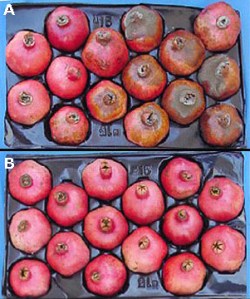
“Gray mold, caused by Botrytis cinerea, is a fungal disease that can be a serious threat to the pomegranate industry. In the 1999 and 2000 growing seasons, gray mold destroyed approximately 30% of California’s harvested pomegranates. California pomegranate packers had difficulties storing fruit for two to three weeks, let alone the goal of two to three months of storage that they needed to reach holiday markets from November to January around the world. Costs associated with repackaging, box losses, and price discounts, as well as crop rejections by retailers, almost destroyed California’s pomegranate industry.

In 2001, Scholar, a new postharvest fungicide containing the active ingredient fludioxonil, received a Section 18 emergency exemption registration for use on pomegranate in California. With this, a postharvest treatment was registered on this crop for the first time.

With these treatments, fruit losses due to gray mold were reduced substantially. Thus, in 2003, 5% of the harvested crop was lost as compared to the previous average of 30% lost in 1999 to 2002 when postharvest treatments were either not available (1999 and 2000) or were not widely  used because most packinghouses had not  installed treatment equipment (2001 and 2002). As a direct result, the crop yield (boxes per acre) in 2003 increased by 66.9% and the gross revenue increased by 61.8% as compared to the average yield and average revenue from 1999 to 2002, respectively.

Profitability to the California pomegranate industry was also regained through an extended storage life of the Scholar-treated fruit. Thus, fruit can now be stored for up to five months as compared to approximately one month before use of the fungicide. This now vastly extends the marketing potential of this fruit of passion.”

Authors: Eric C. Tedford (1), James E. Adaskaveg (2), and Alex J. Ott. (3).
Affiliations: (1) Syngenta Crop Protection. (2) Department of Plant Pathology, University of California. (3) California Grape and Tree Fruit League.
Title: Impact of Scholar (A New Post-harvest Fungicide) on the California Pomegranate Industry
Source: Plant Health Progress. February 16, 2005.
Canadian Onions for Long-Term Storage Depend on Fungicide Sprays

Late Blight Caused By Botrytis

Late Blight Caused By Botrytis

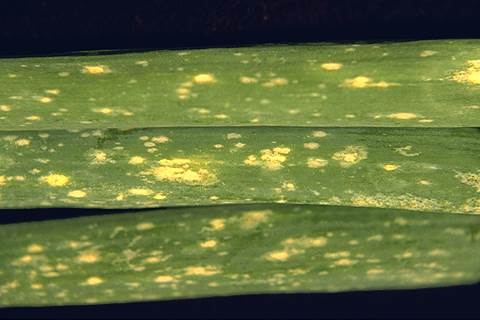
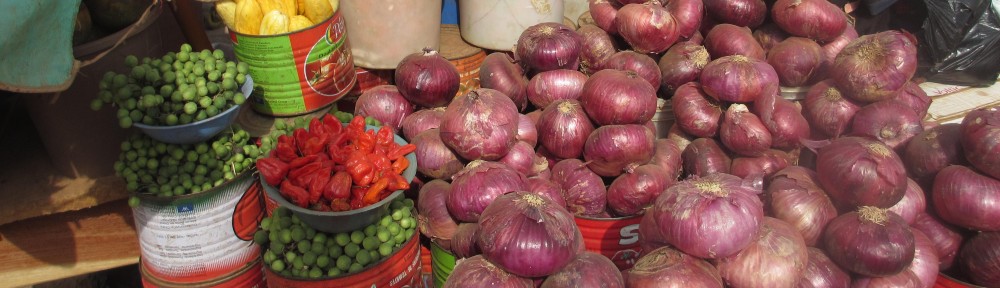
In eastern Canada, Botrytis Leaf Blight (BLB) of onions caused by the fungus Botrytis squamosa is the key disease for scheduling fungicide applications. BLB is characterized by silver halos on green leaves, followed by leaf tip dieback and leaf blighting, which reduces photosynthesis and consequently bulb size. Although there are some onion cultivars that are tolerant to the disease, they are not widely-planted in Canada because they are not suitable for long-term storage.

“There are no commercially available onion cultivars that are resistant to B. squamosa. However, a few of the early cultivars are known to be tolerant. These cultivars can produce a marketable yield under wet weather conditions and are grown on both conventional farms and organic certified farms for which there are no registered fungicides that are effective against BLB. However, these cultivars are not suitable for long-term storage; hence, they represent only a small part of the total onion acreage in northern climates. Consequently, in most onion production areas where BLB is a problem, the disease is managed through repeated applications of fungicides on a regular calendar-based schedule or following a leaf blight predictive system. Typical fungicide spray programs involve applying fungicides every seven to ten days from the four-leaf growth stage until sprout inhibitor application or 50% soft neck stage.”

Author: Herve Van der Heyden, et al
Affiliation: Compagnie de recherché Phytodata Inc. Quebec, Canada
Title: Comparison of monitoring based indicators for initiating fungicide spray programs to control Botrytis leaf blight of onion
Source: Crop Protection. March 2012. 33:21-28.

Century-Old Cotton Rot Problem Solved with New Fungicide

Root Rot

Root Rot

Cotton Root Rot is a highly destructive disease caused by a soil borne fungus in the southwestern U.S. The fungus penetrates the roots of the cotton plant and blocks the flow of water from the roots to the leaves for transpiration, causing the leaves to wilt. Plants infected early in the growing season die before bearing fruit, whereas infections occurring at later plant growth stages reduce cotton yield and quality. Cotton Root Rot has plagued the cotton industry for more than 100 years. Despite decades of research, effective methods to control the disease were lacking until recently……

“On February 2, 2012, the US Environmental Protection Agency approved a section 18 label for Texas for the fungicide Topguard (flutriafol), to control root rot of cotton (CRR) caused by the soil borne fungus, Phymatotrichopsis omnivore.

CRR is the major yield-limiting disease in many of the cotton-production areas of Texas, causing annual losses exceeding $29 million. Yield losses to individual growers vary greatly, but can range up to 100%.

CRR has been a problem of Texas cotton since the 19th century. The first experiments on control of this disease were published in 1888 and in spite of extensive research efforts since then, there has been no substantial progress, until our recent identification of flutriafol as an effective fungicide. In some of our field trials with strong disease pressure, the yield was increased by as much as 60%. The application is made as a liquid spray to the soil around the seed at planting.”

Authors: Department of Plant & Microbiology Bioenvironmental Sciences
Affiliation: Texas A&M University
Title: Breakthrough against cotton root rot
Source: http://plantpathology.tamu.edu/breakthrough-against-cotton-root-rot/

Washington Post Reporter Writes about Benefits of Fungicides

Potato Late Blight

Potato Late Blight

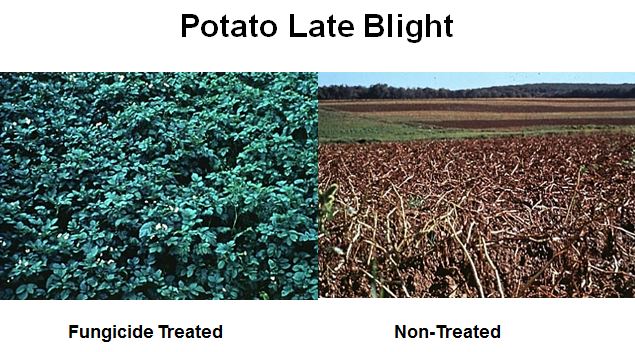
The Washington Post is not known for publishing articles describing the benefits of pesticide use. However, in a recent article about the development of a biotech potato in Ireland, a Post reporter described the current use of fungicides to control the late blight fungus. In the 1840s the Irish peasant population depended almost entirely on the potato for their diets. The late blight fungus destroyed the Irish potato crop in 1845 and 1846 and a million people died. Today, the fungus is well-controlled with regular fungicide spraying, a point made by the Post reporter…..

“The disease has become even more damaging in the past five years with the arrival of new, highly aggressive strains. Unchecked, blight can destroy entire crops in just days.

From the end of May until harvest, farmers spray fungicides every seven to 14 days, depending on the weather.

Without the sprays, the potato fields of Ireland would echo the destruction that began in 1845, when the blight took hold in Flanders and moved like wildfire to the British Isles.

More than a million died of starvation and disease, and as many as another 2 million fled to Britain, North America and other lands.”

Author: Adrian Higgins
Affiliation: Reporter
Title: Modified tuber is no small potato in Ireland
Source: The Washington Post, March 17th 2013

Emergency Fungicide Sprays to Protect Coffee Trees in Costa Rica

Rust Infection

Rust Infection

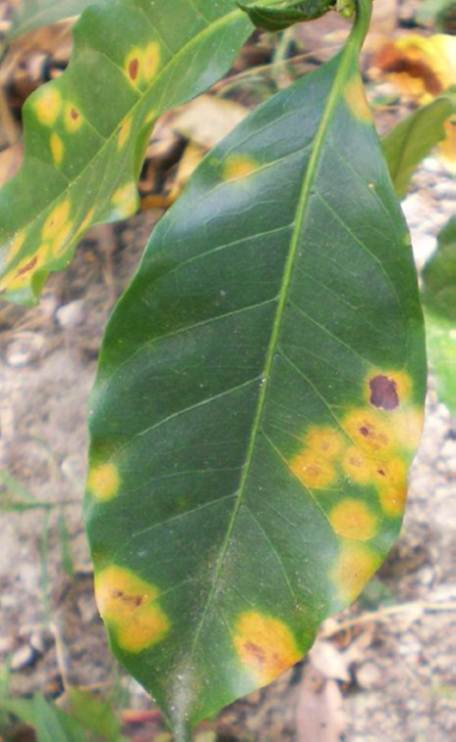
Coffee is the only known host of the fungus Hemileia vastatrix, which causes coffee rust also known as “roya”. The disease damages coffee leaves by causing the premature drop of infected leaves, which can lower yields by 50%.Coffee rust has become a greater problem for coffee growers because of climate change. Higher temperatures and increased rainfall favors rapid development of the disease.

“Costa Rica on Tuesday declared an emergency to tackle the spread of a coffee fungus that has already devastated Central American producers and looks set to destroy about 12 percent of Costa Rica’s planted coffee in the upcoming 2013/14 harvest.

A two-year emergency bill, signed jointly by Costa Rica’s Vice President Luis Liberman and the national coffee institute ICAFE, provisions about $4 million to pay for fungicides to tackle the roya, or leaf rust, outbreak.

Roya kills coffee leaves by sapping them of nutrients and lowering bean yields. The current roya pandemic has already affected other countries in Central America and Mexico, home to more than a fifth of the world’s Arabica coffee production.”

Author: Cota, I.
Affiliation: Reporter, Reuters.
Title: Costa Rica declares national emergency to tackle coffee fungus.
Source: Reuters. January 22, 2013.