Good News for Organic Apple Growers: An Insecticide that Kills the Flea Weevil

Weevil damage

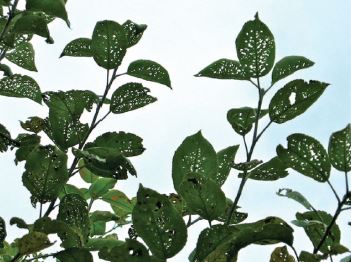
Apple Flea Weevil damage

In 2008, the apple flea weevil emerged as a serious pest in Michigan’s organic apple orchards with some growers experiencing >90% crop loss. The organic apple growers were spraying insecticides later in the season to kill major pests like the codling moth and the flea weevil emerged as an early season pest. The weevils feed on developing buds and leaves. Heavy populations cause significant defoliation of leaf tissue resulting in a lacelike pattern which leads to decreased productivity and possible tree death. Research at Michigan State University led to a solution for the organic growers- spray an insecticide…..

“Organic apple growers in the Midwest appear to have a relatively simple solution to their problems with apple flea weevil, which appeared suddenly as a problem in Michigan two years ago and took out 90 percent of the fruit in some orchards.

The best solution, entomologists say, is to spray Entrust (spinosyn) very early in the season, at green tip to pink… The apple flea weevil adult does its most serious damage by feeding on and destroying fruit buds before they have a chance to emerge in the spring.

John Pote, a graduate student at Michigan State University working with Dr. Matt Grieshop and Dr. Anne Nielsen in the organic pest management laboratory, gave the good news to organic growers during a session at the Great Lakes Fruit, Vegetable, and Farm Market Expo in Grand Rapids, Michigan, in December.

Pote noted that the weevil emerged as a problem for organic growers, who normally do not apply insecticides that early in the season, since few insects become active so early.

In conventional apple management programs, the weevil is likely incidentally controlled by insecticide applications made to kill other insects either in April—when overwintering weevils emerge—or in early July—when the summer generation emerges from leaf mines.”

Author: Lehnert, R.
Affiliation: Writer.
Title: Organic control for flea weevil.
Source: Good Fruit Grower. March 15, 2012. Available: http://www.goodfruit.com/Good-Fruit-Grower/March-15th-2012/Organic-control-for-flea-weevil/
Consumers Want Perfect Avocados: Growers Must Spray

Infected Avocados

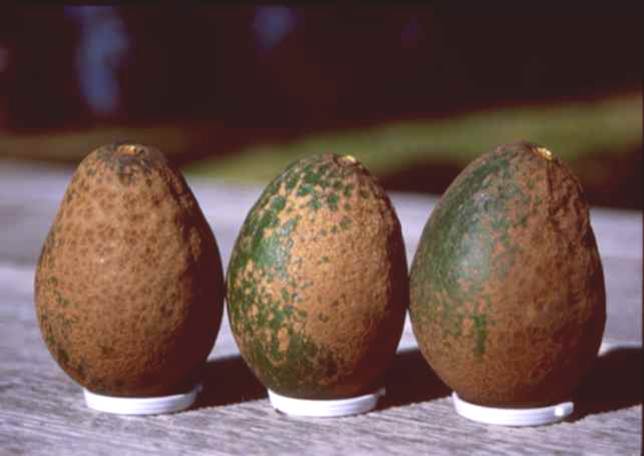
Avocado Thrip Fruit Scarring

Historically, the production of avocados in California required little usage of insecticides. Avocado pests were kept under commercially acceptable control by a variety of beneficial organisms. This situation changed in 1996 with the appearance of avocado thrips which feed on the surface of the fruit. Feeding scars develop while the flesh of the fruit is a healthy green. Even partial fruit scarring results in downgrading of fruit in packinghouses because of cosmetic damage unacceptable to consumers .

“The California avocado industry is under increasing threat from the introduction of arthropod pests. The avocado thrips, was first detected in California avocado groves in June 1996, and it has since spread to most of the major production areas within the state where it has become the primary insect pest. The main source of economic loss arises from feeding damage that causes scarring of immature fruit, leading to a reduction in fruit quality at harvest.

In California avocado groves, the use of foliar insecticides is the predominant tactic adopted by growers for the management of arthropod pests, including the avocado thrips. Aerial applications by helicopter are needed for the majority of California avocado groves because most are grown on steep hillsides.”

Author: Byrne, F. J., et al.
Affiliation: University of California
Title: Field evaluation of systemic imidacloprid for the management of avocado thrips and avocado lace bug in California avocado groves.
Source: Pest Management Science. 2010. 66:1129-1136.

Fly Eggs in Fruit? Insecticides Are the Only Option

bugz

Serrated Egg Layer Drosophila

berries

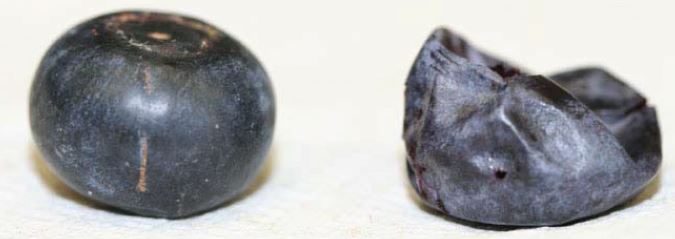
Blueberries: Drosophila Infestation (Right)

The invasive spotted wing drosophila fly came into the US from Asia in 2008 and has spread throughout the US. The fly prefers softer, sweeter ripe fruit- cherries, raspberries, blueberries,blackberries and strawberries. The female flies use saw-like blades on their abdomens to cut through the skin of ripe fruit and lay their eggs inside. The eggs hatch into worms that feed on the flesh of the fruit – ruining the fruit for sale. Insecticides are currently the only option for drosophila control and growers throughout the US are being advised to spray.

“The spotted wing drosophila, a tiny fly that can take a big bite of orchards and gardens, has gradually been making its way across the country from the West Coast and has discovered the summer bounty in the Granite State is much to its liking, according to Dr. Alan Eaton, an entomologist with the University of New Hampshire.

If the flies show up around the time the fruit ripens, the farmers have to immediately spray to kill them off, Eaton said. There are both standard and organic remedies available, he said, but spraying is vital to saving crops. “We’ve had a few growers who weren’t listening to us and their entire crops were wiped out,” said Eaton.”

Author: Nancy Bean Foster
Affiliation: Union Leader Correspondent
Title: Fruit farmers on guard for new pest
Source: Union Leader. August 26, 2013. Available at: http://www.unionleader.com/article/20130827/NEWHAMPSHIRE07/130829419?dm_i=1ANQ,1T79M,6LPYOS,6H5RF,1

Fetzer Gives Up Organic Certification to Save the Vineyard

Lake County

Ceago Vineyard

Ceago Vinegarden is owned by Jim Fetzer, former President of Fetzer vineyards. The Fetzer family built their business into an internationally-respected winery. When the Fetzer family sold the winery in 1992, Fetzer vineyard was producing 2.5 million cases of wine annually. In 1993, Jim Fetzer established Ceago Vinegarden which produces about 6000 cases of wine and has been certified as an organic producer since 2003.All was well at this beautiful vineyard until 2013 when a new pest invaded and Fetzer had to choose between keeping the organic certification or preserving the grapevines.

“Fetzer owns Ceago Vinegarden near Nice, California.

His 49-acre vineyard is situated at an elevation of 1,400 feet in a protected area along the shores of Clear Lake, where the landscape sports some palm and citrus trees.

Fatzer’s vineyard earned organic and biodynamic certification in 2003. This year, however, he lost both certifications. He was unable to control an infestation of the Virginia creeper leafhopper, a recent arrival in the North Coast area, using a soft-chemistry material that he’s used successfully to control the western grape leafhopper.

The leaf-feeding Virginia creeper leafhopper is also called the zigzag leafhopper because of markings on its back.

“It’s very vicious and sucks all the chlorophyll out of the leaves,” Fetzer says.

Even as many as four applications of the insecticide this season would not have controlled the Virginia creeper leafhopper, Fetzer says. So, he switched to Montana, an imidacloprid that is not approved for organic or biodynamic production. He treated his vineyard one time with the product, at a cost in material of $18 per acre. That was in mid-June after all the eggs had hatched so that he could target the adults.

“We had no choice,” Fetzer says. “Otherwise, we would have ended up at the end of the year with little chlorophyll in the leaves and difficulty getting the fruit to ripen. We lost our certification. But the synthetic product did a really good job and saved our vines.””

Author: Greg Northcutt
Affiliation: Journalist
Title: Pest outbreak mars good wine grape season
Source: Western Farm Press. August 28, 2013. Available at: http://westernfarmpress.com/grapes/pest-outbreak-mars-good-wine-grape-season

$17 Billion in Sales of Ornamental Plants in the US-Growers Have to Use Insecticides to Satisfy Consumers

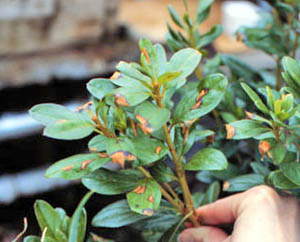
Azalea Leafminer

Azalea Leafminer

Ornamental plants are big business in the US-$17 billion in retail sales. Ornamental plants provide visual beauty and reduce the stagnation that occurs in everyday work environments. Ornamentals may have a profound effect on observers or occupants. Several studies have shown that ornamentals have a positive impact on an individual’s well-being and emotional stability and may improve productivity. When purchasing an ornamental plant, consumers demand that they be free of insects and insect damage.

“The intensive nature of production and aesthetic quality requirements of producing ornamental plants supports the necessity of using pesticides to manage arthropod pests. The use of pesticides is vitally important to the ornamental industry in order economically to prevent the multitude of arthropod pests from damaging plants and at the same time produce quality plant material that may be purchased by consumers/homeowners. Furthermore, the use of pesticides allows ornamental producers successfully to compete in national and international markets.

…a single arthropod pest can significantly damage or vector a disease, rendering a crop unmarketable. As such, ornamental producers cannot wait for arthropod pest populations to build up to a critical level, and so, in actuality, pesticides serve as an ‘insurance policy’ to manage or regulate the diversity of arthropod pests so that they do not damage ornamental crops.

The aesthetic value and the consumer demand for high-quality ornamental crops necessitates the application of pesticides in order to protect crops from the myriad of arthropod pests encountered in ornamental production systems.”

Authors: Bethke, J. A., and Cloyd, R. A.
Affiliations: University of California, and Kansas State University.
Title: Pesticide use in ornamental production: what are the benefits?
Source: Pest Management Science. 2009. 65:345-350.

Tight Market Standards For Sweet Corn Necessitate Insecticide Sprays

Bugs in corn

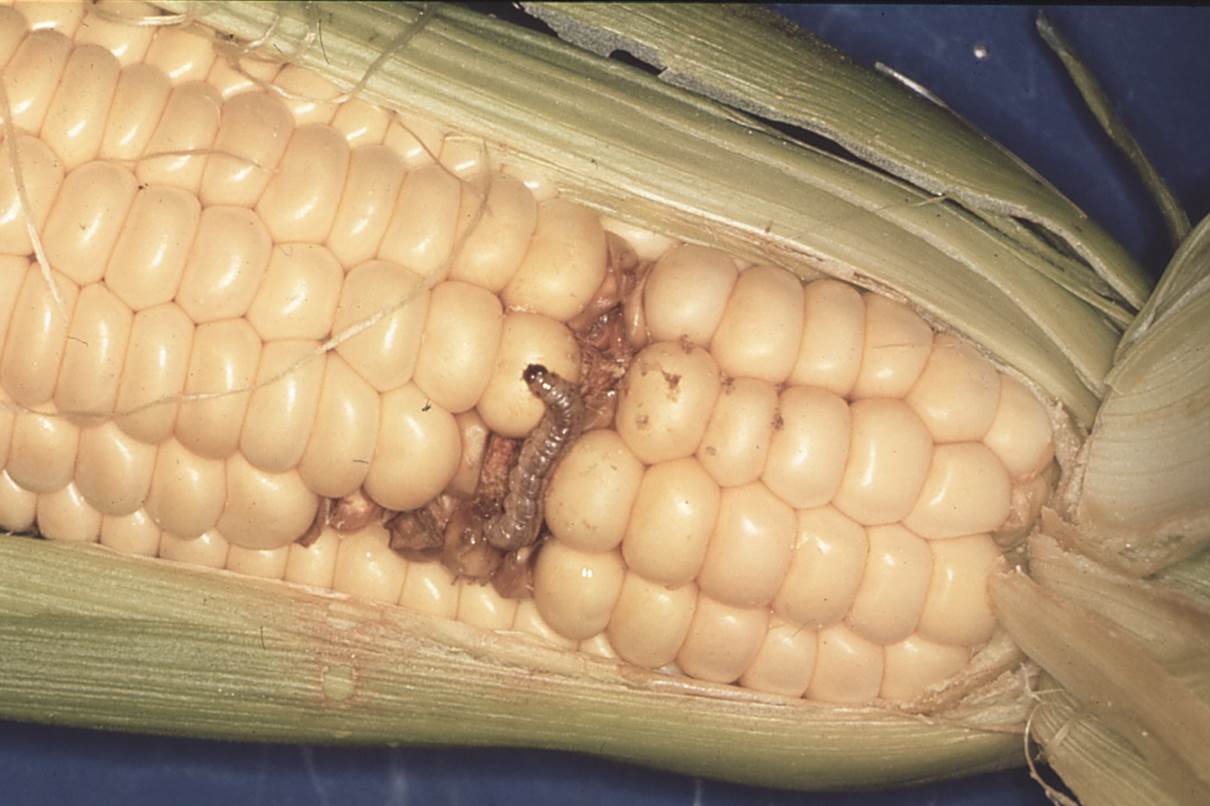
Worms in sweet corn

Consumer surveys show that the lack of insect damage is the most important factor when deciding which sweet corn to buy. Processors and stores require larval infestations to be < 5-10% of sweet corn ears. To meet those standards, sweet corn growers throughout the U.S. must use insecticides.

[1]
”Minnesota is the second largest producer of processing sweet corn, Zea mays L., in the United States with an annual production of >53,000 ha; the state also produces ≈4,000 ha for fresh market. The European corn borer, Ostrinia nubilalis (Hübner), and corn earworm, Helicoverpa zea (Boddie), continue to be the most important insect pests of sweet corn in the upper Midwest. To minimize economic risks associated with insect damage in sweet corn, most growers rely on insecticides to manage these pests.

Most processors and fresh market growers require larval infestations and brown kernel incidence to be <5-10% of harvested ears.”

[2]
”Sweet corn is the most commonly grown vegetable crop in Pennsylvania. Most is grown for fresh-market. Stringent control is required to meet market standards and most acreage (~80%) is sprayed to control corn earworm, fall armyworm, and European corn borer.”

[1]
Authors: O’Rourke, P. K., and W. D. Hutchison.
Affiliation: Department of Entomology, University of Minnesota.
Title: Binomial sequential sampling plans for late instars of European corn borer (Lepidoptera: Crambidae), corn earworm (Lepidoptera: Noctuidae), and damaged kernels in sweet corn ears.
Source: J. Econ. Entomol. 2004. 97[3]:1003-1008.

[2]
Author: Fleischer, S.
Affiliation: Department of Entomology, Penn State University.
Title: Regional patterns in corn borer and fall armyworm populations: implications for management.
Source: 58th New Jersey Agricultural Convention and Trade Show. 2013 Proceedings. February 5-7. Pgs. 118-119.

Florida is Great for Growing Sweet Corn in the Winter, Insects Love Florida in the Winter Too

Florida sweet corn, w/o insecticides

Florida sweet corn, w/o insecticides

Florida Sweet Corn Production

Florida Sweet Corn Production

Florida is the #1 state in the production of fresh sweet corn with production occurring in winter months when the crop cannot be grown in states further north. Many insect species survive the winter and thrive in Florida. 98-99% of Florida’s sweet corn would be damaged by insects if insecticide sprays were not made. The importance of insecticides for Florida sweet corn is underscored by the realization that the crop was not grown in the state until synthetic chemical insecticides were introduced in the 1940s.

[1]“Florida ranks #1 nationally in the production and value of fresh market sweet corn, typically accounting for approximately 20 percent of both national sweet corn production and of U.S. cash receipts for fresh sales. A total of 589 million pounds of fresh sweet corn, valued at $189 million, was produced on 42,100 acres in Florida during the 2009-10 season. Nearly 20 percent of sweet corn producers overall total direct expenses are invested in pesticides and pesticide application costs. Florida’s warm, humid climate is ideal for the development of pest populations. Sweet corn grown in Florida is subject to damage from numerous insect, weed, disease, and nematode pests. Pesticide use is high and the crop may be sprayed daily in some cases.”

[2]”The first commercial production of sweet corn in Florida was reported in the 1947-48 season. The establishment of sweet corn as one of the major crops produced in Florida is attributed largely to successful control of insects with the newer insecticides. “

[1]
Author: McAvoy, G.
Affiliation: Regional Vegetable Extension Agent IV, University of Florida
Title: Sweet corn production in south Florida
Source: Proceedings of the 2012 Atlantic Coast Ag Convention & Trade Show, pp 66-68

[2]
Authors: Hayslip, N. C., et al.
Affiliation: Florida Agricultural Experiment Station, Ft. Pierce
Title: Corn earworm investigations in Florida
Source: Journal of Economic Entomology. 1953. 46[4]:574-583.

Hurricanes Increase the Need for Insecticides in Louisiana Sugarcane Fields

Fire Ant Killing Sugarcane Borer

Fire Ant Killing Sugarcane Borer

Louisiana is the top producing sugarcane state accounting for 40% of the nation’s sugarcane production. Approximately 3 billion pounds of raw sugar are produced annually by Louisiana sugar mills. The sugarcane borer is the most damaging insect pest of sugarcane in Louisiana. The larvae bore into the plant where they feed on the central tissue. Borers make tunnels up and down the stalk. The size and weight of the stalks are decreased. Sugarcane borers in Louisiana are controlled by an integrated system that consists of spraying insecticides, planting varieties with some resistance and by natural enemies of the borer. The most important natural enemy of the borer is the red imported fire ant. Typically, the predation of fire ants contributes an estimated savings of two insecticide sprays. However, when the sugarcane fields are flooded by hurricanes, the fire ants are negatively affected and insecticide use has to increase.

“On 24 September 2005, Hurricane Rita made landfall on the extreme southwestern coast of Louisiana near the border with Texas as a Category 3 hurricane.

Twelve thousand to 16,000 ha of sugarcane produced in south Louisiana were flooded by saltwater from Hurricane Rita storm surge.

During spring 2006, sugarcane growers and contracted agricultural consultants began observing that flooded areas seemingly had more [sugarcane borer] infestations, which might require earlier and more frequent insecticide applications for D. saccharalis control.

This study showed that growers had to treat more (2.4-fold increase) in zones impacted by the hurricane storm surge.

S. invicta [red imported fire ant] seemed to be negatively impacted 10-12 mo after the areawide habitat disruption caused by the storm surge flooding. When plunged into freshwater, S. invicta individuals gather and form floating clusters that can drift for more than a week without drowning. However… S. invicta is susceptible to saltwater, sinking within 30 min when in 3.5% saltwater (approximately equal to seawater), and within 48 h in 1% saltwater. …Susceptibility to saltwater flood and limited dispersal abilities may explain why S. invicta was negatively impacted by the storm surge and slow to recover back to prehurricane population levels.

This study suggests that Hurricane Rita disturbed the pest management stability between beneficial and pest anthropods for the subsequent production season, requiring additional insecticide applications…”

Authors: Beuzelin, J.M., et al.
Affiliations: Department of Entomology, Louisiana Agricultural Experiment Station, Louisiana State University Agricultural Center
Title: Impacts of Hurricane Rita storm surge on sugarcane borer (Lepidoptera: Crambidae) management in Louisiana.”
Source: Journal of Economic Entomology. 2009. 102[3]:1054-1061.

The Dilemma of Insect Fragments in Processed Tomatoes

Tomato Fruitworm Damage

Tomato Fruitworm Damage

The tomato fruitworm is the most serious insect pest of tomatoes in the US, feeding on fruit and contaminating it with insect parts, excrement and decay-causing organisms. Interest in spraying insecticides to control the fruitworm was accelerated in the 1930s by the finding of insect fragments in canned products, which were seized and destroyed as adulterated foods by the FDA. Today, insecticides are used to prevent widespread insect damage to tomatoes and tomato shipments for processing are rejected if more than 2% damage is found. Therein is the dilemma. If the standard was relaxed (say to 4%), tomato growers could probably make one less insecticide spray. However, consumers may not want more insect fragments in canned tomatoes and may actually want a tighter standard which would result in more insecticide sprays.

“All loads of processing tomatoes in California are evaluated by inspectors from the Processing Tomato Advisory Board, a marketing order, under the direction of supervising inspectors from the California Department of Food and Agriculture. A load of processing tomatoes is rejected if 2% or more of the tomatoes by weight have a worm or excreta in the flesh of the tomato.

The damage tolerance acceptable to consumers and industry could be changed accordingly. Increasing the tolerance might be expected to result in a reduced number of insecticide applications when used in conjunction with a careful monitoring program.

A reduction in the tolerance might also be considered, arguing that consumers would not tolerate even the present level of insect fragments which, as our results indicate, is possible to have in the final product.”

Authors: Zalom, F. G., and A. Jones.
Affiliation: Department of Entomology, University of California, Davis
Title: insect fragments in processed tomatoes
Source: Journal of Economic Entomology. February, 1994. 87[1]:181-186.

Rice Insect Pest Invades the World from the USA

Rice Water Weevil Larva

Rice Water Weevil Larva

The home of the rice water weevil is the southeastern US where the species feeds on
grasses in swampy areas. When rice plants were introduced into America, the
insect quickly found this new grass plant to its liking and has been feeding on
rice ever since. The weevils move into rice fields every year from nearby woods
and clumps of grass. Farmers have used insecticides since 1950 to control the
weevil populations in rice fields. The rice water weevil has spread from the
southeastern US to Louisiana, Texas, California, Japan, China and Italy where
it would decrease rice production without insecticide sprays.

“The rice water weevil, Lissorhoptrus oryzophilus, is the most destructive insect pest of rice in the United States. The insect is native to the southeastern United States but has, over the past 60 years, invaded important rice-growing areas in California, Asia and Europe and thus poses a global threat to rice production.

Small-plot research and sampling of commercial fields indicate yield losses from the rice water weevil would likely exceed 10% in many areas if no insecticides are used.”

Authors: Stout, M. J., et al.
Affiliations: Department of Entomology, Louisiana State University.
Title: The influence of rice plant age on susceptibility to the rice water weevil, Lissorhoptrus oryzophilus.
Source: Journal of Applied Entomology. 2013. 137:241-248.