A floating Fungus Would Destroy Much of the World’s Rice Crop Without Fungicide Sprays

Rice Field With Sheath Blight

Rice Field With Sheath Blight

Sheath blight is a disease of rice plants which is caused by a fungus that lives in the soil. When rice fields are flooded, the fungus floats to the top of the water and contacts rice plants; the fungus grows out and moves into the rice leaf. The fungus spreads across the water to adjacent plants. The fungus grows across touching plant parts. The flow of water and nutrients in the rice plant is interrupted and the leaf dies, reducing rice yield. Development of resistant cultivars has been slow, because resistance is linked to undesirable traits such as tall plant stature, late maturity, and poor milling quality. Research has shown that a single application of a fungicide provides almost season-long control of sheath blight.

“Sheath blight of rice, caused by the fungus Rhizoctonia solani, is an economically important rice disease that is occurring throughout the rice-producing areas in the world, including the southern United States. Significant losses in grain quality and yield may occur in severely infected rice fields. Despite its economic importance, there are no completely resistant rice cultivars against this fungal rice disease and control methods for sheath blight are limited to heavy usage of fungicides.”

Authors: Shrestha, B. K., et al.
Affiliation: Louisiana State University Agricultural Center, Baton Rouge
Title: Suppression of sheath blight development in rice and sclerotia germination of Rhizoctonia solani by rice-associated strains of Bacillus spp.
Source: Phytopathology. 2013. 103(Supplement 1)(5):S1.9

Fungal Colonies on Apples are not Acceptable to Consumers

Sotty Apple


Sooty blotch and flyspeck are diseases of apples which result from fungi colonizing the fruit surface without penetrating below the peel. These fungal colonies simply grow on the surface of the apple. However, consumers don’t want to purchase apples with any blemishes. As a result, numerous fungicide sprays are used to prevent the fungal colonies and meet consumer demands.

“Sooty blotch and flyspeck (SBFS) is a disease caused by a complex of saprophytic fungi that colonize the epicuticular wax layer of apple and several other fruit crops in humid production regions worldwide. In the eastern half of the continental United States, SBFS is a major problem for commercial apple growers because the dark blemishes of SBFS colonies result in downgrading fruit from fresh-market to processing use, with economic losses as high as 90%

To suppress SBFS and fruit rots, most apple growers in this region apply fungicide sprays every 1 to 2 weeks from 7 to 10 days after petal fall until shortly before harvest.”

Authors: Diaz Arias, M.M., et al.
Affiliation: Department of Plant Pathology, Iowa State University
Title: Diversity and Biogeography of Sooty Blotch and Flyspeck Fungi on Apple in the Eastern and Midwestern United States.
Source: Phytopathology. 2010. 100(4):345-355.

Canadian Onions for Long-Term Storage Depend on Fungicide Sprays

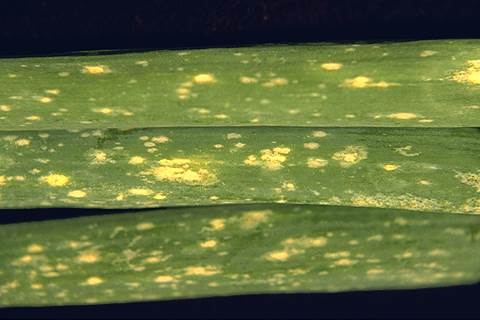
Late Blight Caused By Botrytis

Late Blight Caused By Botrytis

In eastern Canada, Botrytis Leaf Blight (BLB) of onions caused by the fungus Botrytis squamosa is the key disease for scheduling fungicide applications. BLB is characterized by silver halos on green leaves, followed by leaf tip dieback and leaf blighting, which reduces photosynthesis and consequently bulb size. Although there are some onion cultivars that are tolerant to the disease, they are not widely-planted in Canada because they are not suitable for long-term storage.

“There are no commercially available onion cultivars that are resistant to B. squamosa. However, a few of the early cultivars are known to be tolerant. These cultivars can produce a marketable yield under wet weather conditions and are grown on both conventional farms and organic certified farms for which there are no registered fungicides that are effective against BLB. However, these cultivars are not suitable for long-term storage; hence, they represent only a small part of the total onion acreage in northern climates. Consequently, in most onion production areas where BLB is a problem, the disease is managed through repeated applications of fungicides on a regular calendar-based schedule or following a leaf blight predictive system. Typical fungicide spray programs involve applying fungicides every seven to ten days from the four-leaf growth stage until sprout inhibitor application or 50% soft neck stage.”

Author: Herve Van der Heyden, et al
Affiliation: Compagnie de recherché Phytodata Inc. Quebec, Canada
Title: Comparison of monitoring based indicators for initiating fungicide spray programs to control Botrytis leaf blight of onion
Source: Crop Protection. March 2012. 33:21-28.

Washington Post Reporter Writes about Benefits of Fungicides

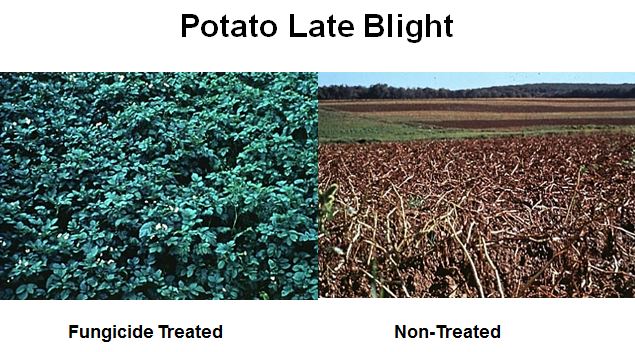
Potato Late Blight

Potato Late Blight

The Washington Post is not known for publishing articles describing the benefits of pesticide use. However, in a recent article about the development of a biotech potato in Ireland, a Post reporter described the current use of fungicides to control the late blight fungus. In the 1840s the Irish peasant population depended almost entirely on the potato for their diets. The late blight fungus destroyed the Irish potato crop in 1845 and 1846 and a million people died. Today, the fungus is well-controlled with regular fungicide spraying, a point made by the Post reporter…..

“The disease has become even more damaging in the past five years with the arrival of new, highly aggressive strains. Unchecked, blight can destroy entire crops in just days.

From the end of May until harvest, farmers spray fungicides every seven to 14 days, depending on the weather.

Without the sprays, the potato fields of Ireland would echo the destruction that began in 1845, when the blight took hold in Flanders and moved like wildfire to the British Isles.

More than a million died of starvation and disease, and as many as another 2 million fled to Britain, North America and other lands.”

Author: Adrian Higgins
Affiliation: Reporter
Title: Modified tuber is no small potato in Ireland
Source: The Washington Post, March 17th 2013

Emergency Fungicide Sprays to Protect Coffee Trees in Costa Rica

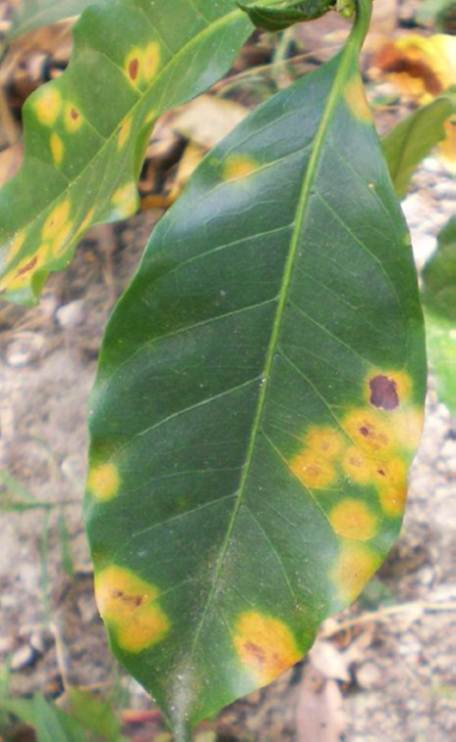
Rust Infection

Rust Infection

Coffee is the only known host of the fungus Hemileia vastatrix, which causes coffee rust also known as “roya”. The disease damages coffee leaves by causing the premature drop of infected leaves, which can lower yields by 50%.Coffee rust has become a greater problem for coffee growers because of climate change. Higher temperatures and increased rainfall favors rapid development of the disease.

“Costa Rica on Tuesday declared an emergency to tackle the spread of a coffee fungus that has already devastated Central American producers and looks set to destroy about 12 percent of Costa Rica’s planted coffee in the upcoming 2013/14 harvest.

A two-year emergency bill, signed jointly by Costa Rica’s Vice President Luis Liberman and the national coffee institute ICAFE, provisions about $4 million to pay for fungicides to tackle the roya, or leaf rust, outbreak.

Roya kills coffee leaves by sapping them of nutrients and lowering bean yields. The current roya pandemic has already affected other countries in Central America and Mexico, home to more than a fifth of the world’s Arabica coffee production.”

Author: Cota, I.
Affiliation: Reporter, Reuters.
Title: Costa Rica declares national emergency to tackle coffee fungus.
Source: Reuters. January 22, 2013.

European Organic Wheat Suffers from “Stinking Smut”

Common bunt is one of the most destructive diseases of wheat. As the fungus grows in the plant, the wheat kernels are converted to bunt balls that, when crushed, release thousands of black spores. They smell of rotting fish, hence the name “stinking smut”. Because of effective chemical seed treatment, common bunt had become a forgotten disease—until its reemergence in European organic wheat.

“The legal requirement for organic seed has compounded the bunt problem in Europe. For many years, it was possible to use conventionally produced seed as long as the cultivars were not of transgenic origin and the seed had not been treated after harvest with synthetic fungicides. All of this changed with Commission Regulation (EC) No. 1452/2003, which stipulated that beginning January 2004, all plant materials used for organic agriculture must be produced under organic farming conditions.”

“In conventional agriculture, common bunt is often exclusively controlled with chemical seed treatments. … Now, more than half a century after common bunt was thought to be vanquished, it has re-emerged in organic wheat. … In the United Kingdom, organic seed lots are predominantly contaminated with common bunt spores.”

“Contamination of wheat with common bunt spores has resulted in considerable loss of yield and seed quality. … Given the epidemiology of the disease, it has the potential to cause economic devastation to low-input and organic farmers.”

Authors: J.B. Matanguihan, K.M. Murphy and S.S. Jones*
Affiliation: *Department of Crop and Soil Sciences, Washington State University
Title: Control of Common Bunt in Organic Wheat.
Publication: Plant Disease. 2011. 95(2):92-103.

The Story of Coffee Rust: Why the British Drink Tea

In England in the early and mid-1800s, the most popular drink was coffee from plantations in Ceylon (Sri Lanka). When the coffee rust fungus destroyed Ceylon’s coffee trees in 1875, the plantations began growing tea.

“When the coffee rust fungus, Hemileia vastatrix, reached Ceylon in 1875, nearly 400,000 acres of the island were covered with coffee trees. No effective chemical fungicide was available to protect the foliage, so the fungus was able to colonize the leaves until nearly all the trees had been defoliated. … In 1870, Ceylon exported 100 million pounds of coffee. By 1889, production was down to 5 million pounds. In less than 20 years, many coffee plantations had been destroyed, and production had essentially ceased.”

“As the coffee trees were dying, however, the plantation owners noticed that the thousand or so acres of tea bushes were still healthy. …the owners replaced most of the dead coffee trees with tea bushes. By 1875, more than 1 billion tea seedlings had been planted on 300,000 acres—an amazing increase from the acreage planted only a few years earlier. … Luckily, no fungus invaded the tea crop immediately, and newly discovered fungicides were soon available to protect tea from its fungal pathogens.”

Authors: G.L. Shumann and C.J. D’Arcy
Publication: Hungry Planet: Stories of Plant Diseases. 2012. APS Press.

Want Cranberries from Oregon? Growers Have to Attack Fungal Rots

Cranberries are subject to infections by pathogens that cause rots. These pathogens are controlled with fungicide applications. Under cool, wet spring conditions the disease problem worsens, requiring additional sprays.

“Statewide, the USDA National Agricultural Statistics Service on Aug. 14 projected Oregon’s 2012 cranberry crop at 400,000 barrels, up 11 percent from las year’s 361,000 barrel crop.”

“One drawback for Oregon growers this year has been rising production costs, as growers increased fungicide treatments to avoid losses to disease. Donaldson and Anderson [two Oregon cranberry growers] said they applied between one and two additional fungicide treatments, as a cool, wet spring triggered heavy disease pressure. … ‘For years, I escaped by doing minimal fungicide treatment, but this year we had to attack (the diseases),’ Anderson said.”

Author: Mitch Lies
Headline: Cranberry growers keep an eye on spotty yields.
Publication: Capital Press. Friday, August 24, 2012.

Without Fungicides, Fungal Infections Would Render Celery Unmarketable

Septoria late blight is a worldwide disease of celery plants. First reported in Italy in 1890, late blight was then reported in North America in 1921, leading to losses of 25-50%. The disease is explosive – a half billion spores can be produced on a single celery plant. Each spore can start an infection resembling a dark spot, which can grow large enough to cause leaf death. Celery growers spray fungicides to prevent septoria infections. Another option is to use laborers to trim off the infected parts of the celery; however, this is not practical.

“Septoria late blight is an important disease of celery worldwide. Yield loss ≤ 70% can occur. … Effective management of septoria late blight is essential for the production of a marketable crop of celery. The disease threshold for celery is effectively zero because plants with noticeable lesions on leaves and petioles [stalks] are unmarketable, so diseased petioles must be removed by hand. … Septoria late blight is difficult to control once present in a field, and celery growers must rely on application of foliar fungicides to manage this disease. The labour requirements to trim fresh-market celery with lesions are high, and loads of processing celery showing disease symptoms can be rejected entirely.”

Author: C.L. Trueman, et al.
Affiliation: Department of Plant Agriculture, University of Guelph, Ontario
Title: Evaluation of disease forecasting programs for management of septoria late blight (Septoria apiicola) on celery.
Publication: Canadian Journal of Plant Pathology. 2007. 29:330-339.