New Fungicides Improve Management of Vomitoxin

Fusarium Head Blight

Fusarium Head Blight

Fusarium Head Blight (FHB), also known as scab, is a destructive disease of wheat and other small grains. In the spring, ascospores and/or conidia are released from crop residues and are spread by wind or splashing water. They land on wheat heads and during wet, warm weather they germinate and infect glumes, flower parts, or other parts of the head.

In addition to lowering grain yield and quality, F. graminearum produces mycotoxins, primarily the trichothecenes deoxynivalenol (DON), nivalenol (NIV) and T-2 toxin. …These mycotoxins are harmful to humans and livestock. In North America, DON, also known as vomitoxin, is the most common and economically important mycotoxin found In Fusarium-infected wheat. …Grain with high concentrations of DON often is discounted or rejected at the elevator, which exacerbates the losses incurred by the farmer.

“In the U.S., a less than desirable number of current commercial wheat cultivars have moderate resistance to FHB and this resistance can be overwhelmed in years with high disease intensity. Fungicides are often applied to control FHB when favorable conditions for disease development are forecast.

Over the last two decades, there has been considerable improvement in the effectiveness of fungicides in controlling FHB and DON. This improvement is attributable in part to improved fungicide chemistries and greater knowledge gained through research on fungicide application rates, timing, and technology.

The best approach to managing FHB is to integrate available management strategies. Research has shown that integrating cultivar resistance with fungicide application can be effective management strategy for FHB.

Availability of moderately resistant cultivars and new fungicide chemistries coupled with improved fungicide application technology has led to greater farmer adoption of an integrated strategy in the management of FHB and DON.”

Authors: Wegulo, S. N., et al.
Affiliation: Department of Plant Pathology, University of Nebraska-Lincoln.
Title: Integration of fungicide application and cultivar resistance to manage fusarium head blight in wheat.
Source: InTech. Fungicides – Showcases of Integrated Plant Disease Management from Around the World. Available at: http://www.intechopen.com/books/fungicides-showcases-of-integrated-plant-disease-management-from-around-the-world
Fungicides Prevent Significant Yield Losses in Argentinian Wheat Fields

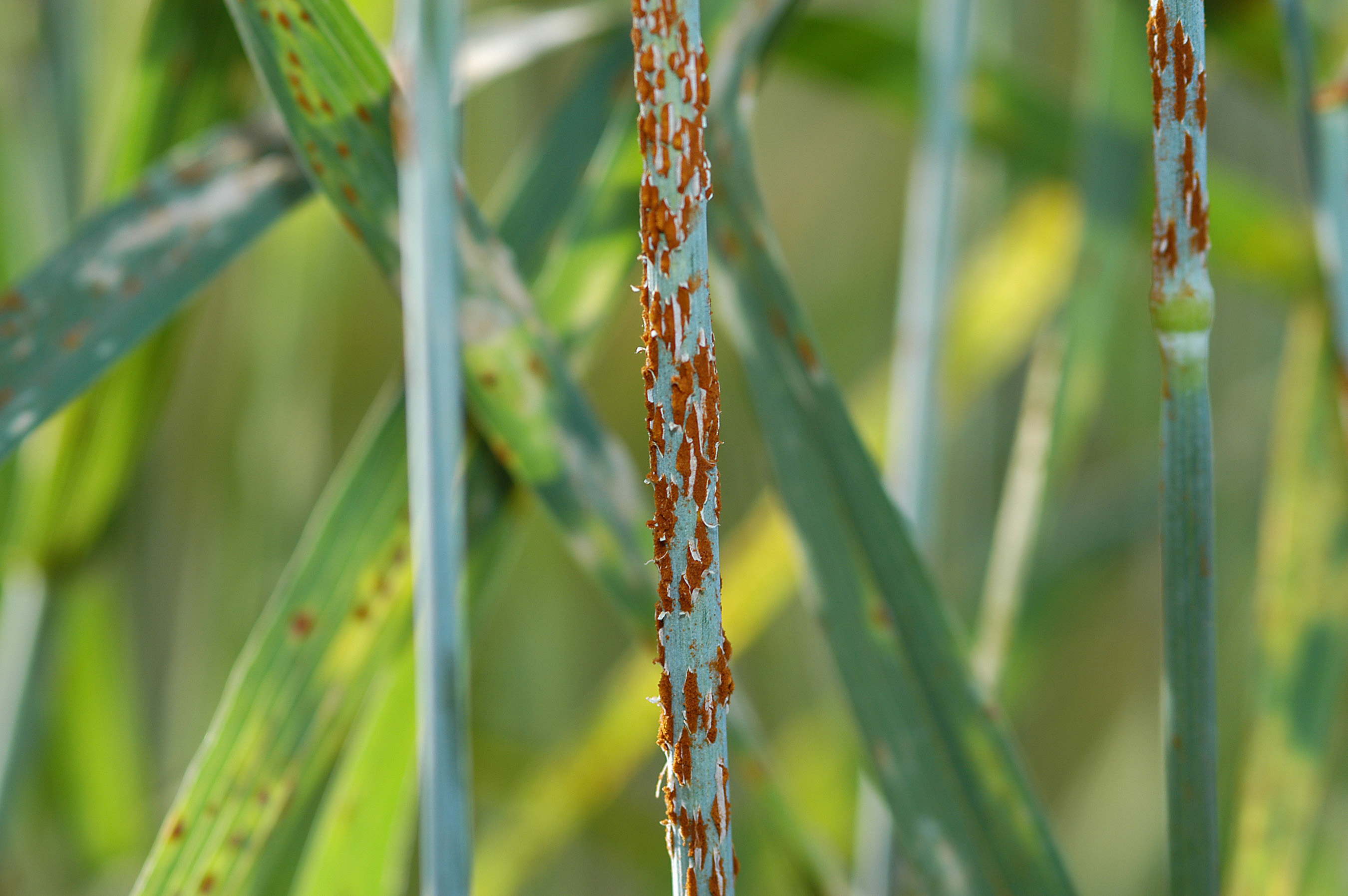
Wheat Rust is a Common Problem in Argentina

Wheat Rust is a Common Problem in Argentina

Argentina is one of the countries with the largest wheat-growing area in the world with more than 5 million hectares spread all over the country.

The grain production region has experienced severe tillage changes in the past twenty years, mostly due to the increased interest in maintaining soils covered with plant residues.

No tillage can reduce costs by decreasing fuel consumption required to produce a crop. However, in the wheat/soybean system under no tillage, as in wheat following wheat, the inoculum of fungi may survive until the next wheat season. Therefore, the use of fungicides is essential to decrease the severity of diseases.

Fungicides are usually applied on foliage to control diseases but they are also used for seed treatments to prevent seed decay. Leaf rust, septoria leaf blotch, and tan spot are the most important diseases in terms of potential yield reduction in Argentina.

“Planting resistant cultivars is one of the least expensive and most effective management strategies to prevent diseases. However, cultivars with an adequate genetic resistance level to necrotroph foliar diseases are scarce, and usually resistance to leaf rust is complete, conditioned by one or a few genes and has a low level of durability in Argentina. Therefore, chemical protection together with cultural practices is a common method of control. In addition, fungicides are also important because Argentinian wheat region combine high yield potential cultivars with high infection pressure, both deriving from adequate temperature and moisture levels, large application of N fertilizers and rotations dominated by cereals, which promote progression of some foliar diseases.

The results of experiments carried out in Argentina indicate that sowing wheat following wheat in no tillage is possible without significant yield losses if effective disease management practices including moderately resistant cultivars, N fertilization and fungicides are applied.”

Authors: Simon, M. R., et al.
Affiliation: National University of La Plata, Argentina.
Title: Recent Advances on Integrated Foliar Disease Management with Special Emphasis in Argentina Wheat Production.
Source: InTech. Fungicides – Showcases of Integrated Plant Disease Management from Around the World. Available at: http://www.intechopen.com/books/fungicides-showcases-of-integrated-plant-disease-management-from-around-the-world
Numerous Fungicide Options a Boon for California Peach Growers

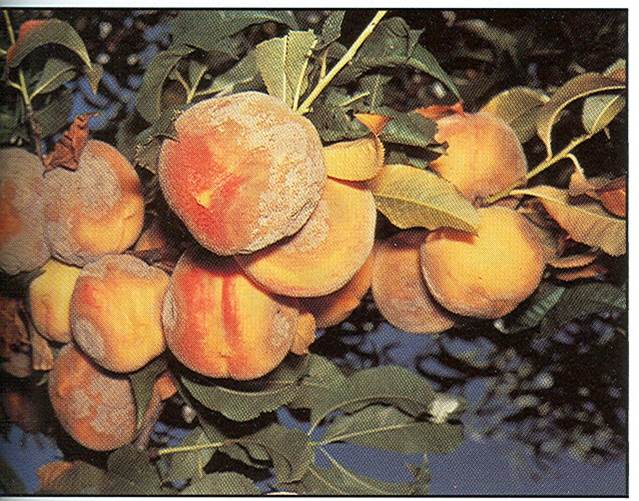
Brown Rot on Peaches

Brown Rot on Peaches

The University of California’s IPM Guidelines list 37 fungicide products available for controlling diseases in peach orchards. Major flower, foliar and fruit diseases of peach include peach leaf curl, shot hole, brown rot, powdery mildew and rust. The key is to select the best fungicide product with the broadest spectrum of activity against these pathogens and time the application at a critical stage.

“Fungicides are the most effective and safe way for managing diseases of cling peach. Fortunately, there are numerous choices because multiple fungicides with different modes of action (MOA) are registered for each disease. This may appear to make a decision more difficult, but having multiple active ingredients available allows for competitive pricing, development of highly effective management programs that target problematic diseases at individual orchard sites, and resistance management. …In recent years, many active ingredients have become available as generic products under different trade names. This has further increased the complexity but also allows for reducing fungicide costs to the grower.”

Author: Adaskaveg, J. E.
Affiliation: UC Riverside
Title: Effective and Economical Management of Flower, Foliar, and Fruit Diseases of Cling Peach
Source: Orchard Notes. January 2014. Pgs. 2-4.

Apple Rots Reappear Because of Fungicide Cancellations


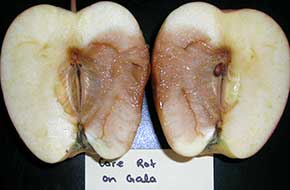
Core rot

Core rot


Many storage rots of apples are actually initiated in the orchard. There are often no pre-harvest symptoms. Core rot is a wet rot that spreads into the flesh of the apple. Core rot can be controlled with spring fungicide sprays in the orchard. However, core rot has reappeared in some Australian apples in storage due to cancellation of some key fungicides.

“In the last couple of months I have attended to a couple incidences of core rot in apples that have arrived in their destination market. This is not a pretty sight and costs the packer/marketers both in financial and brand terms, not to mention degradation of Australia’s reputation as a supplier of quality fruit.

This situation has probably arisen due to low levels of core rots being encountered in the last 15 or so years. This has meant that this problem has slipped from our memories and we have forgotten that in the 1980s core rot could be present in up to 20 per cent of our fruit. This level of infection cannot be tolerated in today’s marketing environment. Its re-appearance is probably due to the de-registration of both Benlate and Rovral for spraying onto the apple flowers, a treatment in common use in the 1990s and 2000s for the control of core rots.”

Author: Brown, G.
Affiliation: Technical Editor.
Title: Getting to the core of the problem: Core rots.
Source: Australian Fruitgrower. September 2012. Pgs. 12-15.

Michigan Tart Cherry Orchards Rely On Fungicide Protection Every Year

Cherry Leaf Spot Infection

Cherry Leaf Spot Infection

Michigan is the leading producer of tart cherries in the United States, with annual yields of 90.9-127.3 million kg, which represents approximately 75% of the total US production.

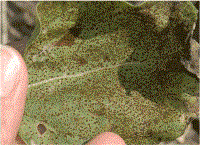
Leaf spot is the most important fungal disease of cherry trees in Michigan. The appearance of numerous spots on the leaf is usually followed by rapid yellowing and dropping. In experiments, it has been demonstrated that poor control of leaf spot can result in 72% of the tree branches dying during the winter months.

“Cherry leaf spot (CLS) is the most damaging pathogen of tart (sour) cherry trees. All commercial tart cherry cultivars grown in the Great Lakes region of the United States are susceptible to CLS, including the widely grown cultivar Montmorency, which accounts for more than 90% of the tart cherry acreage in Michigan. Left unmanaged, CLS infection causes significant defoliation by mid-summer, resulting in fruit that is unevenly ripened, soft, poorly colored and low in soluble solids. Early defoliation also delays acclimation of fruit buds and wood to cold temperatures in the fall, increases tree mortality during severe winters and reduces fruit bud survival and fruit set the following year.

The almost complete reliance of the tart cherry industry on the cultivar Montmorency has driven a strict dependence on fungicides for disease management. Typically, 6-8 fungicide applications per year are required, beginning at petal fall and continuing through to late summer after harvest.”

Author: Proffer, T. J., et al.
Affiliation: Michigan State University
Title: Evaluation of dodine, fluopyram and penthiopyrad for the management of leaf spot and powdery mildew of tart cherry, and fungicide sensitivity screening of Michigan populations of Blumeriella jaapii.
Source: Pest Management Science. 2013. 69:747-754.

Fungicides Protect Sunflowers From Rust

Sunflower Rust

Sunflower Rust

North Dakota, South Dakota, and Minnesota account for two-thirds of U.S. acreage of commercial sunflowers. 1.8 million acres of sunflowers produce an annual crop of nearly 2.8 billion pounds valued at $700 million. This valuable crop was recently threatened by a plant pathogen.

“Since 2008, sunflower rust has been a huge issue across the Northern Plains, increasing every year in severity and incidence.

The good news is that research trials conducted at North Dakota State University locations over the past two years demonstrate fungicides do work and in most cases, only one application of fungicide applied at the right time gives effective control .

“About three years ago, rust became an increasingly big issue,” said Sam Markell, NDSU plant pathologist, at the National Sunflower Association’s annual summer seminar in Bismarck. “When it comes really early, it causes a lot of yield loss.”

And that is precisely what began happening.

Previous to 2007, rust was typically found in late July and early August when it is less likely to cause an epidemic. But an NDSU Extension agent found rust in the aecia stage (which indicated the rust pathogen had completed its sexual cycle) three years ago in mid-June, which was very rare, Markell said.

“This may have been a result of favorable environment or it could be that a resistant sunflower was no longer resistant,” he said.

For example, when the NDSU scientist found rust in the aecia stage, he had the field aerially sprayed twice with fungicide except for one untreated test strip. In the treated field, the yield was 1,400 pounds, but in the untreated strip, the yield was 200 pounds, Markell said.”

Author: Roesler, S.
Affiliation: Farm & Ranch Guide.
Title: Type of fungicide on sunflowers not as vital as timing.
Source: Farm and Ranch Guide. July 16, 2010.

Soggy Weather in the Southeast Leads to doubling of Fungicide sprays on Pecan Trees

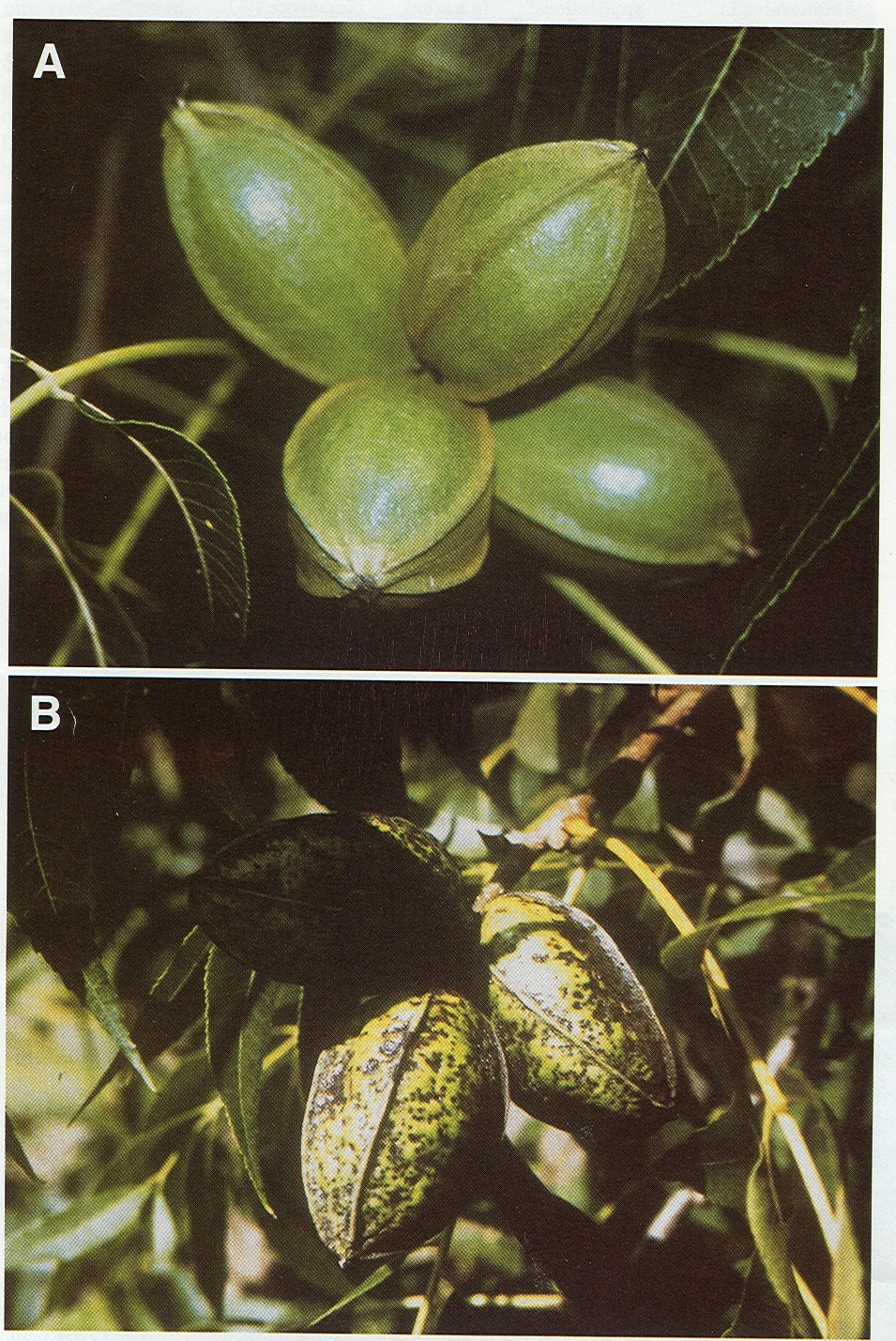
Top: Fungicide Treated Bottom: Scab Infected

Top: Fungicide Treated
Bottom: Scab Infected

Pecan scab is the most significant disease affecting pecan trees in the US. The scab fungus survives the winter in masses of cells in twigs. During the spring, spores are abundantly produced and infection occurs during periods when rains are frequent. In the absence of spray programs, pecan nut losses approaching 100% can occur. 2013 was a very wet year in the Southeast where most pecans are grown.

“The last time Tom Stevenson remembers pecan disease being as bad as this year was in 1994, when a tropical storm stalled over south Georgia and dumped record rainfall in 24 hours – deadly flooding followed it.

Though not deadly, record soggy weather dominated the Southeast in many areas this summer. It left pecan orchards vulnerable for a big attack from the crop’s No. 1 enemy. The fungal disease scab scars husks, cuts yield and hurts quality.

“We’ve had some wet years before, but not like it has been this summer where it has rained all summer long,” said Stevenson, a south Georgia-based pecan orchard manager.

This year, he said, to try and stay ahead of the disease, his orchards got 16 or 17 fungicide sprays, or twice as much as in a normal year, costing $600 per acre this year for fungicide applications. Again, that cost is double what it is typically.

Scab claimed about 20 percent of the crop in 2003.

But unlike 2003, though, growers have more products and better practices to fight scab, even in bad years, Wells said. And, most importantly, growers have a bigger incentive to fight the disease to max out yields. “A lot of it now is nuts are worth more and growers are more willing to spend money on them,” he said.

The U.S. pecan industry has hit a boom in recent years with exports to China now vying for near half of the U.S. production each year. Where once prices fell into a production-driven boom or bust cycle, steady high prices, or $2 to $2.50 per pound, have put orchard management on the front burner for established growers and those looking to expand in it.

Pecan growers have good chemistries to fight scab with several modes of action, including strobilurin, triazole, triphenyltin hydroxide, organotin. Plus, an old tried-and-true chemistry called dodine is once again working on scab in Georgia, where growers stopped using it many years ago because it had lost some effect on the disease. But it seems to be working again, especially in combination with the other chemistries.”

Author: Brad Haire
Affiliation: Southeast Farm Press
Title: Pecan disease worst in recent memory
Source: Southeast Farm Press. September 5, 2013. Available at: http://southeastfarmpress.com/orchard-crops/pecan-disease-worst-recent-memory

Europe Could Learn a Lot from US farmers about Using Fungicides on Corn Crops

Eyespot Disease on Maize Leaves

Eyespot Disease on Maize Leaves

Recently in the US, farmers have increasingly used fungicides on corn crops with a noticeable yield increase. There is significant corn (maize) acreage in Europe, but hardly even any research on fungicides. Recently, a European researcher experimented with fungicides and discovered the great potential of using fungicides for this overlooked problem.

“Since 2008, fungicide trials have been carried out by both the Danish advisory service (Knowledge Centre for Agriculture) and University of Aarhus to test the impact of fungicides on control of leaf diseases. In several of the trials, significant levels of diseases have occurred and significant yield responses have been obtained.

In 2009, a severe attack of northern corn leaf blight (E. turcicum) developed and 50% yield increases were accomplished from fungicide treatments in a number of trials. In 2011, a severe and early attack of Eyespot (K. zeae) developed in several trials and in that season yield increases between 50 to 60% were also achieved in grain maize crops in fields with minimal tillage with maize as the previous crop.

Based on good efficacy trials, the first fungicide epoxiconazole plus pyraclostrobin (as Opera) was authorized in Denmark for control of the leaf diseases in maize between detection of 3rd node and the tassels appearing at the top of the stem (BBCH GS 33-51).

For scientists, advisors and farmers, it was a surprise that yield reducing leaf diseases could play such a major role in the production of maize. When looking around Europe for information on this subject, we were slightly surprised that very little information on the use of fungicides was available. When looking around we also realized that in many countries no fungicides are authorized for control. Looking across to the US, which has long experiences with foliar diseases, there seem to be more knowledge available on disease management, including experiences from use of fungicides.”

Author: Jorgensen, L. N.
Affiliation: Department of Agroecology, Aarhus University, Denmark
Title: Significant yield increases from control of leaf diseases in maize – an overlooked problem?!
Source: Outlooks on Pest Management. August 2012. Pgs.162-165.

To weed or not to weed: Shakespeare as Ag Communicator

Shakespeare

Shakespeare

An Ag Communication specialist recently read through the Bard’s plays and found several quotes about the importance of controlling weeds.

“I suppose Shakespeare wasn’t an agronomist in the proper sense so much as he had an acute, affectionate love of nature along with the transcendent genius to contemplate and express his sublime sentiments. It wasn’t that he surveyed or discovered things in the world that no one else could see externally, but everywhere in nature he found metaphors for the human condition.

The Bard was so comprehensive and universally appealing that multitudes of professions have “claimed” him as their own practitioner: Why can’t we agricultural communicators claim him as our own as well?

Without further ado, here are just a few quotes I plucked out of the Bard’s works pertaining in some manner to the foulness of weeds or other pests.

Gardener:
I would go root away
The noisome weeds, which without profit suck
The soil’s fertility from wholesome flowers.

Servant:
The whole land,
Is full of weeds, her fairest flowers choked up,
Her fruit-trees all unpruned, her hedges ruin’d
Her knots disorder’d and her wholesome herbs
Swarming with caterpillars?
Richard II, act iii, sc. 4

I think the above clearly shows that Shakespeare would’ve concurred with our contention that one must control weeds if one wants to preserve moisture and nutrients for one’s crops.

Hamlet:
How weary, stale, flat, and unprofitable
Seem to me all the uses of this world!
Fye on it, ah fye! ‘tis an unweeded garden
That grows to seed; things rank and gross in nature
Possess it merely.
Hamlet, act I, sc. 2

Fye on you weeds! Thou art rank and gross! My fellow ag communicators have been proclaiming this for years… just like Hamlet.

Friar:
I must up-fill this willow cage of ours0
With baleful weeds and precious juiced flowers.
Romeo and Juliet, act ii, sc. 3
 
“Baleful weeds”…now that’s ominous.

Queen:
Now ‘tis the spring, and weeds are shallow-rooted;
Suffer them now, and they’ll o’ergrow the garden,
And choke the herbs for want of husbandry.
2nd Henry VI, act iii, sc. 1

Bravo! Spray weeds early and often!”

Author: Loftis, D.
Affiliation: McCormick Co.
Title: To weed or not to weed
Source: Agri Marketing. November/December 2009. Pgs.54-55.

2013: Perfect Year for Peanut Diseases, But No Problem Thanks to Fungicides

White Mould

White Mold

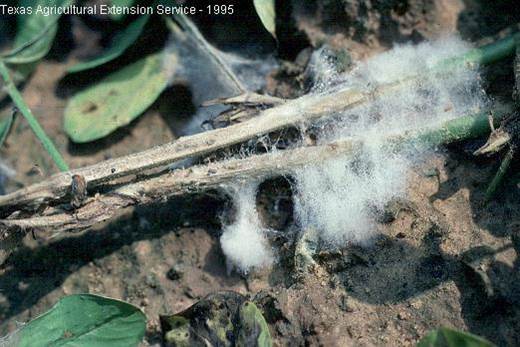
The unrelenting rains of 2013 in southeastern peanut fields created perfect conditions for the rapid development of white mold and rhizoctonia- diseases that can cause plant death. However, disease outbreaks did not occur because peanut growers were vigilant in applying fungicides.

“So far, 2013 has been a perfect weather year for peanut diseases in the Deep South: wet with swampy plus short spurts of hot with swampy.

But that disease pressure just hasn’t hit yet.

“Despite my repeated and dire predictions for severe disease outbreaks this year in our peanut fields, the reports from county agents have been fairly quiet.

…I know of very few situations where disease has overwhelmed a (peanut ) crop,” said Bob Kemerait, plant pathologist with the University of Georgia Cooperative Extension.

Why have peanut diseases not been so bad?

“Fungicides” is the short answer, he said, good fungicide products matched with grower know-how on best ways to use them.”

Author: Haire, B.
Affiliation: Reporter, Southeast Farm Press
Title: Grower know-how, good fungicides keeping peanut diseases at bay.
Source: Southeast Farm Press. August 9th, 2013. Available at: http://southeastfarmpress.com/peanuts/grower-know-how-good-fungicides-keeping-peanut-diseases-bay