It Never Rains in Southern California, But When It Does, Fungicides are Essential

Gray Mold

Gray Mold

Most of the table grape production in the U.S. is located in the San Joaquin Valley. Rainfall at harvest is uncommon. However, when it does rain, gray mold can reach epidemic proportions if fungicides are not used. Gray mold is caused by a fungus that is activated by rainfall. The fungus produces a short tube with a suction cup and a peg that forces its way through the grape cuticle. Inside the grape, the fungus grows and exudes enzymes that degrade the fruit. Cracks form in the grapes and spores are produced that spread gray mold to other grape clusters. Even a single infected fruit within a table grape package can cause severe losses.

“Timing of fungicide applications to control gray mold is primarily driven in vineyard environments by the occurrence of rainfall. Rainfall at harvest, an uncommon event in the San Joaquin Valley of California, causes abundant production of inoculum and epiphytotics of the disease in vineyards, and fungicide applications are critically needed when this rare event occurs. This area, where most of the table grape production in the United States is located, is typically rainless throughout these periods and B. cinerea seldom causes significant vineyard bunch rot, but it routinely causes substantial postharvest decay if measures to control it are not taken.”

Authors: J.L. Smilanick, et al.
Affiliation: USDA ARS
Title: Control of postharvest gray mold of table grapes in the san Joaquin valley of California by fungicides applied during the growing season
Source: Plant Disease. 94[2]:250-257. 2010.

New Fungicide Revolutionizes the California Pomegranate Industry

Untreated vs. Treated

Untreated vs. Treated

In recent years, the California pomegranate industry has grown dramatically. Pomegranates have gained high visibility with the public through a number of health benefits due to some of the fruit’s constituents in preventing cancer. The crop’s recent success was not assured until a fungicide was registered to prevent mold from developing on the fruit in storage. In fact, before the introduction of the fungicide, the pomegranate industry in California was almost destroyed by the mold problem.

“Gray mold, caused by Botrytis cinerea, is a fungal disease that can be a serious threat to the pomegranate industry. In the 1999 and 2000 growing seasons, gray mold destroyed approximately 30% of California’s harvested pomegranates. California pomegranate packers had difficulties storing fruit for two to three weeks, let alone the goal of two to three months of storage that they needed to reach holiday markets from November to January around the world. Costs associated with repackaging, box losses, and price discounts, as well as crop rejections by retailers, almost destroyed California’s pomegranate industry.

In 2001, Scholar, a new postharvest fungicide containing the active ingredient fludioxonil, received a Section 18 emergency exemption registration for use on pomegranate in California. With this, a postharvest treatment was registered on this crop for the first time.

With these treatments, fruit losses due to gray mold were reduced substantially. Thus, in 2003, 5% of the harvested crop was lost as compared to the previous average of 30% lost in 1999 to 2002 when postharvest treatments were either not available (1999 and 2000) or were not widely  used because most packinghouses had not  installed treatment equipment (2001 and 2002). As a direct result, the crop yield (boxes per acre) in 2003 increased by 66.9% and the gross revenue increased by 61.8% as compared to the average yield and average revenue from 1999 to 2002, respectively.

Profitability to the California pomegranate industry was also regained through an extended storage life of the Scholar-treated fruit. Thus, fruit can now be stored for up to five months as compared to approximately one month before use of the fungicide. This now vastly extends the marketing potential of this fruit of passion.”

Authors: Eric C. Tedford (1), James E. Adaskaveg (2), and Alex J. Ott. (3).
Affiliations: (1) Syngenta Crop Protection. (2) Department of Plant Pathology, University of California. (3) California Grape and Tree Fruit League.
Title: Impact of Scholar (A New Post-harvest Fungicide) on the California Pomegranate Industry
Source: Plant Health Progress. February 16, 2005.

Southern California Vineyards Recover Thanks to Insecticide Applications

Grapevines Destroyed in 1999

Grapevines Destroyed in 1999

Temecula Today

Temecula Today

In 1999, about one-third of the vineyards in Temecula Valley, Riverside County, California were destroyed due to Pierce’s Disease which is caused by a bacteria transmitted to grapevines by an insect-the glassy winged sharpshooter. The disease seemed destined to spread throughout Southern California. However, research demonstrated that a carefully-timed insecticide application would prevent the sharpshooter from transmitting the disease to grapevines. As a result of this insecticide use, the wine grape industry in Southern California has recovered and is prospering.

“Twelve years ago a Pierce’s disease epidemic in Southern California wine grapes prompted a multi-pronged local, state and federal attack to contain the disease spread and find a cure or treatment.

Riverside County agriculture officials declared a local emergency in 1999 and 300 acres of Temecula wine grape vines were destroyed after they were found to be infested with the glassy winged sharpshooter.

Emergencies were declared, a task force was formed, and in 2000 $22.3 million in federal financial assistance was secured to reduce pest infestations and support research.

Research found that the Southern California epidemics were almost entirely the result of vine-to-vine transmission…. A protocol of applying one carefully timed application of a persistent systemic insecticide such as imidacloprid virtually eliminates the vine-to-vine spread.

Ben Drake is a Temecula-area wine grape grower and vineyard manager who began seeing problems from PD in the Temecula Valley as early as 1997.

We’ve found that if we apply (imidacloprid) at the middle to the end of May, before the sharpshooter moves out of the citrus and goes into the vineyards, we get levels of the material into the plant high enough that when the sharpshooter flies over from the citrus groves to try it, they just fly back where they came from. Or, if they feed long enough, it will kill them.

But just look at the Temecula Valley now to understand what’s changed: From 12 wineries in 1999, the Temecula Valley Winegrowers Association website today lists more than 50 growers and 34 wineries…. A thriving agritourism industry has developed…. Existing wineries are expanding and new ones are under construction or in planning phases.”

Author: Christine Thompson
Affiliation: Reporter
Title: Grape growers urged to remain vigilant against sharpshooter pest
Source: Western Farm Press. 2011-12-12. Available at: http://westernfarmpress.com/grapes/grape-growers-urged-remain-vigilant-against-sharpshooter-pest

Walnut Blight Sneaks Back Into California

Walnut Blight

Walnut Blight

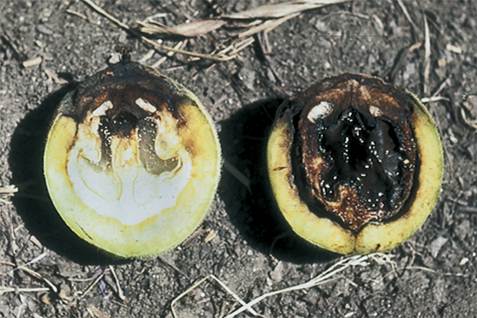
California produces 99% of the walnuts grown in the U.S. and 38% of those grown worldwide. Walnut blight is the most destructive disease of walnuts and is caused by a bacterium that infects only walnuts. When the nut is infected, the infected area turns black as the bacteria invade the surrounding tissues. Drops of black slimy exudates containing myriads of bacteria and decomposed cellular materials may ooze out of the lesions. Control studies were initiated in 1930 and were carried out by the federal government for 16 years. The research demonstrated that the only practical method of controlling walnut blight was by spraying or dusting with protectant bactericides. Control practices for walnut blight have not changed substantially for decades. They are still based upon use of copper-containing materials.

“Walnut blight, depending on the variety, the weather and the pathogen populations, can cause significant crop loss. Such was the case in 2012, when some Chandler walnuts in the late leafing varieties saw 15 percent damage.

Rick Buchner, University of California Cooperative Extension farm advisor for Tehama County, said he thinks growers may have become lulled into a false sense of complacency because they haven’t had a lot of problems with blight in recent years. Consequently, they weren’t vigilant in their management practices as they’ve been in the past, he added.

A lesser treatment program was used that worked well in the past several years when there was low blight pressure, Buchner said, but that has resulted in the inoculum building.

Reverting to old management practices will bring the blight under control, Buchner said. “We’ve actually done that. It’s taken us two years to beat it back down,” Buchner said, recommending that growers plan for two very aggressive treatment years to take it back down.

“Copper spray is not cheap, but it’s a lot cheaper than 10 percent loss of walnuts,” Buchner said.

“Those bacteria are hanging out there now. They’re all set. They’re sitting in those trees just waiting to take off in the spring, so it is very important to stay vigilant,” Buchner said.”

Author: Kathy Coatney
Affiliation: Reporter
Title: Walnut Blight Slowly Sneaks Back Into North State Orchards
Source: Ag Alert. January 16, 2013. Pgs. 9-10.

Cool Spring Weather Leads to Problems for Organic Potato Growers

Organic growers are severely limited in the tools that they can use to fight fungal infections since they cannot use effective chemicals. One unhappy result was severe losses to diseases in the organic potato fields of Northern California last fall.

“John Crawford, part owner of Crawford Farms, Inc. for commercial farming and Cascade Farms for organic farming in Tulelake, said everyone across the county is two weeks behind on their potatoes. … The cool spring also contributed to problems with rhizoctonia disease… Rhizoctonia girdles the roots and the stem, then the plant withers and yield is reduced.”

“Rhizoctonia was a huge problem in Crawford’s conventional potatoes and crops would have a 100 percent infection rate. Now, with the new chemical compounds, he has good control. But Crawford said he continues to struggle with rhizoctonia in his organic potatoes. ‘It’s our worst enemy in organics because we really don’t have a natural compound that is very good at fighting it,’ he said, adding in one field of organic potatoes he estimates 75 percent are infected with rhizoctonia. … Crawford estimated at least a 20 percent yield loss from rhizoctonia damage.”

Author: Kathy Coatney
Title: Rhizoctonia and wilt create challenges for potato growers.
Publication: Ag Alert. September 14, 2011. p.18

Grape Mealybug Control in California Depends on Insecticides

Four species of mealybug feed on grapes in California. They suck out plant content and excrete unused plant material. The result is a layer of sticky, wet honeydew on which thick, black, sooty mold grows. The strict quality standards set by the grape industry and demanded by consumers have led to a dependence on insecticides for controlling mealybug populations.

“Although more vineyards are becoming infested, populations within infested areas are declining because the judicious use of insecticides has successfully lowered mealybug populations in areas that are infested.”

“Season-long control programs for vine mealybug are typically comprised of a combination of insecticide treatments assisted by biological control. … Promoting parasites is very important because they are active late in the growing season and can reduce vine mealybug populations before the pest begins to move to the lower part of the trunk after harvest [where they are protected from insecticides].”

Authors: Chuck Ingels, David Haviland and Steve Quashnick*
Affiliation: UC Cooperative Extension and *Wilbur Ellis
Title: Vine mealybug management in wine grapes in the northern San Joaquin Valley.
Publication: CAPCA Adviser (2012) April:34-37.

Consumer Expectations for High Quality Lettuce Require Insecticide Use

Fresh market lettuce production in the desert growing areas of Southern California and Arizona is a billion dollar industry and the region annually produces >95% of the leafy vegetables consumed in the U.S. in the fall and winter months. Consumers desire lettuce without any blemishes or insect damage. Consumer standards result in the annual use of insecticides on the lettuce crop as described by Arizona entomologists John Palumbo and Steve Castle…

“In desert vegetable production systems, growers have been delivering high-quality safe produce to the fresh market for decades, and this has been accomplished almost exclusively through the use of insecticides.”

“…western lettuce growers and consultants have reported that chemical control is the only effective IPM tactic available for the control of most major insect pests. Naturally occurring biotic control agents are simply not capable of providing the level of crop protection necessary for meeting the marketing demands for fresh produce. … Because of the short time these crops are in the field, minor feeding activity may render the product unmarketable because of high consumer standards.”

“More recently, the fresh produce industry has experienced significant growth in the value-added market, where lettuce and other leafy greens are prepared and sold as fresh-cut lettuce packs and ready-to-eat, bagged salad mixes. The growth of this industry has also resulted in higher cosmetic standards for leafy vegetable crops, often to the point where virtually no insect contaminants or feeding blemishes are tolerated.”

Authors: John C. Palumbo and Steve J. Castle
Affiliation: University of Arizona Department of Entomology
Title: IPM for fresh-market lettuce production in the desert southwest: the produce paradox
Publication: Pest Management Science (2009) 65:1311-1320.

Crop Breeding Failure Led to Increase in Fungicides in CA Spinach Fields

The breeding of crop varieties that are resistant to pest organisms is often touted as an effective means of replacing pesticide use. And yet, pest organisms mutate and overcome the plant’s resistance. According to the California Department of Pesticide Regulation, fungicide use in California spinach fields has doubled in the last decade. The reason for the increase has been the breakdown of the plant’s resistance to mildew (Peronospora farinosa f. sp. spinaciae).

“Downy mildew disease is the most important disease problem facing the extensive spinach industry in California. … While downy mildew has been around California spinach fields for decades, the last few years have seen the development of four or five new races. Each new race potentially overcomes the resistance factors in the cultivars being planted at that time, leaving the crop susceptible to severe damage.”

“Integrated management steps must be used. … Resistant cultivars will remain a foundational piece of such a program. Judicious use of effective fungicides will remain important.”

Authors: Steven Koike and Jim Correll
Affiliation: University of California and University of Arkansas, respectively
Title: Spinach Downy Mildew: Outlining the Challenges.
Publication: Crop Notes (University of California Cooperative Extension)

Without Insecticide Sprays, California Olives are Rejected by Food Companies

The olive fruit fly is the most significant pest of olives worldwide. The female lays her eggs within the olive and her offspring tunnel through the inside, eating as they go, to reach the surface. This ancient pest was first discovered in California in 1998; insecticide sprays have been necessary to prevent serious damage ever since. In 2011 some California olive growers cut back on their insecticide applications. Bill Krueger, a University of California Cooperative Extension farm adviser, and Cody McCoy, Northern California field manager for Bell-Carter Foods, offered their thoughts on the implications of this decision…

“In 2011 the olive fruit fly numbers were higher than they had been since 2004, Krueger said. … ‘You certainly have to think that the lack of spraying had something to do with it, too. I know one particular case where they just didn’t start spraying early enough, and what we saw there was old damage at harvest,’ he said.”

“McCoy agreed, saying he also saw high OLFF [olive fruit fly] damage in 2011. At one point, nearly three-fourths of the olives delivered to the Bell-Carter production facility showed OLFF damage, he said. The majority of the OLFF damage was concentrated in a few olive samples, McCoy said. But because of the extent of the damage, the fruit was rejected.”

Author: Kathy Coatney
Title: Table olive growers are hoping 2012 will be a better year.
Publication: Ag Alert. February 8, 2012. pp.8-9.