Australia’s Most Delicious Bush Nut Protected with Fungicides

dghzdf

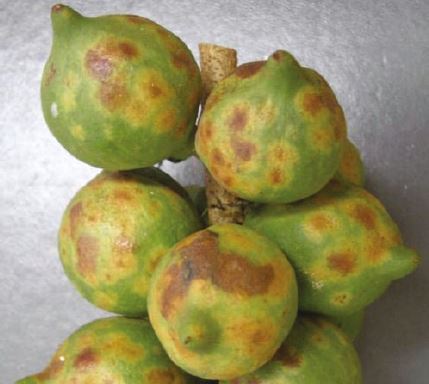
Husk Spot on Macadamia Nuts

Australia is the home of the macadamia nut. Australia accounts for about one-third of world production. Husk spot caused by Pseudocercospora macadamiae is a serious disease affecting macadamia in Australia. Husk spot has not been reported from any other macadamia producing nation. The spores adhere to the husk, germinate and penetrate the host through openings (stomata). A major part of the economic impact is caused by premature fruit abscission from the tree when the kernels are still immature and of low oil content, making them unsuitable for processing and consumption.

“Husk spot, caused by Pseudocercospora macadamiae is a major fungal disease of macadamia in Australia, costing over $10 million in lost productivity if the disease is not adequately controlled. P. macadamiae infects macadamia husks on which it continually produces inoculum, the infection causes premature abscission of diseased fruit, thus, resulting in extensive yield losses and reduced kernel quality. Application of fungicide is currently the only effective method of controlling husk spot.”

Author: Akinsanmi. O. A., et al.
Affiliation: Tree Pathology Centre, The University of Queensland.
Title: An integrated approach to husk spot management in macadamia.
Source: Plant Health Management: An Integrated Approach. APPS 2009. Pg. 22.
Some Like It Hot: Horseradish Needs Protection to Prevent Discoloration

thrtsd

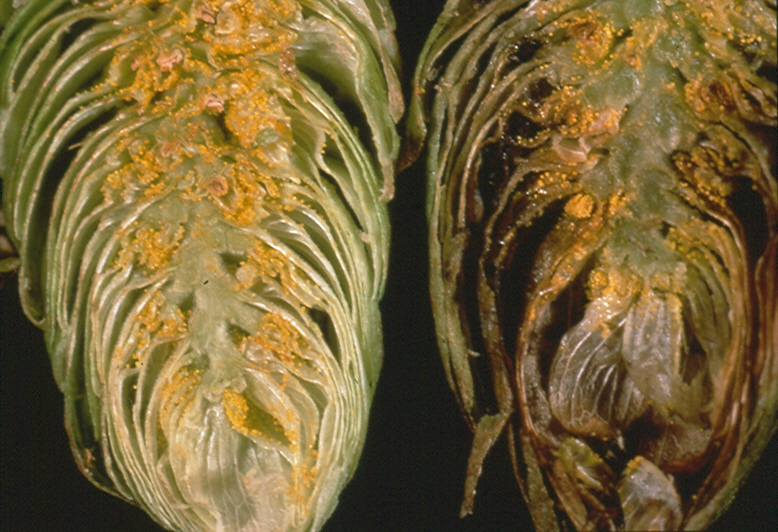
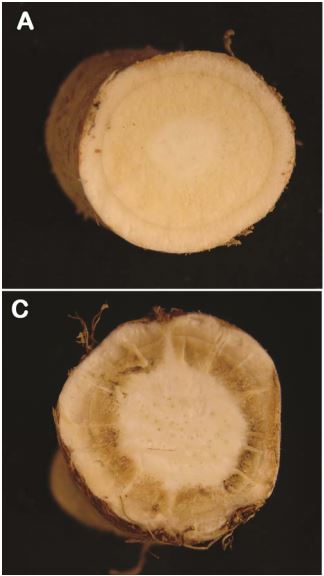
Horseradish: (A) Normal; (C) Internal Discoloration

Horseradish is a root plant from the mustard family. The root is harvested in the spring and fall and is sold to processors who grate the root, releasing the oils that distinguish horseradish from all other flavors. The oil creates a hot and spicy flavor. Consumers expect horseradish to be a light color. Internal discoloration of horseradish roots is the main production problem. Internal discoloration of the root begins with dark brown to black discoloration of the vascular system and gradually spreads to the core and cortex areas in the root. Internally discolored horseradish roots are useless for industrial purposes such as preparing horseradish sauce. Research has shown that fungicides can prevent the discoloration.

“Illinois produces approximately half of the total commercial horseradish in the United States. Over the past years, horseradish growers have experienced internal discoloration in horseradish roots, causing up to 100% yield losses.  …Fungicide fludioxonil (Maxim 4FS or Maxim Potato WP) and biofungicides Trichoderma virens (G-41/ABM 127 or SoilGard 12 G) and Bacillus subtilis (Serenade MAX), applied to pathogen-free sets, protected horseradish roots against the soil-borne pathogens for approximately 12 weeks. …Application of either the fungicide or one of the biofungicides to the tissue culture-generated sets protects roots in the field through July. The remaining period of the growing season is not long enough for infection and discoloration of the roots.”

Author: Babadoost, M.
Affiliation: Department of Crop Sciences, University of Illinois, Urbana.
Title: Set treatment for controlling internal discoloration of horseradish root.
Source: Phytopathology. 2006. 96[6](Supplement):S7

Australian Wheat Yields Have Doubled Thanks to Herbicides

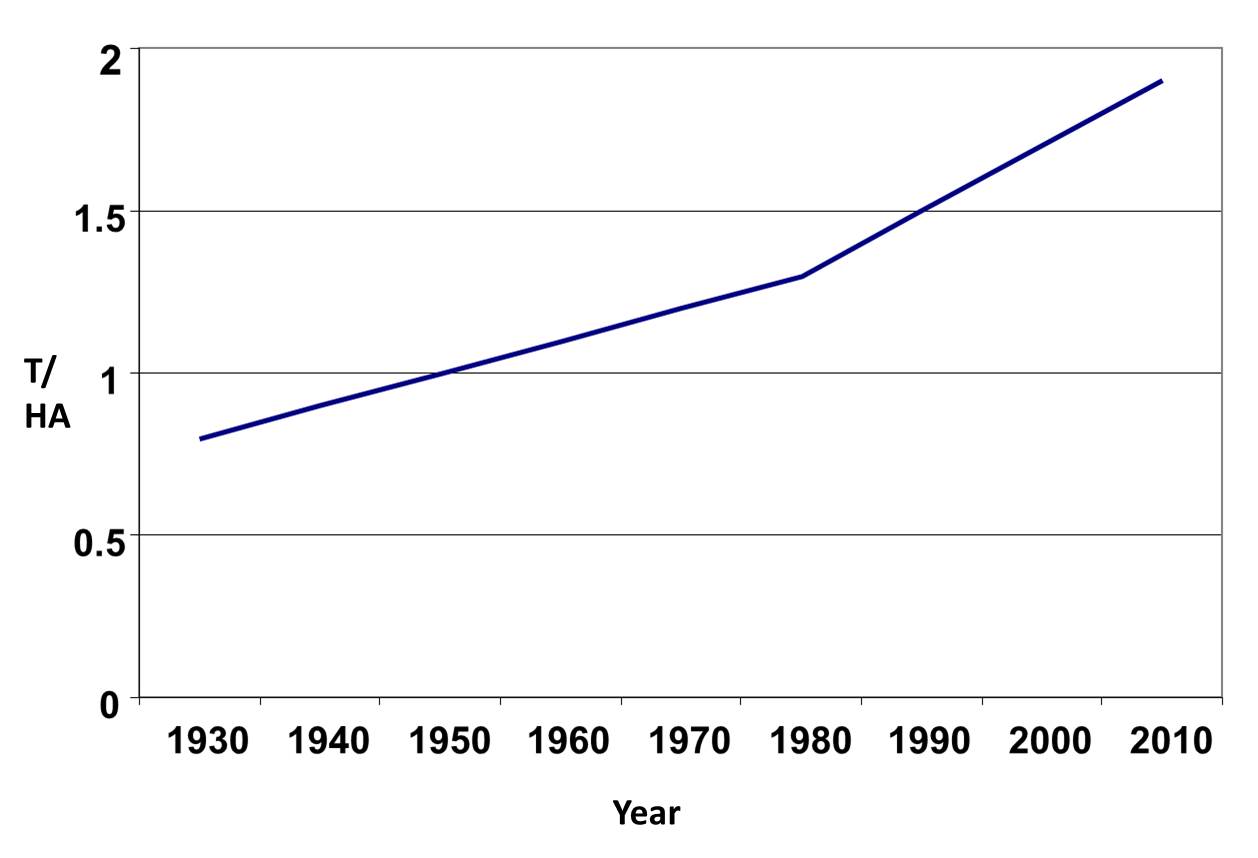
Australian Wheat Yield 1930-2010 (Trendlines)

Australian Wheat Yield 1930-2010 (Trendlines)

Australian wheat-growing areas are dry. Historically, tillage was used to remove weeds, but tillage further dried out the soil. Herbicides have made it possible for Australian wheat farmers to stop tilling entirely. As a result, soil moisture retention has increased and wheat yields have doubled.

“An analysis of the yield trends of wheat production in Australia showed that yields have increased by an average of 12-13 kg ha-1 year-1 over the past six decades, despite rainfall not changing and irrigated wheat contributing only a very small proportion to total production. A more recent analysis of wheat yield trends in Australia and the various states of Australia has shown that since the early 1980s there has been a more rapid increase in yield of over 30 kg ha-1 year-1. In Western Australia, where wheat is not irrigated and rainfall has probably declined over the last 25 years, the increases… arise solely from increases in rainfall-use efficiency.

However, the major impact of agronomic management on rainfall-use efficiency has not arisen from increasing total water use by the crop in evapotranspiration, but from increasing water use by the crop itself in transpiration at the expense of water loss by weeds or from the soil by soil evaporation, deep drainage, surface runoff, or lateral throughflow.

The use of minimum tillage or conservation tillage, whereby residues from the previous crop are left on the surface, weeds are controlled by herbicides rather than tillage, and the seed is sown with minimum disturbance of the soil surface by the use of narrow tines, has led to reduced losses of water by soil evaporation and increased yields. Further, minimum tillage systems allow earlier planting as delays resulting from using tillage to remove weeds are reduced.”

Author: Turner, N. C.
Affiliation: CSIRO Plant Industry.
Title: Agronomic options for improving rainfall-use efficiency of crops in dryland farming systems.
Source: Journal of Experimental Botany. 2004. 407[55]:2413-2425.

Restoring Nature in Hawaii with Herbicides

Paintball gun herbicide warfare

Paintball gun herbicide application

The Nature Conservancy is the leading conservation organization working around the world to protect ecologically important lands and waters for nature and people. Invasive weeds are a major threat to natural areas and herbicides have made it possible to remove these unwanted species.

“Kaua’i is rugged and beautiful, but it is also threatened by a host of invasive plants and animals. One of those invaders is the Australian tree fern, a fast-reproducing ornamental that was brought to Kaua’i almost half a century ago to prettify resorts on the island’s North Shore. It rapidly grows frond to frond and crowds out native plants.

“I’ve been fighting weeds for 20 years and I’ve never seen anything like the Australian tree fern,” says Trae Menard, The Nature Conservancy’s director of forest conservation in Hawaii. “It’s a pretty bad weed.”

In 2001, The Nature Conservancy launched its program to fight the invaders. 

Much of the research and development has focused on the Australian tree fern—“an ecosystem dominator,” as Menard puts it—that has exploded across the island. Menard and his team have developed a wide-ranging arsenal that includes “the Stinger,” a precision herbicide dispenser slung underneath the helicopter, which Hobbs and other pilots use to spray individual Australian tree ferns. The team has also tested herbicide-packed pellets that can be fired by a crew member in the helicopter with a paintball gun. That kind of precision targeting, along with a formula tailored to the Australian tree fern, has allowed the weed fighters to kill a lot of plants with extremely small quantities of Imazapyr, a relatively short-lived herbicide that has almost no effect on animals.

“We treated over 4,000 tree ferns in a 5,000-acre area over a three-year period,” says Menard, “and we only used 11 gallons of herbicide.”

But the tide may be turning in the fight to save Kaua’i’s native forest. More than 90 percent of the mapped Australian tree ferns in  Wainiha Valley have been treated and killed, and Menard’s team is now preparing to attack ferns in neighboring Lumaha’i valley.”

Author: Jenkins, M.
Affiliation: Reporter.
Title: Pacific Invasion: on the Hawaiian island of Kaua’I, scientists are pioneering new technologies to combat a surge of superweeds that threaten native forests.
Source: Nature Conservancy. September/October 2013. Pgs. 51-59.

No Apple Maggots in Northwest Orchards Thanks to Spraying Outside the Orchards

ssgdzfh

Apple Maggots

Apple maggot is a native pest of the eastern United States and Canada. In 1979 it was discovered in Oregon and has since moved into California, Washington, and other Western states. Female apple maggot adults deposit eggs singly under the apple skin. Damage is caused when larvae burrow and feed on apple flesh. Browning of the trails occurs as the apple responds to this injury and bacteria associated with maggots cause fruits to rot internally. No Western commercial apples have been infested with maggots thanks to spraying trees outside the orchards to keep them away.

“The first detection of this species [apple maggot] infesting apples in western North America occurred in the United States in Oregon in 1979; flies were caught in neighboring Washington the following year. However, no commercial apples from central Washington, the major apple growing region in the United States, have been found to be infested by R. pomonella, even though adults were first detected within this region in 1995.  

In Washington, an R. pomonella quarantine is established in 22 counties, including two under partial quarantine.

R. pomonella is widespread and abundant in Washington west of the Cascade Mountain range, but is much less abundant in central and eastern Washington except in Spokane County. It occurs in low numbers on the margins of the apple-growing regions in central Washington in native hawthorns and in even lower numbers in unmanaged roadside and backyard apples.

…In the major apple-producing regions of the Pacific Northwest of the United States, control does not occur at the orchard level but rather outside orchards. There is zero tolerance for infested apples. The probability of R. pomonella being moved in apples from Washington to Canada or Mexico is minimized by an extensive annual fly detection and insecticide spray response program conducted by the WSDA and cooperating county pest control boards. …Similar programs exist in Oregon, Idaho, and California.”

Authors: Yee, W. L., et al.
Affiliation: Agricultural Research Service, United States Department of Agriculture
Title: Status of Rhagoletis (Diptera: Tephritidae) Pests in the NAPPO Countries.
Source: J. Econ. Entomol. 2014. 107[1]:11-28.

An Invasive Fly from Asia Means African Mango Farmers Must Spray to Protect Their Crop

drhzdf

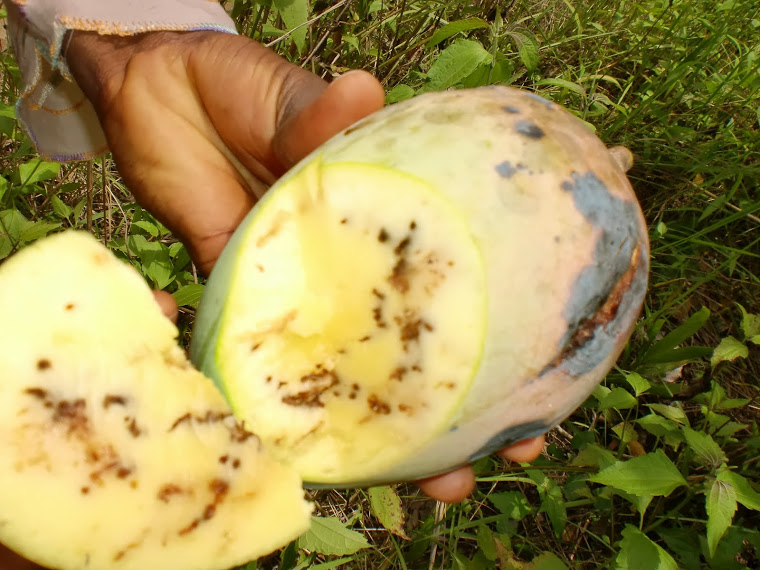
Ruined Mangoes

In 2003, a new invasive fruit fly from Asia was detected in Africa. The pest has spread across a north-south distance of over 5000 km in West Central Africa. The female fly implants its eggs in young mango. The larvae or maggots develop in the flesh of fruit by digging tunnels (which provide opportunities for secondary infections when the larvae emerge from the fruit).

Bactrocera invadens… is a recently described fruit fly species from Asia that is of major quarantine concern in Africa and elsewhere.

On mango, direct damage owing to B. invadens has been reported to range from 30 to 80% of the crop depending on the cultivar, locality, and season. In addition to direct losses, indirect losses attributed to quarantine restrictions on the pest have been enormous.

The European Union (EU) phytosanitary regulations in relation to non-European Tephritidae are tightening and interception and rejection of African mangoes in the EU, owing to fruit flies, have been on the increase since the arrival of B. invadens. These direct and indirect costs have wide reaching socioeconomic implications for millions of people in rural and urban communities involved in the mango value chain across Africa.

In this study, we evaluated the relative efficacy of six commercially available food-based attractants in trapping male and female B. invadens in mango. Furthermore, we evaluated the efficacy of the most attractive bait, sprayed in conjunction with spinosad for field suppression of B. invadens in mango orchards in Kenya during two fruiting seasons.

At harvest, the proportion of fruit infested was significantly lower in the treated orchards (8%) compared with the control orchards (59%). Estimated mango yield was significantly higher in orchards receiving the bait sprays (12,487 kg/ha) compared with control orchards (3,606 kg/ha). Based on bait spray costs, yield data, and monetary gains, a cost-benefit ratio of 1:9.1 was realized, which is acceptable for growers.”

Authors: Ekesi, S., et al.
Affiliation: International Centre of Insect Physiology and Ecology, Kenya.
Title: Comparison of Food-Based Attractants for Bactrocera invadens (Diptera: Tephritidae) and Evaluation of Mazoferm-Spinosad Bait Spray for Field Suppression in Mango.
Source: Journal of Economic Entomology. 2014. 107[1]:299-309.

Here Comes the Sunn…………..Pest

Sunn Pest

Normal Grain (L) versus Sunn Pest Damage to Grain (R)

The sunn pest are a group of insects representing several genera of the shield bug and stink bug families. The sunn pest lives for one year and produces a single generation per year. About three months are spent feeding in wheat fields. The rest of the year is spent resting and in hibernation on hillsides which are usually about 10-20 km from the wheat fields. In spring, the surviving adults migrate down to the wheat fields in one non-stop flight and, after feeding, mate and lay eggs. The adults of the next generation appear and feed intensively in order to accumulate fat reserves for the hibernation period. They return to the higher elevations following wheat harvest.

Sunn pest feeding on wheat results in yield loss as most of the kernel contents can be sucked out by the insect, resulting in smaller, lighter, and shriveled kernels. In addition, the sunn pest injects digestive enzymes to liquefy the wheat tissues into a nutrient-rich slurry.

In some countries, foliar applications of insecticides to control sunn pest are made by air by governments, while in others, ground sprays, partially supported by the government, are made by farmers. A single spray will often suffice to control populations effectively.

“One of the most significant limiting factors in the production of wheat and barley in many areas of the world is the Sunn pest, Eurygaster integriceps, which causes severe damage to cereal yield. This insect has been observed in >15 million ha of wheat and barley farms, which extend from northern Africa, throughout the Middle East and western Asia, to central Asia and some parts of Russia. The Sunn pest feeds preferentially on wheat. Thus, its damage to wheat is considerably greater than that to barley (i.E., it often causes losses of 20-30% in barley and 50-90% in wheat).

In recent years, considerable efforts have been made to biologically control this pest. However, pesticide application is the main method of Sunn pest control in areas where infestation is high.”

Author: Rahimi, V. and A. R. Bandani.
Affiliation: University of Tehran, Iran.
Title: Comparison of the effects of cereal and legume proteinaceous seed extracts on a-amylase activity and development of the Sunn pest.
Source: Journal of Asia-Pacific Entomology. 2014. 17:7-11.

Slugs Thrive When Policies Promote Biodiversity

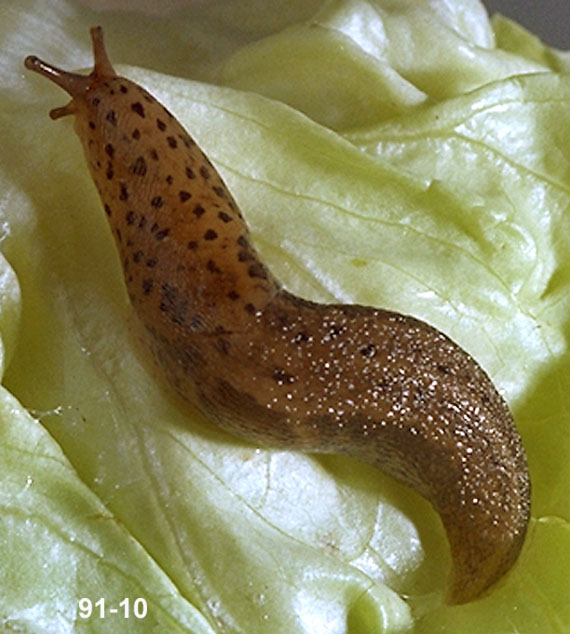
Garden Slug

Garden Slug

In order to increase biodiversity around crop fields, some countries have adopted policies to reward farmers for growing a diversity of plants in field margins. These diverse plants attract other species. Unfortunately, slugs thrive in these diverse field margins and move into fields.

“Most field margins on arable land in Switzerland are narrow and intensively managed. As a consequence, field margins generally harbor few plant and animal species. To enhance biodiversity in arable landscapes, sown species-rich field margins, so-called improved field margins, were introduced in 2008 as a part of the Swiss agri-environment scheme.  

Such field margins are semi-natural, permanent habitats a minimum of 3m wide sown with indigenous forbs, grasses and legumes and adjacent to arable fields.

Slug activity density was increased by the establishment of improved field margins in our study. This means that crops grown near improved field margins suffer a higher risk of slug damage. Where possible, farmers should refrain from growing susceptible crops such as oilseed rape or sugar beet adjacent to an improved field margin. If necessary, a strip treatment with molluscicide pellets may reduce slug damage.”

Authors: Eggenschwiler, L., et al.
Affiliation: Agroscope Reckenholz-Tanikon Research Station ART, Zurich, Switzerland.
Title: Improved field margins highly increase slug activity in Switzerland.
Source: Agron. Sustain. Dev. 2013. 33:349-354.

Europe Needs to Plan for Increased Need for Fungicides Due to Climate Change

Capture

The climate is changing in Europe with increasing temperatures predicted. Higher temperatures create improved conditions for the growth of fungi and infection of crops. More infection events will create the need for more fungicide use. Will European policymakers be ready?

“Here, we estimated the evolution of potential infection events of fungal pathogens of wheat, rice, and grape in Europe. …Our results show an overall increase in the number of infection events, with differences among the pathogens, and showing complex geographical patterns. For wheat, Puccinia recondite, or brown rust, is forecasted to increase +20-100% its pressure on the crop. Puccinia striiformis, or yellow rust, will increase 5-20% in the cold areas. Rice pathogens Pyricularia oryzae, or blast disease, and Bipolaris oryzae, or brown spot, will be favored all European rice districts, with the most critical situation in Northern Italy (+100%). For grape, Plasmopara viticola, or downy mildew, will increase +5-20% throughout Europe. …Our findings represents the first attempt to provide extensive estimates on disease pressure on crops under climate change, providing information on possible future challenges European farmers will face in the coming years.

On the whole, moving from the 2030 to the 2050 time frame, an increase in the number of potential infection events is expected. …Policy makers can use the outcomes of this study to be aware of possible future challenges to face when planning regional or local policies in terms of disease pressure and consequently of chemical control.”

Authors: Bregaglio, S., et al.
Affiliation: University of Milan.
Title: Fungal infections of rice, wheat, and grape in Europe in 2030-2050.
Source: Agron. Sustain. Dev. 2013. 33:767-776.


No Pesticides = No Hops = No Beer

PICTURE

Hop Cones: Healthy (Left); Aphid damage (Mold)(Right)

Hops are a specialty crop used for bittering and flavoring beer. All beer may contain two types of hops. Bittering hops are used to make beer more bitter. Aroma hops are used for flavoring. …Mature hop cones contain numerous lupulin glands, which contain the important brewing constituents of alpha-acids, beta-acids and essential oils.

The hop aphid is native to Europe. the hop aphid first appeared in the U.S. in 1863 and ruined the crop in many eastern states with reported yield losses of 90%.

Aphids feed directly on hop plants, extracting cell sap and nutrients with their sucking mouthparts. high aphid populations reduce yields and seriously weaken plants. Hop aphids excrete prolific amounts of honeydew. Honeydew is plant cell sap, composed of sugars passed through the aphid’s digestive system. Sooty mold grows on the honeydew and can destroy a crop’s value, as mold renders hop cones unacceptable for brewing.

“Damson-hop aphid (Phorodon humuli Schrank) is a serious problem in all hop-growing districts of the Northern Hemisphere. If uncontrolled it is capable of completely destroying the crop. In the past aphids severely influenced hop and both its quality and quantity depended on the activity of their natural enemies. …Together, such natural enemies can provide satisfactory control of aphid populations, provided that the environmental conditions are more favorable for the natural enemies than to aphids.

On the other hand it is necessary to realize that hops free from damage caused by pests and diseases in commercial hop gardens will be hardly possible to produce without efficient insecticides, miticides and fungicides.”

Author: Vostrel, J.
Affiliation: Hop Research Institute, Czech Republic.
Title: Negative Effect of Fungicides Used in Practical Hop Production Against Downy Mildew (Pseudoperonospora humuli) on Aphidophagous Coccinellids Propylea quatuordecimpunctata L.
Source: Acta Hort. 2013. 1010:109-112.