
Herbicide Use in Finland has Increased Significantly to Protect the North Sea

Herbicide sales: Finland

Herbicide sales: Finland

In 2001, herbicide use began to increase in Finland largely due to government policies subsidizing growers to no longer plow fields for weed control. Finland is a signatory to the North Sea Treaty which includes a goal of reducing nutrients into the North Sea by half. Research showed that a considerable amount of phosphorus moves into waterways with eroded soils from fields that are plowed in the autumn. Thus, growers now are using herbicides to control weeds without plowing in order to keep phosphorus out of the North Sea.

“Our weed survey represented part of a follow-up project on the impacts of agri-environment policy in Finland. For instance, reduced tillage has been one of the subsidized measures primarily implemented to reduce nutrient leaching. Spring cereals, 1.1 million hectares in total, covering 50-55% of arable land, dominate crop production in Finland. In the 1990s ploughing was still the standard tillage practice in spring cereal fields, while the latest statistics show that only approximately half of the cultivated cereal field area is currently ploughed. Ploughing has been replaced with reduced tillage methods (29%) or direct drilling (17%). At the same time, the sales of glyphosate have more than doubled within a decade in Finland.

Increased use of glyphosate in Finland is notable; in 1999, the annual sales of glyphosate products were sufficient to treat about 13% of arable land under cultivation or fallow, while the same figure had increased to 37% in 2010.”

Author(s): Salonen, J., et al.
Affiliation: MTT Agrifood Research Finland, Plant Production Research, Jokionen, Finland
Title: Impact of changed cropping practices on weed occurrence in spring cereals in Finland – a comparison of surveys in 1997-1999 and 2007-2009.
Source: Weed Research. 53:110-120. 2012.
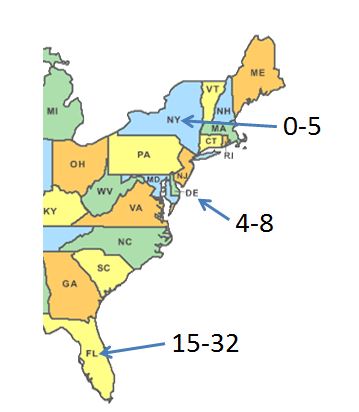
Global Warming Likely to Result in Increased Insecticide Sprays in the Northeast

# of Insecticide Sprays for Sweet Corn (Today)

# of Insecticide Sprays for Sweet Corn (Today)

The U.S. is likely to warm substantially over the next 40 years. Along the eastern seaboard, average temperatures will increase in a northward direction. Future temperatures in New York State will be similar to current temperatures in the Carolinas. Increased temperatures and earlier onset of the growing season will reduce the winter mortality of insects, increase the rate of insect growth and increase the number of generations during the crop season. In response, insecticide applications are likely to increase in the northeast-a point recently made in a major climate change report from USDA.

“A warming trend is likely to lead to increased pesticide use in the Northeast due to earlier arrival of migratory insects, higher winter-time survival of insects that currently are only marginally adapted to the region, and more generations of insects within a single season.

With more pests shifting northward, generation times decreasing, and abundances increasing in the future, management costs are expected to increase due to more frequent application of pesticides. For example, pesticide applications to control lepidopteran pests (e.g., moths) on sweet corn decrease with increase in latitude from 15 to 32 times per year in Florida, four to eight times per year in Delaware, and zero to five times per year in New York. “

Author(s): Walthall, C.L., et al.
Affiliation: USDA
Title: Climate change and agriculture in the United States: effects and adaptation
Source: USDA, February 2013. Available at: http://www.usda.gov/oce/climate_change/effects.htm

Southern California Vineyards Recover Thanks to Insecticide Applications

Grapevines Destroyed in 1999

Grapevines Destroyed in 1999

Temecula Today

Temecula Today

In 1999, about one-third of the vineyards in Temecula Valley, Riverside County, California were destroyed due to Pierce’s Disease which is caused by a bacteria transmitted to grapevines by an insect-the glassy winged sharpshooter. The disease seemed destined to spread throughout Southern California. However, research demonstrated that a carefully-timed insecticide application would prevent the sharpshooter from transmitting the disease to grapevines. As a result of this insecticide use, the wine grape industry in Southern California has recovered and is prospering.

“Twelve years ago a Pierce’s disease epidemic in Southern California wine grapes prompted a multi-pronged local, state and federal attack to contain the disease spread and find a cure or treatment.

Riverside County agriculture officials declared a local emergency in 1999 and 300 acres of Temecula wine grape vines were destroyed after they were found to be infested with the glassy winged sharpshooter.

Emergencies were declared, a task force was formed, and in 2000 $22.3 million in federal financial assistance was secured to reduce pest infestations and support research.

Research found that the Southern California epidemics were almost entirely the result of vine-to-vine transmission…. A protocol of applying one carefully timed application of a persistent systemic insecticide such as imidacloprid virtually eliminates the vine-to-vine spread.

Ben Drake is a Temecula-area wine grape grower and vineyard manager who began seeing problems from PD in the Temecula Valley as early as 1997.

We’ve found that if we apply (imidacloprid) at the middle to the end of May, before the sharpshooter moves out of the citrus and goes into the vineyards, we get levels of the material into the plant high enough that when the sharpshooter flies over from the citrus groves to try it, they just fly back where they came from. Or, if they feed long enough, it will kill them.

But just look at the Temecula Valley now to understand what’s changed: From 12 wineries in 1999, the Temecula Valley Winegrowers Association website today lists more than 50 growers and 34 wineries…. A thriving agritourism industry has developed…. Existing wineries are expanding and new ones are under construction or in planning phases.”

Author: Christine Thompson
Affiliation: Reporter
Title: Grape growers urged to remain vigilant against sharpshooter pest
Source: Western Farm Press. 2011-12-12. Available at: http://westernfarmpress.com/grapes/grape-growers-urged-remain-vigilant-against-sharpshooter-pest

Non-chemical Weed Control Methods Fail to Control Weeds in Organic Peanut Trials

Extensive research has been undertaken in Georgia to determine the effectiveness of non-chemical weed control methods for organic production systems. None of the systems has proven effective, meaning that hundreds of hours of hand weeding are necessary to make these peanut fields viable.

“The inability to sustain a reliable domestic supply of organic peanut is partially due to difficult and costly weed control. … The initial attempt to develop weed management systems using propane flaming and [Organic Materials Research Institute] OMRI herbicides in organic peanut was a weed control failure. Propane flaming and OMRI herbicides did not control annual grasses and perennial nutsedges, and provided only short-term control of dicot weeds.”

“A factor that limits successful in-row weed control using cultivation is inconsistent performance. … The lack of consistency using cultivation as the primary means of weed control in organic peanut appears to be a major unresolved challenge. Even when cultivator implements are properly adjusted and operated in a timely manner, in-row weeds can escape control. …hand weeding cannot be completely replaced by intensive in-row cultivation. … This is also shown by the time and cost of hand weeding to control escapes, particularly the brush-hoe cultivator at VE/1 wk in 2009 needing 116 hours/ha to remove escapes at a cost of $1,021/ha.”

Authors: W.C. Johnson1, M.A. Boudreau2 and J.W. Davis2
Affiliation: 1USDA-ARS, 2University of Georgia
Title: Implements and cultivation frequency to improve in-row weed control in organic peanut production.
Publication: Weed Technology. 2012. 26(2):334-340.

Herbicides Have Helped Stabilize Wheat Production in Kazakhstan

Kazakhstan ranks in the top 10-15 wheat-producing countries in the world depending on weather conditions (drought is a significant factor 2 out of 5 years). Kazakhstan is a major exporter of wheat with about 4 million tons exported annually. Weeds are a key limiting factor in Kazakhstan’s wheat production; however, recent increases in herbicide use have significantly reduced yield losses.

“Although weather remains the single most important determinant for grain yield in Kazakhstan, improvements in crop management practices fueled by the growing State subsidies have contributed to the recent increase and relative stabilization in wheat yield.”

“According to specialists at the Ministry of Agriculture, nearly half the total cultivated area in Kazakhstan is infested with weeds, including 2.5 million hectares infested with black oats. Between 1999 and 2002, farmers applied virtually no herbicides for the control of black oats on approximately 320,000 hectares. In 2003, treatment expanded to 1.0 million hectares thanks to government subsidies of about US$2 million which reduced farmers’ cost of chemicals by 30 to 40 percent. Herbicide subsidies increased to nearly US$3 million in 2004 and the treated area grew to about 1.4 million hectares. Specialists report that weed infestation has decreased by about 15 percent every year since the anti-black oat campaign was launched.”

Author: Mark Lindeman
Affiliation: USDA Foreign Agricultural Service
Title: Kazakhstan Wheat Production: An Overview
Available at: http://www.fas.usda.gov/pecad2/highlights/2005/03/Kazakh_Ag/index.htm

New Rice Planting Method Makes Herbicides Necessary in Pakistan

Traditionally, rice has been planted manually in flooded fields in Pakistan. This method of planting requires large amounts of water and a high level of labor. The sustainability of this system is threatened by severe labor and water shortages. Research has focused on direct machine planting of rice seeds in non-flooded soil. However, weeds flourish when the soil is not flooded making herbicides a necessary component of the new planting system.

“An increasing water crisis, as well as the unavailability and high cost of labor, in Pakistan has forced rice-growers to plant rice directly into the field. However, severe weed infestation causes disastrous effects on the productivity of this rice system. In this study, three herbicides were evaluated for weed control in direct-planted rice on a sandy loam soil. Weedy check and weed-free plots were established for comparison. Weed infestation decreased the rice yield by 75.2%. However, the application of herbicides suppressed the weed infestation, with a simultaneous increase in the rice yield.” 

Author: Khawar Jabran, et al.
Affiliation: Ayub Agricultural Research Institute, Faisalabad, Pakistan
Title: Application of bispyribac-sodium provides effective weed control in direct-planted rice on a sandy loam soil.
Publication: Weed Biology and Management. 2012. 12:136-145.

Organic Sugar Production in Mauritius Derailed Due to Weed Problems

Sugarcane is the major crop in Mauritius. Weeds are usually controlled with herbicides. In the early 1990s, three sugar processing firms in Mauritius decided to grow organic sugarcane without the use of herbicides. However, the weed problems led to the curtailment of organic production. At the time of this article’s publication, there was still one organic producer; today, we have discovered there are no organic sugar companies operating in Mauritius.

“Organic sugar production started in Mauritius in 1992 after it was realized that a demand existed in Europe. … As the use of herbicides is not permitted in fields under organic crop production, manual weeding had to be resorted to. In view of the acute labour shortage and the increasing cost of labour, this item was a major contributor to the costs of production and one of the main sources of discouragement for producers who generally do not like to see their fields infested by weeds. Manual weeding is also known to be ineffective.”

“Although alternative methods of weed control exist, they could not be envisaged in the Mauritian context. Using a flame applicator would represent a fire hazard because of the presence of dry trash in the field, and weeding by mechanical means is not convenient because of the rocky nature of the soil. Weed control in the fields under organic cane was therefore not carried out to the same extent as it is in conventionally grown cane. … Owing to these constraints, producers gradually lost interest in organic sugar and only one estate, out of the three originally, is still involved.”

Author: J Deville
Affiliation: Mauritius Sugar Industry Research Institute, Reduit, Mauritius
Title: Organic sugar production – the Mauritian experience.
Publication: Proceedings of the XXIII International Society of Sugar Cane Technologists (ISSCT) Congress. February 22-26, 1999, New Delhi, India.

Recent Evidence – Herbicides Improve Nutrition of Sweet Corn

According to a 2009 study, application of two common herbicides to several varieties of sweet corn significantly increased the amounts of key nutrients carotenoids in the corn kernels. Corn is among the few vegetable crops that are good sources of zeaxanthin carotenoids, which help ward off diseases of the eye.

“Kernel lutein and zeaxanthin levels significantly increased 15.6% after mesotrione+atrazine early postemergence applications, as compared to the control treatment.  … This is the first report of herbicides directly up-regulating the carotenoid biosynthetic pathway in corn kernels, which is associated with the nutritional quality of sweet corn. Enhanced accumulation of lutein and zeaxanthin is important because dietary carotenoids function in suppressing aging eye diseases such as macular degeneration, now affecting 1.75 million older Americans.”

Authors: Dean A. Kopsell, et al.
Affiliation: Plant Sciences Department, University of Tennessee
Title: Increase in nutritionally important sweet corn kernel carotenoids following mesotrione and atrazine applications.
Publication: Journal of Agricultural and Food Chemistry. Published June 19, 2009 on http://pubs.acs.org.

Hand-Weeding Labor Shortages Result in Organic Crop Loss

Agriculture is facing a severe shortage of workers. Many fruit crops are even going unharvested because of a lack of pickers. Organic growers require more labor for tasks such as weeding since herbicides cannot be used. A recent experience by an organic grower in Washington illustrates the risk of going without herbicides in these times of labor shortages…

“Jon Warling, a labor contractor in Othello, said demand for workers is high and that an organic corn grower near Connell is discing under his corn because he can’t find enough workers for weeding.”

Author: D. Wheat
Headline: Labor committee hears litany of woe.
Publication: CapitalPress.com. July 20, 2012.

At Mid-Century, German Crop Production Turned to Herbicides

In the 1950s and 1960s, as Germany industrialized, millions of workers moved from rural to urban areas and to factory jobs. When people left the farms, weed control technology was desperately needed to replace the major task of hand weeding crop fields. The introduction of herbicides saved German agriculture.

“Weeds cause drastic yield losses in food production, on average 25% in developing countries and 5% in developed countries, despite the control measures practiced. … Weed control is one of the major labour-consuming operations in traditional crop production, amounting from <30 up to about 70% of the total labour input.”

“In Germany, industry needed an increasing number of employees around 1960 and rural people left their fields. When this occurred there was no longer the question about traditional weed control with high labour input, but growing the crop with chemical weed control or no crop at all.”

Author: W. Koch
Affiliation: University of Hohenheim, Stuttgart, Germany
Title: Impact of weeds on developing countries.
Publication: Proceedings of the First International Weed Control Congress. 1992. Melbourne, Australia.